

 Remember those grade-school history-book pictures of Conestoga wagons with “California or bust” painted on their sides? You might view the five years since the FAA’s sport pilot rule created the LSA category as a similar period of wild dreams…and sobering realities.
“GA is saved!” was the early cry from pilot pundits far and wide…until the bottom dropped out of the dollar versus the euro. Nearly 70% of all LSA are produced overseas, so prices shot up, and sunward they’ve climbed since. Then the economy tanked, and it seemed our early vision of cheap-to-buy LSA pretty much ground-looped on its first flight. While most manufacturers managed to stay afloat through 2009’s economic apocalypse, U.S. makers were hard-pressed to build even the most basic designs for less than $60,000.
Likewise, flight-training operations nationwide were slow to jump into the new, much-ballyhooed LSA trainers. Why spend three times the purchase price of a used C-152 or Tomahawk?
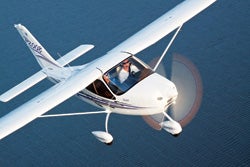 In addition to the 105 new LSA designs that have already achieved ASTM certification, many new models will be introduced this year, including Tecnam’s P2008 (above). |
Boom…Or Bust?
Although the training picture began to improve over the last year (with more operations adding LSA to their training fleets), a boom/bust psychology still nibbles away at the industry’s ankles.
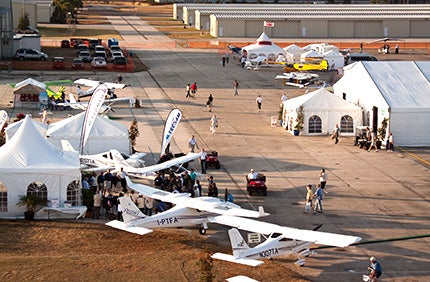
Boom: 105 new LSA designs have won ASTM certification. Even more new airplanes (including Tecnam’s lovely P2008, which made its U.S. debut at Sebring) will earn ASTM approval this year.
Bust: No big “shakeout” yet—chalk it up to lean/mean business practices, but a few companies closed up shop, and others are hanging by their kitty claws.
Boom: New player Icon Aircraft wracked up 450 sales for its high-visibility, super-sexy A5 amphibious LSA. The U.S.-produced A5 is priced at $139,000, and Icon plans deliveries for 2011.
Bust–Boom–Bust: Cessna Aircraft experienced flight-testing woes (two spin accidents in which test pilots successfully deployed the airframe parachute) that delayed deliveries of the 162 Skycatcher to more than 1,000 customers. Then, in December 2009, Cessna delivered the first production Skycatcher (to Rose Pelton, CEO Jack Pelton’s wife). Things were looking up.
But this January, just before the Sebring U.S. Sport Aviation Expo, Cessna announced its delivery drought: The project that was born in 2006 would last another six to 10 months, into the third quarter of 2010.
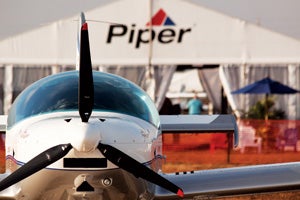 PiperSport |
Big Boom: Piper Aircraft, with masterful if serendipitous timing, debuted the PiperSport at Sebring. The airplane is a rebranded, popular, Czech-built low-winger that has turned heads for years as the SportCruiser. Piper didn’t buy a stake in Czech Sport Aircraft, choosing instead to lock up global distribution. SportCruiser, already flying in impressive numbers—hundreds worldwide, 100+ in the States—will still be built in the Czech Republic as the PiperSport, albeit, we can assume, with Piper input and oversight. Perhaps Piper’s biggest kudo over Cessna: Its LSA are set for first deliveries in April. If this was poker, Piper just put down four aces, infusing new legitimacy into the LSA industry overnight.
Bust: Cirrus Design, best-selling purveyor of single-engine GA planes, suspended its own LSA project, the SRS. This pretty low-winger has wowed pilots across the pond as the Fk 14 Polaris. Alas, Cirrus’s economic setbacks likely have doomed the project.
Boom And…Huh?: And then there’s Remos, which, like Icon, made a strong marketing push in 2009 with a high-profile, big-bucks presence at major air shows. Company execs brashly promised that Remos’ lovely line of high-wing, composite aircraft soon would be numero uno in LSA sales. At its Aviation Summit last November, AOPA jumped on the bandwagon by naming the Remos GX its first-ever LSA sweepstakes plane. Remos seemed bound for light-sport glory. Indeed, according to LAMA President Dan Johnson, Remos sold 32 aircraft last year: the best U.S. sales record of 2009. Note: SportCruiser (once-and-future PiperSport) sold 31.
Alas, Remos’ bubble, while not burst, wobbled back onto the grass a scant month later as it laid off some U.S. personnel and dealt with rampant rumors of liquidity problems. The company quickly put out press releases that it had “strengthened its capital base” by acquiring new investments, following reports of scrutiny into its financial affairs by the German government.
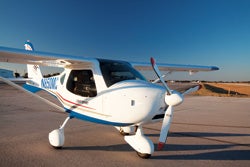 Flight Design MC |
Reading Some Tea Leaves
LSA growth and maturation likely will continue with mood swings for the near future. It’s the Gold Rush again: Talented designers at home and overseas have new tools for design and economical construction. And veteran fabricators overseas often work for much lower wages than in this country.
Even with the euro/dollar mismatch, more LSA-style aircraft will be designed and produced: There’s a strong and growing recreational aviation market abroad. If the euro should crash, as some financial wizards predict for later this year, U.S. buyers may see prices drop, but not dramatically.
The LSA infrastructure of schools and repair stations grew last year, but has a long way to go. Flight Design USA, the leading airframe distributor (with more than 300 U.S. sales), has broadened its training network to 21 locations nationwide. Other distributors and manufacturers are working hard to place their aircraft in training ops.
And LSA flight-training fleets are expanding as old Cessnas and Pipers continue to wear out. Veteran GA flight schools like Lou Mancuso’s Mid Island Air Service in New York (5,000 pilots since 1946) and Florida Institute of Technology (two Remos GXs joined its flight line of 41 GA trainers) are only two of many.
The story repeats across the country as established flight schools and small, one-man operations pop up everywhere. Doug Stewart, 2004 CFI of the year, gives LSA instruction and rental checkouts throughout New England, and Santa Monica Flyers in California trains pilots in a SportCruiser.
Then there’s the sticky problem of ownership. Current top-of-the-line LSA cost upwards of $110,000. The least expensive S-LSA (ready built) is the X-Air LS, a cute Dacron-sailcloth-covered flivver priced at $59,995. [Read our review of the X-Air LS in P&P May 2010.] Veteran U.S. manufacturer Rans Aircraft is a close second with the S-6ELS at $63,000.
As potential students and budget-watching buyers shake off 2009’s economic gloom and doom, and reemerge into the aviation sunlight, pride of sole ownership—that vaunted American tradition—may give way to new frugality, through shared ownership or that old local-airport standby, the flying club. Once buyers realize they can have most ownership benefits at a fraction of the cost (through such shared-ownership programs as LetsFly.org and the Aircraft Partnership Association), we may see a real uptick in sales ahead.
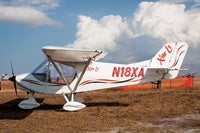 X-Air LS |
The A-Team
The year 2009 was a tailspin for most industries, and LSA was no exception. LSA sales were off 42%. It could have been worse—GA posted a 50% drop!
Yet most companies hung in there. Matthias Betsch, CEO of Flight Design, the German producer of 1,400 recreational-class aircraft worldwide, expects U.S. sales to improve in 2010.
“Yes, it was a hard year,” said Betsch at Sebring, “but better than we expected. In the last two to three months, we’ve had quite a pickup. U.S. dealers sold all their stock, so they have to buy more airplanes…that’s good!”
Betsch believes 2010 sales will recover to 30% of the company’s boffo 2007 to 2008 sales period. “The rest,” he added with a confident smile, “we’ll do in 2011.”
With 105 ASTM-registered LSA models and more likely by the time you read this, it’s impossible to cover the entire LSA market. Let’s update the LSA leaders and talk about some thoroughbreds coming up on the outside.
Flight Design, maker of the best-selling CT line of composite-carbon-fiber cruisers and the new MC all-metal trainer, continues atop the U.S. leaderboard. In 2009, Flight Design tied with Tecnam, coming in #4 in LSA sales with 20 sold; only Remos (32), CSA/CZAW (SportCruiser, 31) and CubCrafters (24) sold more. Flight Design expects a third of its future sales from the MC.
CubCrafters’ 180 hp Carbon Cub SS (formerly Super SportCub) may appeal to GA pilots partial to more muscle. The handsome taildragger, by regulation, can use full power for five minutes for climbs (at 1,700 fpm!).
 LSA growth and maturation likely will continue with mood swings for the near future.
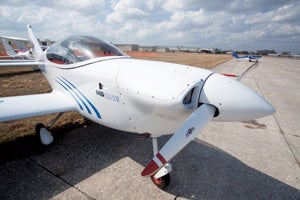 MySky MS-1 |
Tecnam, the 63-year-old Italian airframe maker, augmented its excellent LSA fleet with the P2008, a gorgeous high-wing, luxury entry that will sell at $170,000! The company one-upped Remos’ boast to predict Tecnam will be #1—by 2014. And Tecnam could do it.
Rans Aircraft offers a number of popular aircraft. Currently in the second tier of overall sales (#13), it raised the stakes in ’09 by ranking #5 in LSA registrations. The company’s affordable S-6ELS Coyote II should spark good numbers for the multimodel company.
Overall #2 seller American Legend, with its Legend Cub S-LSA and Texas Sport Cub kit, had to tighten its belt, although it still tied for sixth place with Aerotrek’s Aeropro and Skykits (by registering seven aircraft). Legend’s new amphibious FloatCub wowed the crowd with its impeccable workmanship, long a hallmark of the company.
Pete Krotje’s Jabiru USA registered 11 airplanes in ’09 for its Australian-built models. Krotje also is part of Arion, which makes the lovely Lightning low-wing kit and S-LSA. He claimed four Lightning sales at Sebring. Anticipate more sales of this eye-catcher: 51 prospective customers flew it at Sebring—a record.
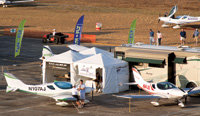 A Full Basket
Perhaps the glory of LSA is its sheer “robustitude.” More airplanes will come online this year, more spectacular flights will be made to prove the category’s potential, and avionics makers like Garmin, Dynon, MSL, Grand Rapids, Advanced Flight Systems and others will keep coming out with amazing glass display panels.
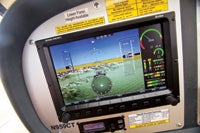 Increasingly, LSA are equipped with advanced glass displays; above, Dynon’s SkyView system in a Flight Design CTLS. |
Two highlights that started out 2010 were Dynon’s SkyView system (with its incredible 3-D display) and Garmin’s G3X, both of which drew big attention at Sebring.
In the flight drama department, two South African pilots flew their own LSA design (now in production) around the world, after stopping at Oshkosh. Another couple of intrepid aviators flew coast to coast in 19 hours. This year, several flights using LSA to gain attention for worthy causes are planned.
Longtime kit-builder Vans is looking into producing its RV-12 E-LSA kit (338 sales to date, with 17 flying) as an S-LSA. Electric aircraft are works in progress to keep your eye on; particularly, the Yuneec E430, Yuneec eSpyder ultralight developed by Flight Design USA’s Tom Peghiny, Randall Fishman’s ElectraFlyer-C and new ElectraFlyer-X, and the Sonex Waiex. There’s even the Terrafugia LSA autocar, which finished its proof-of-concept phase and is being redesigned for first flights sometime next year.
More LSA are available for rentals, but you can typically expect five-hour checkout rides before you can fly one solo. Also keep alert for local LSA shows: many more LSA events mushroomed at airports and even shopping malls last year, with more expected for 2010. There’s more—a whole lot more—to say about LSA for the year to come. The first five years have been a wild ride. Only time will tell what’s to come.
More airplanes will come online this year, more spectacular flights will be made to prove the category’s potential…But with Piper coming on board with its PiperSport, and Cessna finally getting Skycatchers out the hangar door later this year, look for this to be a solid year for LSA. These two market heavyweights know the turf, and how to seed fertile ground. And there’s definitely no shortage of pilots who are eager to get their share of fun flying.
| The FAA, NTSB & LSA |
| The LSA industry that came about in 2004 through FAA regulation is, to be blunt, a grand self-certification experiment. The FAA allows airworthiness certificates to be awarded to LSA so long as they’re built according to the industry standard put out by the ASTM’s Committee F37.
Dan Johnson, president of LAMA and a longtime mover in the LSA industry, maintains a calm eye in the center of the LSA storm. I asked him for his take on the FAA’s current mood and anticipated future stance regarding light-sport matters: “Our safety record for LSA is decent, in line with GA. But we’re only a five-year-old industry, and the buzzword here is: self-certification. It has never been done before. The rest of GA is decades old, and the kinks have been worked out. The FAA just hasn’t had enough time yet to work it out with LSA.” What about rumored Part 23 type certification? “Not likely. The entire EU and other countries are looking into adopting LSA standards now. American companies could then sell overseas. India and China already have certified the Flight Design CTLS,” he explained. “The FAA requiring Part 23–style certification would have a negative global impact. We’ve lost some airplanes, but in truth, the record isn’t that bad. And the FAA keeps affirming that. It’s seeing that LSA aren’t exhibiting any worse accident records than the rest of aviation. So why make huge changes? The FAA wants to make sure it’s done right. It will continue to tweak the program, but there’s no need to chop down the tree.” What about the possibility that a company might falsify or shortcut procedures, without actually having complied with the ASTM standard? “There are several self-correcting elements in place to prevent that,” asserted Johnson. “First, when companies earn a LAMA label, it says its entire program has passed a rigorous audit, adding credibility to the product. That should increase sales. “At any time, the FAA can descend on a company and perform its own full-blown audit. If anything’s amiss, it could ground the company’s entire fleet. Also, insurance companies are in the business to make money. They won’t insure airplanes that break and hurt people. And probably the most powerful disincentive of all: legal liability. If a company screws up, it’ll pay for it—big time. If you make enough airplanes, you’ll eventually be sued, whether or not you’re at fault. You had better have all your stuff—paperwork, QA, processes—in perfect order. Or you could lose the entire company. Nobody’s going to take that risk. If you can’t convincingly prove you did everything the way you were supposed to, then you’ve got a big, big problem.” |
 To date, Flight Design, Evektor, IndUS and BRS, the emergency airframe parachute company, all have passed full LAMA audits, which cost around $7,000. Paradise, a Brazilian company with a strong U.S. presence, also has signed up. “Industry people are realizing the value in our audit program,” said Johnson. Meanwhile, the FAA continues to conduct on-site “assessments” (roughly 30 to date) to spot-check for compliance issues. So far the system is working. Stay tuned.
 | The Light-Sport Plane |
| ⢠Light sport aircraft (LSA) can’t weigh more than 1,320 pounds fully loaded (1,430 pounds float-equipped). If lighter-than-air, max gross weight is 660 pounds. ⢠LSA only can have two seats, for pilot and passenger. ⢠LSA must fly no faster than 120 knots, level flight, full power; nor stall faster than 45 knots. ⢠LSA have only one nonturbine engine and a fixed or ground-adjustable prop. The landing gear must be fixed, although amphibious floats with repositionable wheels are kosher. |
| The Light-Sport Pilot |
| ⢠Any person can start training at age 14, and earn a sport pilot license at age 16.
⢠An FAA flight medical isn’t required, only a valid driver’s license. As long as you’ve never failed or been denied a flight medical, you can fly as a sport pilot. If, however, you’ve ever been disqualified medically for flight by an aviation medical examiner (AME), then you can’t fly as a sport pilot until you clear up that medical condition and get okayed by the AME. If you’ve never taken a flight medical and do possess a valid driver’s license, you still can legally fly as a sport pilot—even if you have a medical condition that would disqualify you on a private pilot’s flight medical. This is the sport pilot version of “don’t ask, don’t tell,” with one important understanding: The FAA isn’t empowering potentially unsafe pilots to fly. All sport pilot ticket holders are expected to take the “mirror” test: Look in the mirror and ask yourself, “Am I healthy and safe to fly today?” If you can’t without hesitation self-certify that you are, then stay on the ground. An interesting nuance: If your driver’s license is suspended for any reason, even for a parking ticket or smog-device violation, you’re grounded until the situation is remedied! |
| Sport Pilot’s Basic Licensing Requirements |
| ⢠Apply for a student sport pilot certificate. ⢠Take ground training from an instructor or home-study course. ⢠Pass the FAA Sport Pilot written test. ⢠Fly a minimum of 20 hours (15 hours dual, five hours solo). ⢠Take two hours of dual cross-country training. ⢠Make 10 full-stop takeoffs and landings. ⢠Make one solo cross-country flight (the solo XC must exceed 75 miles and have three legs, one at least 25 nm, with full-stop landings on two legs). ⢠Take three hours of dual training for the FAA checkride. ⢠Pass the oral test and checkride with an FAA examiner. |


