

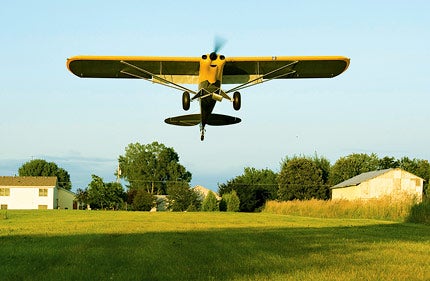
 CubCrafters Carbon Cub |
Over the last four-plus years, I’ve had the good fortune to fly around 30 S-LSA models. There’s nothing quite like the LSA category. Today, 125 models have received FAA’s blessing—enough choices to confound even the most crazed shopping addict. This is one all-purpose, many-colored group of recreational flying machines.
LSA flight is high, wide and free. I’ve vaulted skyward in one-after-another lazy wingovers high above a long-shadowed grove of trees at sunset in a lively low-wing Sting S3; eased through a downwind/base/final arc, fourth in line in a gaggle of eight immaculate Legend Cubs, to chop power and settle on with a happy hiss of wheels on grass; watched the world revolve around my cockpit in a biplane LSA aerobat.
Near the northeast end of a glider port, I’ve shut down power in a 49-foot-span composite Phoenix S-LSA motorglider to practice my first deadstick landing, only to have Ma Nature serve up other plans: a bump of lift, and so a quick turn and a five-minute climb of 1,500 feet or so, sharing the thermal core with a pure sailplane, and only the whistling wind over the bubble canopy to break the grateful silence.
Welcome to my aerial meditation: Om mane padme LSA. Whether sporty, lazy-daze or long-leg flying is your passion, well…there’s an LSA for that.
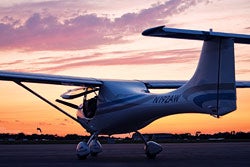 Allegro Light-sport aircraft must have a max gross weight of 1,320 pounds, a max speed of 120 knots and a max stall speed of 45 knots. They’re limited to a two-person capacity of a pilot and a passenger. |
By The Numbers
The LSA sector is GA’s true “Freedom” category. For the first time in general-aviation history, a type of aircraft has been allowed to exist and use the domestic airspace without direct FAA-airworthiness certification being required. All light-sport aircraft are certified instead to the ASTM compliance standard, which FAA accepts without requiring that its own multi-million-dollar testing standards be met.
From the beginning, naysayers worried the category’s limited flight regime was too restrictive, the aircraft themselves too light in weight, the useful load too puny and the no-medical medical was asking for airplanes to fall out of the sky and kill people. Looking back over eight years, none of these or several other dire predictions has borne much fruit.
The one big downer for potential buyers remains the unanticipated high price tag of many new LSA. Otherwise, it’s a happy story all around. Safety wise, both the ASTM-compliance model and the driver’s-license “medical” have validated themselves: The accident rates for LSA are no worse than for general aviation. That statistic alone has challenged a lot of cherished beliefs about the need for such rigorous certification standards or medical exams.
Today, even with the sluggish market brought on by global economic woes, the flood of innovative LSA designs continues apace. Tube-and-fabric flivvers, sleek composite cruisers, all-metal cross-country ships, J3 Cub clones, a fully aerobatic biplane and monoplane, ultralight-style trikes and even a slew of powered parachutes all grace the category with its lively, kaleidoscopic persona.
LSA also have become a flying proving ground for a fabulous array of non-certificated but reliable digital avionics that cost a mere fraction of their GA equivalents. The Rotax 912 engine (and now the new 912iS fuel-injected model), with a 2,000-hour TBO and installation in thousands of aircraft, has also proven itself. And the new Lycoming IO-233-LSA power plant is gaining traction for those lovers of “conventional” aircraft engines, along with custom mills from Jabiru, CubCrafters, HKS and other makers.
Jamming The High-Cost Argument |
|
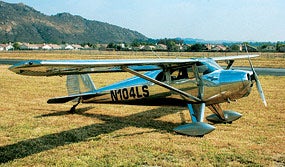
Every certified aircraft ever built that fits within the light-sport definition is legal for a sport pilot to fly. That happy group includes all those wonderful old flivvers of yesteryear…and they’re often successfully wooed for considerably less than a new, or even used, LSA. Here’s a brief list with some current low-end, online-advertised prices: â¢âAeronca and its many variants ($17,000) |
|
Even the flying automobile is getting a rebirth of sorts with two designs: the powered paragliding dune buggy Maverick, already in production, and the Terrafugia Transition, still in development after six years, but hey, the second prototype is flying and is road legal. And let’s not forget the WWII German Storch 3â4-scale replica for flying history buffs.
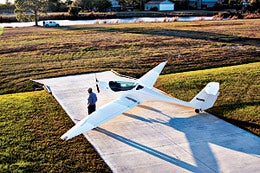 Phoenix |
Gratitude…With Reservations
We live in an amazing time. Yes, the unfavorable dollar/euro exchange rate has jacked up prices on foreign-built LSA. And the recession has put the brakes on everybody’s discretionary spending. Yet the light-sport category and sport- pilot license still offer recreational flight that’s more affordable, more diverse and more accessible than arguably any other mainstream sector of aviation since Wilbur and Orville made that immortal hop at Kitty Hawk. Freedom is still very much the name of the game.
For those who decry the high cost of top-line LSA, many of which carry a price tag well beyond $100,000, there are such entities as the Aircraft Partnership Program, created by Bob Kruger and now implemented by AOPA. AOPA handles all aspects of putting together and helping to manage partnered ownership.
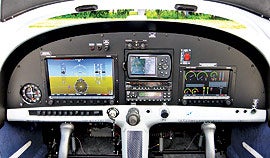 Dynon SkyView Innovative avionics, such as Dynon’s SkyView panel, are commonplace in LSA since certification isn’t required. |
Flying clubs of yore are re-emerging all across the country. Groups like Chris Dillis’ highly popular Skyraider Aviation in the Denver area are finding there’s more to winged life than filling out flight plans and spending $200 on the proverbial hamburger flight.
Many studies have shown that the current hourly cost of owning and flying a new, single-engine, four-seat GA aircraft can range from $500/hour and up. Many pilots can’t afford that any more and have simply quit flying over the long decline since the 1970s.
Silver Linings
That’s where LSA flight offers real advantages. No, you can’t fly an LSA on a Bonanza-style 160-knot mission. But if local flight or 100-knot-plus, 500-mile-plus cross-country adventures lift your wings, there are plenty of budget- and medium-priced LSA available from Rans Aircraft, Aerotrek, Allegro, Pipistrel and many others.
Even more affordable are ultralight-style, enclosed or open-air, ready-to-fly S-LSA like the Breese 2 ($20,000), Hawk Arrow II (starting at $35,000), BushCat (base price around $50,000) and the X-Air ($60,000). Don’t forget those sexy “trikes” (hang-glider-style wings with powered, racy-looking tricycle undercarriages) as offered by several makers, including North Wing and Revo. They can be had starting around $30,000. And for the really adventurous among us, there are those S-LSA powered parachutes, and at reasonable prices.
The No-Medical Medical |
|
A lot of back-and-forth discussion came down in the beginning of the sport pilot era and the no-medical concept continues to generate speculation and debate. A key, sometimes confusing provision of the driver’s license question is that a rated private pilot who has failed an FAA flight medical in the past may not fly as pilot in command under the sport-pilot license unless the original medical condition has since been remedied. Many veteran or medically challenged pilots, concerned that they might not pass their next trip to the flight doc, forego the medical exam altogether and continue their flying as sport pilots. Advertisement
Here’s the challenging part: A new pilot, even one who may have a medical condition that would prevent passing a flight medical, may legally use the driver’s license as qualification for the sport pilot “medical.” The underlying factor in both cases though is that all pilots flying under the sport-pilot license are expected to self-certify they are medically safe to fly. Here’s a challenge to common assumptions: What exactly does the private-pilot FAA medical actually guarantee about a pilot’s fitness to fly? After all, the medical covers two whole years, or 730 days. A lot can happen to a pilot’s health over that much time. Advertisement
Relevant to that thought: AOPA and EAA petitioned FAA last March to remove the flight medical for general aviation recreational aircraft, with LSA-similar restrictions such as 10,000 feet maximum altitude (or 2,000 feet max AGL, whichever is higher), 180 hp or lower powerplant, and two passengers only, even if the aircraft is a four-seater such as a Cessna 172 or Piper Archer. One of the petition’s prime arguments benefits from eight years of light-sport accident statistics. The bottom line regarding self-certification: No pilot, whatever the rating, should ever fly in a compromised physical state. That includes excess fatigue, muddled thinking, stress and other factors we might not always think of as medical problems. The proposed change could be a boon for older pilots and those who prefer to fly the many (and generally less expensive) certified aircraft that already exist and fit the LSA category. |
|
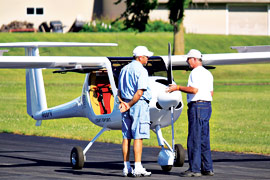
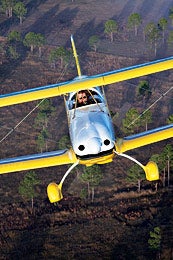 FK12 Comet |
If you want to fly and can afford to buy a car, you can own some form of LSA, either on your own or in a partnership. And, of course, you can always rent. Another consideration is the ever-growing numbers of LSA showing up on the used-aircraft market, most of them with low flight hours and much-lower-than-new prices.
Finally, let’s not overlook the FAA Part 103 Ultralight Vehicle category, the original freedom wings. The sector celebrates its official 30th anniversary this year. Ultralights are great for those not in a rush to get anywhere and don’t mind—or even prefer—that patented bugs-in-teeth, no-regulation flight away from airspace and populated areas. Many new, ready-to-fly ultralights like the Breese or Quicksilver (which delivered more than 14,000 aircraft all by itself!), starting as low as $10,000, remove all rationale for saying you can’t afford to fly!
A Global Phenomenon
FAA recently indulged in a surprising prediction. Consulting its general-aviation crystal ball, the regulatory body projected that over the next 20 years, only LSA and jets/turboprops would enjoy market growth! One driving factor in that anticipated growth is the growing international acceptance of light-sport-style aircraft.
U.S. and overseas makers alike are seeing their global market expand. Australia and Brazil already accept the ASTM standard. Top-selling LSA maker Flight Design earned a type certificate in China—the first of many companies that hope to tap that sleeping giant of private aviation. Until recently, only military and airline flights were permitted there.
Tips From A Veteran |
|
Veteran aviation personality Lou Mancuso owns Mid Island Air (www.midislandair.com) on Long Island, N.Y. His busy flight school offers a mixed fleet of both GA and LSA aircraft, so he knows the adjustments GA pilots have to make to enjoy safe LSA flight. Here’s a taste of the Mancuso Manifesto for LSA: â¢â Always reposition LSA by pushing down on the tail and rotating around the two mains to save wear and tear on the gear and save dragging out that tow bar! |
|
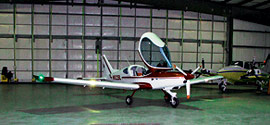
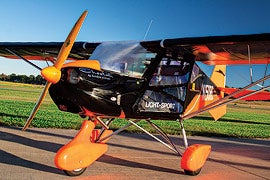 BushCat |
As LAMA (Light Aircraft Manufacturing Association) head Dan Johnson wrote recently, several LSA makers, among them Arion (Lightning LS-1), U.S. Sport Aircraft (SportCruiser), Remos (GX series) and Flight Design (CT line) have worldwide dealer networks.
Meanwhile, the most dramatic boost recently to growing the global light-sport market is the creation by EASA (FAA-equivalent European Aviation Safety Agency) of the long-awaited CS-LSA category. Three aircraft have already been certified under the new type: Flight Design’s CTLS-ELA, Czech Sport Aircraft’s PS-28 Cruiser (the original SportCruiser and one-time Piper Sport) and Evektor’s SportStar RTC (for restricted type certificate).
As in the U.S., CS-LSA aircraft are limited to two seats and a max of 1,320 pounds all-up weight, and must be flown with LSA-similar airspace restrictions. The good news is tempered by a significant downside for smaller LSA manufacturers though: Although EASA accepts the ASTM standard, it also imposes its own stiff certification costs. Simply put, CS-LSA is more like an FAA-style type certification, and will bring higher production costs to manufacturers, which will be passed on to buyers.
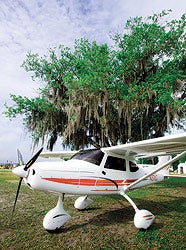 TL 3000 Sirius |
Still, this development does mean that American producers able and willing to pony up and jump through the EASA hoop now have a clear path to selling S-LSA in Europe. There’s also more potential incentive for the Euro-buyer that’s not allowed in the U.S. LSA category: the EASA certificate will allow commercial use, including charter and other for-hire activities. For potential owners, dealers and flight schools seeking ways to maximize the earning potential of LSA purchases, that could make the higher price pay off in the long run.
Still, not every company with deep pockets is eager to jump on board the EASA bandwagon as it currently stands. Cessna has put a halt to its European sales, complaining that the CS-LSA rules are just too costly. Big C says it may resume European sales, if it can convince EASA to modify and adjust downward its certification tariff. Since the Skycatcher is already listed at $149,900, although that includes some standard features that are optional on other LSA, you can understand the company’s reticence to compete across the pond.
But the overall trend looks positive, if improvement seems glacial sometimes. The global market and regulatory framework are maturing—ultimately a good thing for the LSA industry.
For would-be students, veteran pilots and everybody in between, there’s a rich and colorful world of flight waiting for you. Go out and learn to fly a taildragger, spend $10 to $15 an hour on gas for a lazy flight above the countryside, or take your sweetheart or best pal for a long cruise in comfort at over-100 knot speeds. Or hop in an acro bipe and turn yourself upside-down.
All that’s waiting is your desire, because whatever your pleasure, you’ll likely find an LSA to match it.
LSA And Sport-Pilot Review |
| In case you’re new to LSA or are a bit rusty on the basics, here’s a bare-bones list of the salient points for the light-sport aircraft category and sport-pilot license, as created and revised by the FAA.
Light-Sport Aircraft Sport-Pilot Rule |


