

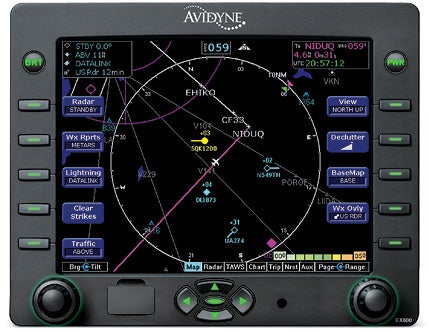
 Avidyne is upgrading their TAS-600/610/620 TCAS products to add ADS-B support, associating N-numbers and airline flight numbers with active targets. |
Autonomous Dependant Surveillance-Broadcast (ADS-B) has to be one of the most misunderstood technologies of the 21st century. Among other things, it has been called a replacement for radar, an open invitation to attacks on the air traffic control system and a stalking horse for user fees, all of which are demonstrably false. ADS-B is, however, by the FAA’s own admission, an unfunded mandate on owner-pilots that will cost most aircraft owners several thousand dollars each over the next 10 years.
Today’s System
To operate in most controlled airspace in the U.S. today, you’re required to have a transponder, which responds to interrogation from primary and secondary surveillance radar signals, sending altitude and a four-digit “squawk code” to the radar site. Air traffic controllers use that to identify where aircraft are located, keep them separated if operating on IFR flight plans and offer traffic advisories if they’re operating VFR.
Radar accuracy varies: Traffic near a radar site can be located to within a few dozen feet, but at long distances, there can be errors of up to a mile or so. Worse, traffic position is updated only when an aircraft passes through the radar beam—typically every 12 seconds—and even light aircraft can move quite a distance in that time. The upshot is that today’s radar-based system requires a five-mile separation between aircraft.
In VFR conditions, ATC works around that by relying on pilots to see nearby traffic, but when the clouds roll in, they’re back to the five-mile rule, and traffic slows to a crawl. Even in visual conditions, the system can break down if there’s a radar outage, which I’ve personally encountered twice in Los Angeles airspace. And surveillance radars usually are located on (or near) busy Class B and C airports. That’s fine if you’re flying into those airports; but if you’re flying into a smaller airport, you may find that coverage is poor. It’s not unusual to have a controller say “radar service terminated, report closing your flight plan in the air or on the ground.” That generally means you’ve flown below the base of the radar coverage, which is limited by terrain or other factors. And until you close your IFR flight plan, nobody else can get into that airport.
NextGen Technology
The FAA has been working on a better system for more than a decade. It’s called the Next Generation air traffic system (NextGen), and instead of radar as the primary sensor, it’s based on satellite navigation systems like GPS. A majority of general aviation airplanes today have a GPS in the panel, and they’re being added to business jets and airliners. By providing a link between the GPS on the airplane and controllers on the ground, dependence on radar can be broken. ADS-B is the technology designed to provide that link. It’s autonomous, sending the aircraft position, a unique 24-bit identifier, your N-number (or airline flight number), altitude, transponder squawk, heading, velocity and other data every two seconds. It’s dependent on GPS (or an equally accurate system) for its position information. The data transmitted by ADS-B is used by ATC for surveillance of traffic in their airspace, broadcast using one of two radio links through a network of ground stations being installed by ITT Corporation, under contract to the FAA.
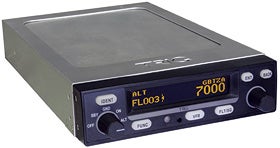 The Trig TT31 is a 1090ES-capable Mode S transponder designed to replace a KT76A. The manufacturer plans an upgrade to meet the FAA’s TSO-C166b standard, required for ADS-B out. |
The two different radio links operate in different frequency bands. One is an enhanced version of the 1,090 MHz Mode S link called Extended Squitter (ES). It’s the easiest to understand: Replace your existing Mode C transponder with a Mode S transponder that supports 1090ES operation, and you’re equipped to meet the FAA mandate. Unfortunately, the 1,090 MHz frequency band is congested—all existing transponders, whether Mode 3/A, C or S, respond to interrogation at 1,030 MHz with a reply on 1,090 MHz. As an alternative, the FAA and ITT also are supporting ADS-B on the less congested 978 MHz frequency band, which requires a completely new piece of equipment called a Universal Asynchronous Transceiver (UAT). A UAT doesn’t replace your transponder—it’s a separate piece of equipment installed in addition to your transponder, which still is required because the FAA plans to keep about half of today’s surveillance radar sites as a backup and to verify integrity of the ADS-B system. By comparing radar targets with ADS-B data, ATC will be able to prevent “spoofing” and other attempts to misuse ADS-B. Keeping radar also provides redundancy that today’s system lacks: In a GPS satellite outage, radar service will still be available; if the radar’s out, ADS-B will still work.
The one-way link from aircraft to ATC described so far is ADS-B out, which is being mandated by the FAA. ADS-B in, which transmits information from the ground to aircraft for display in the cockpit, offers additional capabilities. The FAA hasn’t mandated ADS-B in equipment, but supports it with two kinds of information being sent from the ground stations for use on an advisory basis by pilots of airplanes equipped to receive them.
The first is traffic information: If you’re equipped with a two-way 978 MHz UAT and display, you’ll be able to “see” other 978 MHz traffic, but not traffic that’s sending on 1,090 MHz. To deal with that, the ground stations include a feature called ADS-Rebroadcast (ADS-R). Signals from any 1090-ES equipped traffic within 17 miles of an aircraft that listen on a UAT are copied and transmitted on 978 MHz and vice versa. Another feature called Traffic Information Service-Broadcast (TIS-B) does the same thing for transponder-equipped aircraft not equipped with ADS-B, if you’re flying in a radar service volume. The effect is that with either a 1090ES or 978 MHz ADS-B receiver and display, you’ll have a complete picture of all traffic within 17 miles of your position, provided you’re in line of sight of a ground station.
Airplanes with a 978 MHz UAT receiver also can receive Flight Information Services—Broadcast (FIS-B), including NEXRAD radar mosaic, current weather conditions, terminal forecasts, significant weather alerts, winds, temperatures aloft and pilot reports, along with temporary flight restrictions and other notices to airmen. Unlike today’s satellite-based weather services that require a monthly subscription, once you install the receiver and display, FIS-B is free.
There’s one more advantage of a 978 MHz UAT over a 1090ES Mode S transponder: UATs support an “anonymous” function equivalent to squawking 1,200 that generates a random 24-bit address and doesn’t reveal your N-number. That’s partly intended to combat what an FAA rep told us are “completely untrue” rumors that ADS-B will be used to enable user fees. As an avionics vendor pointed out to us: “If you think the government needed to add a 24-bit number to your airplane in order to keep track of you, you’re kidding yourself!”
FAA Mandate: What It Means
Now that I’ve got all that out of the way, here’s what the FAA has mandated: As of January 1, 2020, any aircraft operating in Class A, B or C airspace and in Class E airspace above 10,000 MSL (and above 2,500 AGL) will require both a Mode C transponder and one of the two ADS-B out links. Above 18,000 feet, the ADS-B out link must be 1090ES Mode S, which is also the accepted international standard and may be required for operations outside the U.S.
To understand what this means in practice, let me personalize things a bit: I’m a partner in a 1975 Cessna Skylane. We installed a Garmin GNS-530W IFR GPS last year, which can serve as both a position source for ADS-B out, and (hopefully) a display for ADS-B in. We don’t fly above 18,000 feet, but do take the airplane to Mexico at least a couple of times each year, so for international compatibility, our ADS-B-out link will be 1090ES. For ADS-B in, we’ll have a couple of options. At least one avionics vendor plans to offer an ADS-B-in option on Mode S transponders for under $2,000. That would give us traffic, or we could spend a similar amount for a 978 MHz receive-only device, which would give us both traffic and weather. The FAA rule doesn’t require ADS-B-in and ADS-B-out devices of the same type.
Two doors down from our hangar is another Skylane with an older IFR GPS that may not work as an ADS-B position source. Since the owner doesn’t fly outside the U.S., a better option for him will be to get a 978 MHz UAT with a built-in “blind” (no display or database) GPS, which will be cheaper than replacing the unit in his panel. If he wants to get traffic and weather, he’ll need to add some sort of display. Since TIS-B and FIS-B are advisory-only, it should be possible to use an electronic flight bag or other portable display, or he can spend more money for a multifunction display in the panel. He’ll need to keep his existing Mode C transponder, and there may be some installation issues involved in coupling it to his UAT (they’re required to use the same barometric pressure source for altitude and a common control for the squawk code).
On the other side of our hangar is an RV-8 homebuilt that’s flown only VFR and rarely in Class B or C airspace. Its owner can probably get by with just a Mode C transponder. He’ll need permission from ATC for entry to Class B or C (or E above 10,000 MSL) airspace.
Across the field, a bizjet operator who wants to take full advantage of the system will replace his Mode C transponder with 1090ES Mode S; but instead of using ADS-R and TIS-B for situational awareness, he’ll probably upgrade his existing traffic alert and collision avoidance system (TCAS) to a version that combines actively detected transponder traffic with ADS-B in. Avidyne has announced exactly that option for its TAS-600/610/620 series devices. For that, he’ll need dual (top and bottom) antennas (the rest of us can get by with a single bottom-mount antenna).
None of this will be cheap. The FAA estimates that equipping the roughly 160,000 aircraft in the general aviation fleet for ADS-B out will cost at least
$1.2 billion, which works out to $7,500 per aircraft. I expect to spend less than that, since I already have a compatible GPS, but others may find they’ll need to spend more.
What will we get for that money? An air traffic control system that’s more reliable, offers better coverage at low altitude (ITT’s John Kefaliotis, a former air traffic controller who heads the effort to build ground stations told me he’s installing them at many general aviation airports—35 so far—to provide a usable signal all the way to the ground), plus advisory traffic and weather for those who install a receiver and display. And it might not have to be our money! Several industry representatives interviewed for this story pointed out that there’s precedent for the federal government subsidizing purchases of equipment that’s required for the ATC infrastructure, whether ground or aircraft based. My current plan is to wait for my existing transponder to fail—but I could be persuaded to equip more quickly if someone made it worth my while. Stay tuned!
| For More Information |
| Accord Technology (NexNav Min GPS SBAS receiver/sensor) www.accord-technology.com/ Avidyne FAA Final Rule Requiring ADS-B In Free Flight Systems Garmin ITT NavWorx Trig Avionics University Of North Dakota |


