

 |
There’s a verse that goes: “To be successful, all you have to do is work half a day, and most of the time, you get to pick which 12 hours per day you want to work.” Take a standard 40-hour work week. This expands to 160 hours for the month. I would wager that the vast majority of private pilots (noncommercial) fly 200 hours or less per year. This results in flying an average of approximately 17 hours per month.
If you have 160 available hours per month, and your plane is in use 17 hours per month, that leaves 143 hours of unused time that the plane is sitting on the ground and not being a productive asset. Now, if you have a job that allows you to fly your plane 160 hours a month for business, then you’re probably the most envied pilot in the world. But my point is this: Airplanes cost money to own, operate and maintain. Therefore, every hour that it’s not generating revenue and increasing cash inflow, or reducing expenses and saving cash outflow, opportunity costs are lost.
Are Leasebacks For You?
At this time in our economy, we’re searching for alternatives to maximize every possible return on our investments. Yes, an airplane that’s used in business should be evaluated just like any other purchase of equipment. Will it make money for the business, or will it create expense savings for the business? If the answer to either question is “yes,” then consideration should be given to making the purchase or investment in the asset.
Now that you’ve decided that your plane is a wise business investment and will either make money or save expenses, how many hours will it be in use? Can you find a way that the plane can be used in an alternative business arrangement that will generate additional cash inflows during the downtime? If so, this will help with the carrying costs associated with ownership.
If the plane is financed, the note payment will have to be made every month. There are numerous fixed costs that have to be paid every month, regardless of the amount of time the plane is flying in the air. Examples of these expenses are hangar and tiedowns, insurance and inspections.
Lease Options
If you have an asset with excess capacity, there are solutions to improve the return on your investment. Have you considered a business arrangement where you allow your plane to be leased out to either another company or possibly a flight school?
In a situation where you don’t want a partnership or other shared-ownership arrangement, but another business needs the use of a plane for so many hours per month, consider entering into an arrangement where the company purchases a certain number of hours per month. This can be done in a block of time or on an hour-by-hour basis. You may have to agree to give them first opportunity for the use of the plane on a given day, but that isn’t the end of the world when they’re helping you underwrite the cost of ownership and operations.
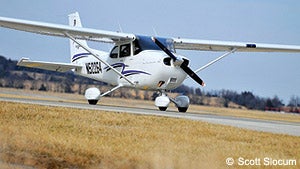 If your airplane isn’t flying as much as it could be, you may be missing a cash-flow opportunity. Consider a leaseback arrangement for your aircraft. |
Another version of a lease arrangement is an association with a flight school. This may be lucrative if you have a high-performance IFR single or a twin. Pilots looking to move up in their ratings generally have a higher degree of pilot skills, and aren’t as rough on the plane as a new pilot climbing into the cockpit for their first 40 hours.
A possibility also exists for you to lease your plane to an air charter company. They could be looking for a plane to ferry passengers or freight.
Each of these alternatives must operate within the guidelines prescribed by the FAA. As such, the plane must be maintained to a higher standard than if you’re the sole user of the plane. If you make a deal with another party to lease your plane, your contract should clearly define what the payment will be or how it will be determined.
Also, who’ll be responsible for what expenses should be clearly defined. Many times, leases involving flight schools and air charter operations state that they’ll be responsible for all of the expenses to keep the plane airworthy, and these expenses are often paid by the lessee. This arrangement will be reflected in lower gross revenue to you, the owner, but this shouldn’t really matter because it’s the net cash flow that will make this deal come together.
Making Sense Of Taxes
About this time in the conversation, the topic of income tax comes up. People always want to know if something is deductible. Funny, they never ask questions about the revenue they receive. But the revenue is taxable and the operating expenses are tax deductible—maybe. It depends on several factors.
Revenue from a lease is pretty straightforward. If someone pays you for the use of your plane, you have income and it’s taxable. Expenses incurred to produce this revenue are tax deductible. This includes the fixed costs for storage and insurance. Variable costs incurred for supplies, fuel and oil are tax deductible, assuming they’re provided by you.
 Each taxpayer is unique, and any lease agreement must be individually evaluated. As such, any tax decisions must be evaluated on their own merit for each respective taxpayer.
The costs associated with maintenance can be tricky. Ordinary maintenance made necessary though normal operations is generally tax deductible. But improvements that add value to the plane or increase the useful life of the plane must be capitalized and depreciated. So, deductible maintenance (not capitalized maintenance) along with depreciation becomes the final component for determining the tax-deductible expense of the airplane.
Let’s stay with depreciation for a minute. For 2011, there are numerous ways to compute the depreciation expense for assets placed in service this year. There’s bonus depreciation that only applies to the purchase of new equipment. There’s the Internal Revenue Code Section 179 depreciation deduction that applies to new or used assets placed in service, but with caps on the amount of the deduction. Under Section 179, the deduction could be entirely phased out and reduced to zero. And then there’s the old tried-and-true standardized depreciation tables. All of these methods have an impact on determining if there’s a profit or a loss.
Airplanes generally have a short life when it comes to depreciating the airplane for tax purposes—generally five years. Because of that, an aircraft is likely not to show a profit for the first five years after considering a deduction for depreciation. Then in years six and later, without the deduction for depreciation, the aircraft owner begins to show a profit on the plane.
Whether there will be any income-tax advantages is dependent on several issues. First of all, and probably the most critical question to answer, is centered on the nature of the business activity. Are you operating an aircraft-rental business, or is this a de minimus and incidental part of the business use of your plane?
If the transaction is viewed as a part of the business use of your plane and a part of your trade or business, then there generally are no restrictions on claiming a deduction if you have a loss. If you’re in the rental business, then you’ll come under the provisions of IRC Section 469, which limits the deductibility of rental losses.
The kink with Section 469 is that rental losses are allowed as a deduction against rental income only. In the event that rental losses exceed rental income, then the net rental losses in excess of rental income are carried over to future years and deducted against rental income of future years.
Oftentimes, the expenses during the first five years reduce the revenue down to, but not below, zero. Then in years six and later, as these years report profits, the unused (suspended) losses from years one through five come into play. These early-year unused losses provide a tax deduction against the profit in years six and later to reduce the income to zero for a given year. This will continue until all of the early year losses have been absorbed. What a mess.
Another kink with Section 469 is that there are real-estate rentals and there are “other” rentals. The bad part is that even though they’re both rentals, they can’t be paired together and both must stand alone.
Section 469 contains several exceptions, elections and deals that can be made with the IRS regarding the leasing of your plane. Section 469 also has the ability to completely change the expected outcome of your leasing proposal. I highly recommend that you discuss aircraft leasing with your tax professional before you sign any leasing contract. Most surprises under Section 469 aren’t very pleasant.
Unfortunately, there doesn’t exist one clear-cut definition that will solve everybody’s individual tax situation. Each taxpayer is unique, and any lease agreement must be individually evaluated. As such, any tax decisions must be evaluated on their own merit for each respective taxpayer.
Regardless, any time you can put your airplane to work during the hours it would otherwise just be sitting on the ground, cash inflow will be generated to help fund the airplane operations and ownership. Sit down and work out what the net cash flow will be. If there are tax advantages to be gained, add them in to the equation. Give your plane a chance to do its job and make some money for you.
Leasebacks: Where to Go
|
|
AirShares Elite (www.airshareselite.com) is ideally suited to owners of Perspective-equipped Cirrus SR22 aircraft. Their leaseback program is unique in the industry and leverages the company’s size and focused customer base to provide attractive leaseback options. In one scenario, AirShares leases time in your aircraft to members in specific markets. In addition to a high hourly return for the owner, AirShares offers turnkey supervised maintenance and exceptional insurance coverage. Another scenario is to let AirShares sell fractional interest in your plane to other AirShares owners. This allows the owner to reduce their ownership to a level that matches their needs while still enjoying the benefits of ownership, without the capital commitment and ongoing costs. In either program, your airplane is flown only by qualified and carefully trained AirShares owners, and not primary students. Another benefit for leaseback owners is they have access to AirShares’ nationwide fleet of aircraft, something a traditional FBO could never provide. Access to this fleet of identical aircraft nearly anywhere in the country gives members nearly the same availability as full ownership. |
|

O. H. “Harry” Daniels, Jr., is a CPA and a CFP licensee. Daniels has held his license as a private pilot since 1991. He’s a partner with the firm of Duggan, Joiner & Company, Certified Public Accountants, and can be reached at [email protected].


