

 Walter Beech was born with a nearly H.G. Wellsian vision of things to come, at least when it came to aviation. In 1905, at the tender age of 14, Beech designed and built his own glider. Nine years later, he experienced his first flight. During World War I, Beech flew as an army pilot and he became a barnstormer after the war.
Ever the innovator, Walter Beech had a talent for thinking “outside the box” long before the cliché phrase was coined. In fact, Beech hardly recognized there was a box. Even for those of us who weren’t around back in the ’30s, the Beech model D17s are remarkable machines. Dubbed the Staggerwing because of the reverse stagger of its top wing, mounted about 18 inches aft of the lower wing, the new Beech design offered perhaps the most remarkable speed range of any airplane of its time. With the benefit of electrically activated, bicycle-chain operated, retractable gear, the Staggerwing featured a speed range from 60 to 200 mph (52 to 174 knots)—an operating ratio of 3.35 to one. It would be almost 50 years before another piston airplane (the 1989 Mooney TLS) would exceed that level of efficiency. Famed aviatrix Jacqueline Cochran won the 1937 Bendix Trophy Race flying a Staggerwing.
When World War II ended, Beech had another innovative design up his sleeve, and he created arguably the most trend-setting, single-engine plane ever built—the model 35 Bonanza. Like the Staggerwing, the V-tail Bonanza was a revolutionary airplane for its time, offering roughly the same cruise in mph as its horsepower. With only 165 maximum continuous horsepower out front, the 1947 model 35 Bonanza turned in a cruise of 172 mph. In the late ’40s, Douglas DC-3s were the standard airliners of the day, and the first Beech Bonanzas could cruise at the same or better speed.
Despite Beech Aircraft’s reputation as one of the most conservative manufacturers in general aviation, the company that Walter and Olive Ann Beech launched in 1932 continues to produce cutting-edge aircraft.
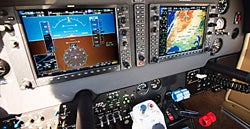 |
| A Garmin G1000 integrated avionics system with a GFC 700 autopilot comes standard in the 2006 Baron G58. |
Certainly one of the most durable of the modern Beechcraft designs is the Baron. Initiated in the late ’50s as the model 95 Travel Air, flying behind a pair of 180 hp Lycomings, the first Barons received new engines with 260 hp mills and were dubbed model 55s.
That first Baron 55 was eventually stretched to the six-place model 58, which was introduced in 1970. The Baron 58 remains the only medium piston twin still in continuous production. These days, the entire piston twin class consists of only three airplanes: the Piper Seneca V, Piper Seminole and the Baron 58 (with the Baron at the top of the class).
Like all Beech products that came before, the Baron 58 was always a well-engineered, impressively constructed airplane. Over the last 36 years, Beech has progressively improved the Baron to the point where it’s difficult to find anything to criticize. Virtually every glitch (and there weren’t many to begin with) has been fixed.
The 58’s gear switch used to be on the right with flaps on the left, exactly the opposite of the rest of the industry. Similarly, the Baron’s throttles used to be in the center—standard practice for older, two-pilot military and airline aircraft—so that both pilots could more easily reach them. Nothing wrong with either mount—that’s just the Beech way of doing things.
For pilots who learned to fly in Barons, the location of the controls wasn’t an issue, but some pilots transitioning from other types were mystified when they accidentally feathered both props on final. Typically, there was no harm done.
On the other hand, gear and flap switch location weren’t so forgiving. More than one pilot looking to transfer as much of the airplane’s weight as quickly as possible, to maximize braking after touchdown, has retracted the gear when he meant to raise the flaps.
In fairness, that’s always a risk on any retractable airplane, one reason many instructors teach that you should never touch anything on the panel until you’ve pulled off the runway and stopped. Others preach that you should always say out loud, “hand is on flaps,” before you reach for any control after landing, the premise being that the sound of your own voice will stop you from grabbing the wrong lever. On the old Bonanzas and Barons, unconventional control placement simply made it easier to mistake one control for the other.
Eventually, in 1984, Beech bowed to convention and swapped the gear and prop-control locations, plus they moved the throttles to the far left. The company also did away with the thick control bar that sprang from the center panel and branched to both yokes, obscuring the instruments and controls on the lower panel. Today’s Baron features conventional, independent yoke controls mounted on shafts directly in front of the pilot and copilot.
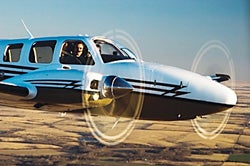 |
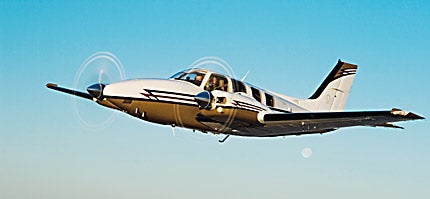
| Each of the Baron 58’s engines is rated at 300 hp. The aircraft climbs at 1,700 fpm and cruises at 202 knots. |
For 2006, the G58 Baron incorporates all the best features that came before and now adds the Garmin G1000 integrated avionics as standard equipment—certainly one of the most talented electronic suite of avionics and instrumentation ever installed in any general aviation airplane.
Just as Garmin quickly became the dominant force in GPS 15 years ago, the company has similar plans for its G1000. Cessna, Columbia, Diamond, Mooney and now Beech have all adopted the G1000 system as the top-of-the-line avionics option.
If there’s any downside to the newest, best, most modern Baron ever built, it’s the price. Historically, Baron buyers have never been the type to ask “How much?” and that’s a good thing. A typical, G1000 Baron goes out the door at Wichita with a list tab just over $1.2 million.
At this writing, contractor Jim Hill has been operating one of the first G1000-equipped Barons for nearly five months, and he’s enthusiastic about the airplane’s performance and technology. “I traded a 2004 Bonanza 36 for the Baron, so the interior layout and panel configuration were already fairly familiar,” says Hill. If current utilization continues, it looks as if we’ll be logging at least 500 hours a year.”
Hill is a contractor in the southwestern United States who builds multi-family homes, primarily condos and apartments. A private/multi/instrument pilot who’s been flying since 2000, Hill usually takes trips that are as far as 350 nm afield. “Our projects are fairly wide-ranging, so we use the airplane a lot, probably at least three to four times a week. Most often, we carry three or four people—bankers, investors and employees—and everyone likes the double, aft-right entry doors,” Hill explains. “Weather in Arizona, Nevada and California is generally pretty benign, mostly VFR or soft IFR, and that means we can fly pretty much any time we need to, day or night.
“Almost without exception, everyone loves the new airplane. Climb is excellent, about 1,600 fpm initially and an easy 1,300 fpm in a 140-knot climb. That means we can usually reach cruise altitude in no more than five to seven minutes. If I’m in a hurry, I can score 195 knots on about 34 gph, but the more intelligent way to run the airplane is at 185 knots on two gph less fuel burn. All the systems work well. So far, the G1000 has seemed fairly bulletproof—I’ve used the deicer several times. It does a good job, though again, we rarely need to deice in the Southwest.”
The Bonanza legacy of crisp, precise handling carries over to the Baron, and virtually every Baron owner raves about the airplane’s wonderful in-flight manners. “You don’t really notice the weight that much,” says Hill. “The controls are so tight and well harmonized that the 58 makes a great IFR platform. Of course, once you get adjusted to the G1000, it just makes everything easier in instrument conditions. The glass-panel displays are so large and the positional awareness so obvious that you’d have to work to become disoriented.”
Beech was also the first to come to market with Garmin’s new autopilot. Following the G1000’s battle cry of being “fully integrated,” the GFC 700 autopilot isn’t a stand-alone in the avionics rack. Instead, a new gaggle of buttons appears on the edges of the G1000’s 10.4-inch, high-definition displays. The GFC 700 isn’t just compatible with the G1000, it’s part of the system, and obviously communicates seamlessly with all the other in-cockpit technologies.
Jim Hill’s typical missions don’t demand long range, so he selected the standard 166-gallon tanks to maximize cabin payload rather than the more typical (but optional) 196 gallons. With air-conditioning, deice, the G1000 system and all the other options installed (plus only 996 pounds of fuel in the tanks), Hill’s airplane can carry just less than 600 pounds of people and things. “That works out well for us,” says Hill, “because we almost never need to fill the seats. Our trips are short enough, usually under two hours, that if we do need more payload, we can partial-fuel to only 100 gallons or so and add 400 pounds more in the cabin.”
If Hill plans to fly the G58 at its maximum 5,500-pound gross weight, zero fuel weight is 5,215 pounds, so he’d need to fly with a minimum of 47.5 gallons of fuel. “The airplane is nearly perfect for us,” says Hill. “More speed wouldn’t make much difference, and we already have plenty of seats. I can’t imagine a better airplane for our missions.”
Walter Beech died in 1950, long before the Barons became a reality, though somehow, you can’t help but think he’d be pleased with the latest iteration of the world’s premier medium-piston twin.
