

 |
I was at Sun ‘n Fun two years ago when a subscriber walked up to me and asked a question I wasn’t quite ready for: “Why don’t you ever write stories about airplanes you don’t like?” As the resident “primary” pilot reporter for Plane & Pilot/Pilot Journal, that stopped me cold, but not for long. The answer is that there are few airplanes I don’t like. In fact, I’ve never personally met an airplane I didn’t like.
Certainly, some flying machines are better than others in some or all respects—faster, quicker climbing, easier to fly, more comfortable, more economical and, yes, more attractive—and I usually try to point out those differences in every evaluation.
Fact is, practically every airplane has something to recommend it, if not one thing, then a handful of advantages. A few are charismatic charmers capable of bending minds and endearing themselves to practically everyone.
If you’re wondering if the new Baron G58 is an airplane I don’t like, then you’ve come to the wrong place. The current version of the Baron 58 is almost impossible not to love.
Over the last 38 years, Beech has gradually improved the Baron to the point where it’s really difficult to find things to criticize. True, the basic airframe and wing of today’s Baron 58 are nearly identical to those on the original stretched 58 from 1970. The first Baron (the 55) was born in 1961 when Beech decided that if you took a Bonanza and added a second engine, voilà , you’d have a Baron.
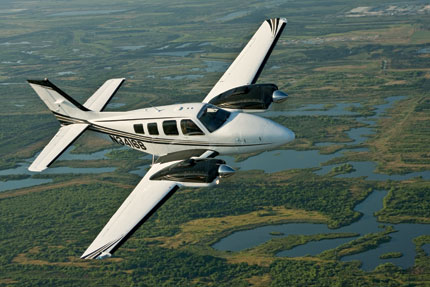
 Luggage is stored in a compartment in the Baron G58’s nose. With full 194-gallon tanks, payload is about 300 pounds. |
Perhaps the nicest benefit of such a marriage was that all the positives and none of the negatives were transferred directly from the Bonanza to the Baron. The twin-engine airplane had a conventional, three-member tail, so there was less of the V-tail’s inherent yaw instability. Roll and pitch response remained excellent, just as they were with the later straight-tailed Bonanza.
In order to create the first Baron, Beech merely stretched the Travel Air’s wings six inches, added an additional six inches to the fuselage and upgraded the two 180 hp engines to 260 hp.
That’s a gross oversimplification—of course developing a larger, heavier airplane with more power involved far more than “merely” changing powerplants and stretching and adding span. In order to accommodate the thirstier engines, Walter Beech initially bumped fuel capacity from 112 to 142 gallons, adding other changes to handle the bigger power.
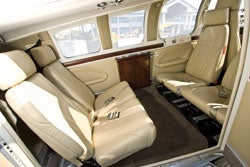 Through aft double doors in the aircraft’s right side, passengers step into a comfortable, air-conditioned cabin featuring conference-style seating for up to four back-seaters. |
The current G58 incorporates all the best features that came before. Aerodynamically, Beech got it right the first time out of the box. In 2006, the company added the Garmin G1000 avionics system to round out the airplane’s already considerable talents.
If there’s any downside to the newest, most modern Baron ever built, it may be price. If you have to ask how much, then perhaps you don’t really want to know. A typical Baron G58 exits the Wichita, Kans., door with a list price of about $1.2 million.
While the Garmin G1000 suite makes the Baron seem as modern as tomorrow, the basic airplane has proven itself over nearly half a century. Today’s Baron remains the last of its kind from a class that once included the A55 through E55, the 58TC, the top-of-the-line 58P and the original, “real” six-seat Baron, the straight 58.
With the help of 600 horses out on the wings, the Baron has always had a deserved reputation for scampering across the sky as if something bigger was chasing it. Specifically, Beech places the new Baron’s cruise at 202 knots, which puts it at the head of its class, though it’s admittedly a very small class.
 |
There are basically four piston twins available today. Two of them, the Piper Seminole and Diamond DA42 Twin Star, are intended as trainers, so they have little need for high cruise numbers. The Seminole is a scaled-up Arrow with an extra engine, and the DA42 is a significantly modified Diamond Star with a pair of Thielert diesels on its wings.
The only true contender to the Baron is the Piper Seneca V, and in terms of sheer numbers, it’s indeed a formidable competitor. Born at about the same time in the early ’70s, the modern Seneca employs a pair of turbocharged, 220 hp Continentals to protect it from evil, and that allows the newest PA34 to cross the sky at 197 knots, though, admittedly, that speed is only available in the flight levels.
 |
The Seneca has two primary advantages over the Baron. One is a much wider cabin, about seven inches more elbow room in the front seats. If that doesn’t sound like much, it’s actually a huge improvement. The Baron makes the most of its room, but it’s important to remember that the fuselage has the same cross section as that used in the 36 Bonanza, 42 inches at the forward midsection. The Piper twin uses a more laid-back seating position, so the Baron is the taller of the two airplanes, and that may count for something if your passengers are centers for the Boston Celtics.
The Seneca’s second advantage is lower fuel burn by virtue of its smaller engines, on the order of 26 gph total. The reduced consumption is matched by reduced capacity, so it doesn’t translate to any better range or payload.
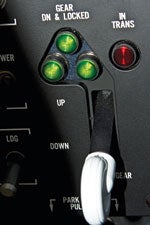 The Baron G58’s landing-gear lever (above). With its two 300 hp Continental IO-550C engines, the aircraft can reach a 202-knot cruise speed at 75% power. |
Both twins share a similar problem when it comes to payload. Neither can fill the tanks and the seats at the same time, a common syndrome with most business airplanes. This is nothing new, a fact of life that corporate and airline aircraft must deal with every day. Though some pilots consider full fuel/full seats to be a standard litmus test of aircraft utility, such talent is, in fact, limited to a very few general aviation airplanes.
The Baron and Seneca both offer excellent access to an air-conditioned, comfortable cabin that seats six via aft side double doors (though mounted on opposite sides). Hauling six large folks in either airplane, however, would be a challenge, especially if the model were equipped with the gamut of options, as most are. The Baron mounts its aft doors on the right, and the Seneca’s are on the left, but both offer easy access to a long, comfortable cabin. Separation between the conference-style second- and third-row seats is generous, which minimizes overlapping legs. If there’s no one in the opposing seat in back, you can put your feet up and feel like a business-class airline traveler with a luxury footrest.
With the Baron’s standard 194-gallon tanks topped off, a fully equipped aircraft offers only about 300 paying pounds. That’s equal to one pilot plus baggage or two lightweight folks. In order to haul six full-size people plus reasonable luggage, you’d need to limit fuel to about 58 gallons, roughly an hour and a quarter plus reserve. You obviously always have the option of leaving the airplane partially fueled if you must substitute people pounds for fuel pounds.
 |
At a burn of roughly 16 to 17 gallons/engine/hour, the big tanks provide five hours of endurance plus reserve. Five hours at 200 knots makes the math fairly simple—range is 1,000 nm. If there’s a need to stretch the limits, long-range power settings at 10,000 feet can boost the airplane’s reach to more like 1,300 nm.
I’ve had the good fortune to ferry a half-dozen Baron 58s around the world, and they’ve been consistently good rides. They offer few objections to being loaded as much as 1,000 pounds over gross. In one instance, I brought an older 58 back from Nadi, Fiji, to San Francisco, Calif. The airplane had an additional 300 gallons temporarily plumbed to the engines from the aft fuselage and nose baggage; handling remained acceptable and range was never a consideration.
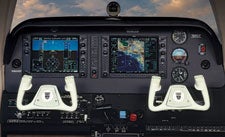 The Garmin G1000 contributes avionics sophistication to an airplane that has proven itself since 1961. For those who are unfamiliar with glass, the PFD and MFD screens may take some getting used to, but they ultimately ease the flying process and make it safer. |
We asked Jim Hill, a contractor in Van Nuys, Calif., and owner of a 2006 Baron G58, for his assessment of its talents, and he felt that climb and handling are perhaps the airplane’s strongest benefits. “Almost without exception, everyone loves the new airplane. Climb is excellent, about 1,600 fpm initially and an easy 1,300 fpm in a 140-knot climb. We can usually reach cruise altitude in no more than five to seven minutes,” says Hill. “If I’m in a hurry, I can score 195 knots on about 34 gph, but the more intelligent way to run the airplane is at 185 knots on 2 gph less fuel burn. All the systems work well. So far, the G1000 seems fairly bulletproof, and I’ve used deice several times. It does a good job, though again, we rarely need deice in the Southwest.”
The Bonanza’s legacy of crisp, precise handling carries over to the Baron, and virtually every Baron owner raves about the airplane’s wonderful manners in flight. “You don’t really notice the weight that much,” says Hill. “The controls are so tight and well-harmonized that the 58 makes a great IFR platform. Of course, once you get adjusted to the G1000, it just makes everything easier in instrument conditions. The glass-panel displays are so large and the positional awareness so obvious that you’d have to work to become disoriented.
Hill’s only criticism of his new airplane is cabin room. “The airplane is beautifully furnished and lavishly appointed, but the cabin is essentially identical to the A36 Bonanza’s, only 42 inches wide and not that tall,” Hill comments. “When we have big guys to carry, anyone over six-foot-two, we place them in the aft-facing center seats that seem to have the most headroom. Tall people don’t do so well in the front or aft two seats.”
Everyone agrees that the Baron is a strong, comfortable twin with performance to spare, excellent range, good resale value and perhaps the best handling of any light twin. Priced at well over a million dollars for a fully equipped airplane, no one can guess what will happen when the single-engine VLJs come on line, but for the nonce, the Baron continues to deserve its royal title.
SPECS: 2008 Beechcraft Baron G58
