

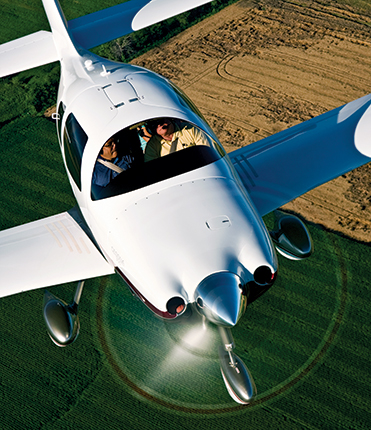
 If you want to start a lively debate with a group of pilots, take a side on the high-wing/low-wing debate, and then stand back. You’re almost guaranteed to hear passionate arguments from both sides of the issue.
Cessna has always built its single-engine airplanes with the wing on the top. Columbia Aircraft models are most emphatically not high-wing airplanes. Perhaps for that reason, it came as a surprise in November 2007 when Cessna purchased the rights to a bankrupt Columbia Aircraft for a relatively paltry $26.4 million.
There were several reasons the merger didn’t seem a perfect fit, and the high-wing/low-wing question was only one of them (but I had to bring it up anyway). Cessna has long since learned that clinging to the tried and true might not be very exciting, but it works. The Wichita, Kans., company has manufactured the best-selling models in practically every class, from light singles to jets. (Okay, it’s true that the popular Cirrus SR22 has outsold the Skyhawk for the last few years.) Cessna’s success may be the manufacturing equivalent of the traditional advice, “Age and experience trump youth and enthusiasm every time.”
In contrast, Columbia’s two-plane line was about as innovative as production airplanes got. Featuring a brilliantly smooth, all-composite structure of prepreg glass fiber around a honeycomb interior, the 350 fuselage is assembled like a giant model airplane, with left and right halves bonded together from the firewall aft. Bonded structures certainly aren’t new to Cessna—the company has been using them on the Citation line of corporate jets for years—but the new 350 and 400 represent the first Cessna singles to make extensive use of the technology.
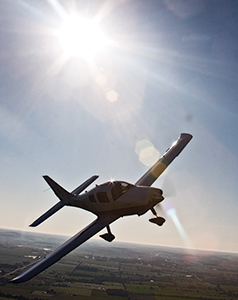 |
| The all-composite Cessna 350, powered by a 310 hp Continental IO-550N engine, is the first Cessna single to extensively use bonded composite structures. |
The former-Columbia airplanes feature an efficient natural laminar flow (NLF) airfoil; a wider cabin than in a 206; twin gull-wing doors; dual side sticks, angled inboard for roll and pitch control; flat-panel PFD/MFD screens, originally Avidyne and now Garmin; a standard rheostatically controlled climate-control system; and fixed tube-steel gear that’s so aerodynamically clean, the turbocharged version once went toe-to-toe with the retractable Mooney Acclaim as the world’s fastest production single.
In short, the Columbia airplanes seemed to be from a different aeronautical planet. Yet here we are a year later, and the Cessna 350 and 400 have become stablemates with our old friends, the 172 Skyhawk, 182 Skylane and 206 Stationair. Indeed, the 350 and 400 are effectively the top of Cessna’s piston line, with the 350 checking in at a base price that’s $32,000 above that for the 206, and the 400 pegged at $79,000 above the Turbo Stationair.
The 350 features performance you might not expect from a fixed-gear airplane. Designer Lance Neibauer took special care to configure his first production single with a small but efficient wing and slickly faired tri-gear design to complement rather than argue with the wind. Wing area is a mere 141 square feet, but a combination of wing cuffs bonded to the outboard leading edge to increase camber and the clever NLF airfoil help generate impressive climb.
| Under The Same Roof: Traditional & Modern |
|
Walk into the showroom at Tom’s Aircraft (www.tomsaircraft.com) in Long Beach, Calif., and you’re presented with a contrast of airplanes. There are Skyhawk SPs available for less than $300,000, and turbocharged Cessna 400s priced at more than $600,000. Throw in an occasional Caravan plus a sprinkling of T-Skylanes and T-Stationairs, not to mention the subject Cessna 350, and you have the makings of an airplane for every mission. How do you sell Cessna 350s and 400s alongside Skyhawks and Skylanes? “The question rarely comes up,” says Rich Manor, sales manager at Tom’s, world’s largest piston Cessna dealer for five of the last eight years. “Most of the time, prospective buyers have already narrowed their search, they know what airplane their flying ability and income qualifies them for, and it would be difficult to redirect their interest. We’ve rarely seen a prospect come in who was undecided between a Turbo Skylane and a 400, though we’ve had some who’ve stepped up from a T-182 to a 400.” Advertisement
A buyer for the new-generation 350 or 400 has more disposable income and is usually instrument-rated with more experience than other pilots. In many instances, he or she has already flown some fairly high-performance airplanes, so the transition to the 350 or 400 is less of a jump than it might be for someone else. “The Cessna 350 and 400 are the most innovative single-engine airplanes Cessna has ever sold, because of course, they didn’t start off as Cessnas,” Manor explains. “While the Cessnas are generally regarded as among the most proven designs in the industry—and that counts for quite a bit with some buyers—the 350 and 400 are very different in all respects: low-wing rather than high-wing, gull-wing doors, all-composite construction. It’s a totally different design concept, but one that buyers seem to like.” |
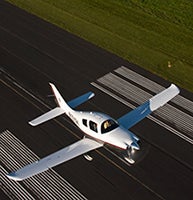 With the flaps set at the first notch, 12 degrees for liftoff and climb, expect an initial 1,200 fpm with a full load from sea level. Better still, you’re liable to maintain 1,000 fpm through at least 5,000 feet. Service ceiling is 18,000 feet.
Like the Cirrus SR22, the Cessna 350 relies on a combination of copious power and extreme aerodynamic cleanliness to overcome drag. Officially, the airplane’s max cruise speed checks in at 191 knots, but that’s probably not the way most pilots run the 350. The penalty for big cruise is big fuel burn, not very popular at a time of $6-per-gallon gasoline.
Cessna’s 350 uses a normally aspirated version of the same engine rated for as much as 350 hp in the Lancair IV application. The engine can pull 75% of 350 hp, i.e., 263 hp, roughly 85% of the derated power. In fact, Cessna lists max cruise power slightly lower at 81%.
 Designer Lance Neibauer took special care to configure his first production single with a small but efficient wing and slickly faired tri-gear design to complement rather than argue with the wind.
 Specific fuel consumption is fairly immutable, and with an SFC of 0.43 pounds/hp/hr, max cruise burn comes out to about 113 pounds/hr, roughly 19 gph. With 98 gallons in the tanks, that translates to almost four hours of IFR endurance (plus alternate plus reserve) at high cruise, worth an easy 750 nm. Cessna’s figures suggest a range of 1,395 nm at 55% power (158 knots) on just under 10 gph. That’s not to suggest anyone is likely to run the airplane at that setting (it’s sort of like driving a 911 Turbo at 70 mph on the San Diego Freeway in sixth gear), but for those strange folks who like to fly fast airplanes slow!
If the Cessna 350 has an Achilles wing, it may be payload. Unlike the bad ole days when manufacturers used to stretch weight and performance specs far beyond any reasonable credibility, Cessna’s website acknowledges a typical empty weight of 2,475 pounds for the 350. Columbia chose to fit the 350 with 98-gallon tanks, fairly big fuel for a 3,400-pound airplane. In contrast, Beech installs only 74-gallon tanks on the A36 Bonanza, Cirrus uses 81-gallon containers on the SR22-G3 and Mooney fits its new Ovation III with 95 gallons. That means full fuel in the 350 limits payload to only 345 pounds, barely two folks plus toothbrushes.
 |
Most people who fly four-place airplanes know that such weight limits are a little artificial, as pilots of four-seaters normally use the backseat as a huge baggage compartment. I bought my current Mooney in 1988, and in 20 years, I’ve carried four full-sized folks exactly three times.
The reality is that most of us buy at least two seats more than we need, then fill the tanks and fly, so a two-person limit with full fuel may not be a significant penalty. (How many times have you cancelled the flight, told one passenger to stay on the ground or defueled an airplane when the suggested weight and balance were slightly over gross?)
Still, if you do need to transport a full string quartet (without instruments) in the 350, you’ll need to leave about 56 gallons in the truck, limiting your flight to two hours. Baggage capacity is 120 pounds if it really is stored in the baggage compartment. The CG envelope is generous, so the 350 offers a variety of loading options.
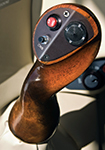
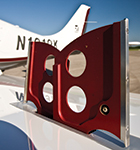 As mentioned, the 350 and 400 use side sticks to control roll and pitch, and that’s both good and not-so-good news. The lack of a conventional yoke directly in front of the pilot and copilot does free up panel space and legroom, providing a certain feeling of openness, but if you’re expecting control response akin to an F-16, you’ll be disappointed. It’s true that air show pilot Sean Tucker performs limited aerobatic routines in a Columbia 350, but roll rate is fairly slow and ponderous, closer to that of a 206 than a Bonanza. The side sticks are mounted on the sidewalls of the front cabin, so by definition, you can only fly with your outboard hand. Handling either side stick with the inboard hand is next to impossible.
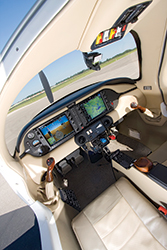
Columbia, and now Cessna, installed the Garmin G1000 glass-panel display coupled to its attitude-based 700 autopilot. This combination of avionics wizardry provides all the automation you could ask for in autoflight mode. Cessna uses the G1000 on all its piston models, so the 350 and 400 are standard additions to the fold.
This combination of avionics wizardry provides all the automation you could ask for in autoflight mode
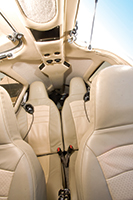 My girlfriend is working on her private ticket and is making the transition from round gauges to flat panel in a new Skyhawk faster than I ever could. She loves the G1000’s large, vertical tape presentation. (Cessna hedges its bets by providing three two-inch, round backup instruments.)
The new Cessna 350 is far from a simple machine, but it’s an all-electric airplane, with no vacuum or hydraulic systems to complicate matters. This brings up the obvious question of what happens in the event of a total electrical failure. The 350 features separate wire routings, a backup battery, dual alternators and regulators with full crosstie capabilities to maximize redundancy. That means there are no vacuum-driven instruments to worry about as there’s no vacuum system installed.
If the 350 is willing to scamper cross-country at 191 knots, it’s also capable of noodling down final at almost sleep speed. Eighty knots works just fine. The stall on the 350 is practically nonexistent. Prior to my landings in the new 2009 model, I tried a half-dozen stalls at altitude. I brought power to idle, eased the side stick straight back to the aft stop and held it there for a full 30 seconds. The aircraft responded with little more than a gentle hobbyhorse pitching up and down, with no tendency to roll off on a wing. It was apparent that I could have mushed all the way to the ground under good control.
It’s a stylish, comfortable machine …incorporating new ideas for the world’s most successful GA airplane company
 Such manners relegate normal landings to student’s play. It’s apparent this airplane will make an easy transition for anyone stepping up from practically any entry-level trainer, such as the Skyhawk, Diamond Eclipse, Warrior, Liberty or even a 152.
At a price of admission near $550,000, the 350 probably won’t sell by the hundreds. Cessna hopes to sell 30 of the 350s and another 60 of the 400s by the end of 2008. It’s a stylish, comfortable machine, however, incorporating new ideas for the world’s most successful GA airplane company. Combine Cessna’s experience and marketing with Columbia’s innovation, and the result very well may be a winner.
| Garmin G1000 Advanced Tips | |
| Maximizing the all-glass avionics suite By Joe Shelton In a previous issue, we brought you some initial tips for getting the most out of your Garmin avionics system. [See “Garmin G1000 Tips” in “The Ageless Skylane” from P&P October 2008.] |
|
| 1) USE DME FOR NAVIGATING CLASS B AND C AIRSPACE. When navigating in Class B and C airspace, pilots can set the map display to show the boundaries of the special use airspace (SUA). That works, but it isn’t precise enough, and knowing exactly where you are relative to the airspace borders can be problematic, depending upon the map scale. Instead, press the PFD’s soft key and then the BRNG soft key to set up a Bearing Pointer display on either side of the bottom of the HSI; it will show distance to the selected VOR or GPS waypoint. Select VOR because the GPS references the current active waypoint, which is already displayed at the top of the PFD. The Bearing Pointer isn’t really DME, but indicates a GPS-derived, great-circle distance from the bearing source. In the context of navigating Class B and C airspace, the difference in distances is negligible. | 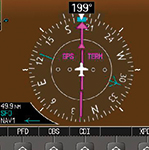 1 1 |
| 2) SET YOUR AIRCRAFT V-SPEEDS TO DISPLAY ON THE AIRSPEED RIBBON. Use the TMR/REF button at the bottom of the PFD to display the glide, Vr, Vx and Vy speeds on the airspeed tape. The reference speeds are indicated by small “r,” “x,” “y” and “g” icons to the right of the vertical airspeed ribbon. These values are useful because they’ll always be displayed, so you don’t have to remember them. There is, however, a caveat: All of the speeds are for aircraft at full gross weight; they’ll be lower if the aircraft isn’t at gross weight. If you’re at a lower weight, then you need to interpolate. Using the data in your POH to get an idea of how much the speeds will vary depending upon weight, do a calculation of the speeds at the lowest logical aircraft weight. Worst-case scenario, you can always use the gross weight reference speeds as displayed on the G1000. | 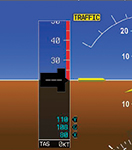 2 |
| 3) USE THE G1000’S RUNWAY CENTERLINE EXTENSIONS FOR AWARENESS, ESPECIALLY IN LOW-VISIBILITY CONDITIONS. The MFD map can display “runway extension” lines that extend outward from each runway at the flight plan’s destination airport. Press the Menu button and use the Map Setup–Aviation Group option to set the desired extension parameter. Runway extensions are very useful as you arrive in the vicinity of an airport because they provide a reference regarding where your aircraft is in relationship to the runway centerline. They’re useful in lining up on the correct runway when flying a straight-in approach from miles out, but can be critically important when visibility is marginal. | 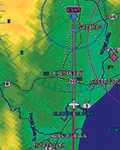 3 |
| 4) CONFIGURE THE FLIGHT PLAN WINDOW TO HELP MANAGE YOUR FLIGHT. The tabular waypoint data in the Flight Plan window can be configured in two views: narrow or wide. Use the FPL button and View soft key, then select Wide to configure the window in the wide display and show fuel required, ETA, etc. You’ll still have the use of the map display, albeit, a smaller version. In addition to the normal bearing and distance information, the wide display adds fuel remaining, ETE and ETA for each waypoint. | 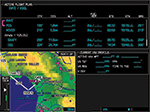 4 |
| 5) KNOW WHERE YOU ARE WHEN CONTACTING ATC. Using the G1000 to give flight following your exact position can sometimes be difficult. When navigating with a GPS, your bearing to and distance from the next waypoint is displayed at the top of the PFD. Instead, you might need bearing and distance either from a nearby airport or VOR. You could use the information in the PFD’s Nearest Airports display, but that requires calculating the reciprocal of the bearing to the airport and, besides, it’s often better to reference from a VOR. Turn the MFD’s FMS knob to Nearest Group and then the Nearest VOR page, press the FMS knob, and scroll to highlight the desired VOR. The map will display a line between the aircraft and the VOR icon so you have the direction. The distance is shown beside the VOR in the list at the top right of the page. | |
SPECS: 2009 Cessna 350


