

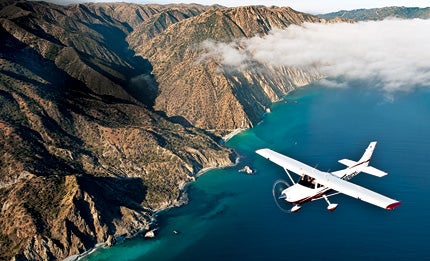
 Bill Cox and Jade Duckart pilot a new 2011 Cessna Skylane along the western side of Southern California’s rugged Catalina Island. |
Back in 1979, I purchased one of the very first Mooney 231s, my first-ever new airplane. At the time, the price seemed more applicable to something with a three-car garage and a circular driveway. Still, with all the tax benefits (investment tax credit and accelerated depreciation), the 231 turned out to be an excellent financial move. This was the first of the turbocharged, four-seat Mooneys, however, and the turbo system wasn’t quite ready for prime time.
I purchased the 231, and immediately leased it on an all-encompassing, two-year contract from the date of delivery, so I had little to do with the airplane until 1981 when the lease expired. (In fact, I didn’t even see “my” Mooney until the lease expired.) I found out later that the engine had suffered turbocharger problems from the beginning, and those problems continued when I took the airplane back, after the warranty expired, of course.
Between 1981 and 1987, when I finally traded the 231 for a Turbo Executive, I went through three more turbos, despite toeing every operational limit on temperature and cooldown. ”
Fortunately, today’s turbos are a new, more reliable generation of blowers. Mooney and every other manufacturer that uses turbochargers employ systems that are greatly improved from those first semiprimitive systems. By all accounts, today’s turbos are as durable as the engines themselves, and operating characteristics are so similar, you might forget there’s a compressor out front.
Case in point—the Cessna Skylane TC. A year ago, I made a 14-hour delivery of a new 2010 model from Lakeland, Fla., to Long Beach, Calif., and more recently, I flew a 2011 T182T equipped with essentially every option. Both experiences only served to reinforce the belief that today’s turbochargers are tough compressors. Better still, the Skylane’s sloped controller is automatic. It won’t allow an overboost beyond the 32/2,400 limits under most conditions.
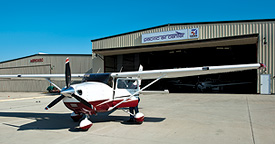
The Cessna store in the mountainous West of Southern California, Pacific Air Center on Long Beach Airport, only orders T182s for inventory (though they’ll be happy to order anything you wish). Company president Rich Manor comments, “Here on the West Coast, the IFR MEAs for any flight other than right along the beach will nearly always be 11,000 feet or higher. A normally aspirated Skylane can climb to that altitude without problems,” Manor continues, “but a turbo provides so much more flexibility of route, weather and height that most Western pilots prefer to have a blower out front. That becomes especially important for operation over the mountains north and east.”
The Skylane TC’s Lycoming engine is gently turbosupercharged. In other words, it develops more than the normal 29 inches of manifold pressure. Specifically, the TC’s TIO-540-AK1A mill produces 235 hp at 2,400 rpm and 32 inches mp. Keep in mind, this is a significantly derated version of an engine that can develop 350 hp, so it’s not even breathing hard at 235 hp.
 |
Here at Plane & Pilot, we know a little about Skylanes, as we operated a succession of two of the type for perhaps 1,500 hours over a period of almost 20 years. We flew a 1963 model 182F and a 1978 model 182Q on a variety of editorial missions over much of the USA, in all kinds of weather to runways long and short, smooth asphalt and dirt. They weren’t fast transportation, but they were universally reliable and safe to fly under practically all conditions, and modestly comfortable for a long day of flying. Most important, they were easy to fly. I could teach my German Shepherd to fly a Skylane.
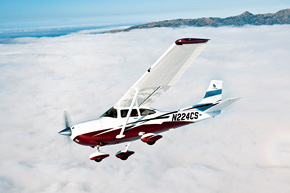
Despite the deliberate esthetic resemblance of the modern Skylane with our renovated older models, the new airplanes are far more technologically advanced. Considering the cost in both time and money to certify practically any system improvement, it’s not surprising that general aviation manufacturers are sometimes reluctant to innovate, but some change is inevitable (except from vending machines).
The 2011 Skylane TC displays more than its share. In total, the new 2011 Skylane TC incorporates several dozen improvements over the old-generation 182s. The top 10 major improvements are:
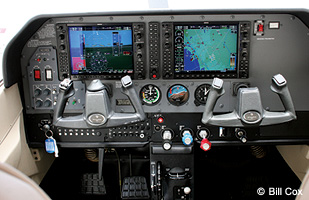
1 The new Skylane’s Garmin G1000 glass panel has been detailed ad nauseum in this and other magazines, so we won’t restate its attributes here, but nearly everyone agrees it’s an amazingly talented avionics system.
2 All the new-generation Cessnas feature fuel-injected rather than carbureted engines, and they’re all Lycomings. Additionally, both normally aspirated and turbocharged engines offer the same TBO and warranty, a further testament to the reliability of turbos.
3 The re-start airplanes certified after 1996 were approved under the more rigorous FAR 23 standards rather than the looser limits of CAR 3.
4 Stainless-steel control cables now are standard. Prior models used stainless steel on floatplanes only, where corrosion was a more consistent risk.
5 Prior to 1997, corrosion proofing was an option, now it’s standard and performed with epoxy before the airplane is assembled.
6 The seats now are 26G structures, and they were completely redesigned for improved comfort, including AMSAFE air-bag/seatbelts standard.
7 Soundproofing has been dramatically improved with better interior insulation and fewer firewall penetrations.
8 Sidewalls and interior fittings are now predominately metal rather than the old Royalite plastic that was prone to cracking and breaking.
9 Instrument panels have also gone all metal, again to replace plastic/fiberglass parts.
10 Fuel tanks now feature wet wings rather than bladders that were prone to developing wrinkles and eventual leaks.
The inevitable penalty for all of this innovation is reduced useful load. Our older-generation Skylanes boasted 1,150-1,200 useful pounds, whereas the new models sport more like 1,050-1,100 pounds. With 80 gallons in either Skylane, the old airplane can lift about 670 pounds, the new bird around 570 pounds.
Weight reduction in an airplane that has been around for nearly half a century is a magic trick that David Copperfield couldn’t match on his best day. Talk about making an elephant disappear. Aircraft manufacturers, from Boeing to Aeronca, have spent millions trying to find extra pounds that could be translated to payload, and not always successfully.
 They were UNIVERSALLY reliable and safe to fly. Most important, they were easy to fly. I could teach my German Shepherd to fly a Skylane.
Nevertheless, the Skylane offers a comfortable cabin that has only improved with time. It’s quieter, the materials are of better quality and ventilation is superior, with airline-style Wemac vents in place of the old, ill-fitting slide tubes. The Skylane’s people space is tall, almost 49 inches from floorboard to ceiling at the front-seat station, and the cross section abeam the front buckets is 42 inches. That’s the same as a 36 Bonanza, and only ½ inch narrower than a Mooney. The Skylane is a comfortable place to spend an hour, or four (or sometimes, in our case, eight or 10). The fuselage does begin to taper toward the tail at the front seatbacks, but even the aft horizontal dimension is 40 inches, so the airplane is happy to accommodate two, two-plus-two limitation.
!If the load will allow. As mentioned above, a standard Skylane TC features a max takeoff weight of 3,100 pounds, and Cessna acknowledges that even a typical turbocharged airplane weighs in at 2,023 pounds. Payload with the 87-gallon tanks topped is only 555 pounds. Should you opt for the 76-pound Keith Products air-conditioning system, payload will be reduced to 479 pounds. Without the A/C, you could plan on lifting three, full-size folks, full fuel and toothbrushes.
 |
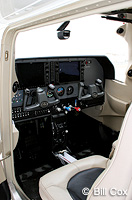 |
| Among many new improvements to the 2011 model, the instrument panel, standard with a Garmin G1000, is all-metal to replace plastic/fiberglass parts. | |
In fairness, four-seat airplanes with only three usable seats are more the rule than the exception these days. If you need to carry four standard souls in a Skylane TC, you must leave behind 126 pounds or 21 gallons of fuel. This will limit capacity to 66 gallons, but that still leaves an easy three hours’ endurance plus reserve, even at high cruise.
The inevitable question arises, how high do most T182T pilots fly, and what does the turbo do for them at cruise? If you operate the airplane in the bottom three miles of sky, where most pilots run turbocharged airplanes most of the time, you’ll see 15 knots better cruise speed.
 |
The simple truth is that turbocharging without pressurization only does half the job. Surveys by a variety of manufacturers have revealed that pilots who own turbocharged, unpressurized airplanes rarely fly above 12,500/13,500 feet because of the inconveniences and cost of supplemental oxygen. Since there’s no real penalty of flying high in a pressurized airplane, pilots operating inflatable models are more likely to cruise at 16,500-17,500, or higher where supplemental O2 is mandatory.
Semi-high may be good enough. At 13,500 feet, the Skylane TC delivers probably 15-20 knots better cruise than the normally aspirated model. That equates to 160 knots if you’re doing everything right—airplane properly trimmed, ball in the center, cowl flaps closed, etc.
Pilots rarely come to grief because their airplanes are too slow, but lack of climb performance can be a major problem. In this case, the overriding benefit of the turbo is the ability to jump up to tall heights without breaking a sweat; then, transition to taller altitudes expeditiously if there’s a need. Many of us have been in the uncomfortable situation of being nearly topped out in altitude while clouds ahead continue to climb faster than we can keep up with them. That won’t happen as often with a turbo providing compressed power.
Both the normally aspirated and heavy-breathing Skylanes start off with about 1,000 fpm climb at sea level gross, but the turbo version begins to outdistance the standard model after the first mile of ascent. The turbo airplane loses only 150 fpm in the initial 10,000 feet of climb, whereas the standard Skylane leaves behind half its vertical performance in the same distance. In fact, the Skylane TC still scores 700 fpm climb when the normally aspirated airplane is at its service ceiling, 18,000 feet.
Critical altitude, the maximum height at which the turbo can still deliver sea-level power, is a full 20,000 feet with the T182. This means you can still plan on having 75% available for cruise at FL200. If you’re willing to climb the airplane to the Skylane TC’s maximum operating altitude, you’ll see about 165 knots on 16 gph.
(Max operating altitude, incidentally, isn’t the same as service ceiling. The latter is defined by performance, the height at which climb is down to 100 fpm on a single-engine airplane. Maximum operating altitude is more typically designated because of system or other limitations. In fact, the Skylane TC will still climb at better than 600 fpm at 20,000 feet.)
Either the standard or turbo 182 fly as you might expect for a 3,100-pound Cessna. Roll response is slow and deliberate rather than quick and reactive. The Skylane TC handles more like the six-place Stationair than its little brother, the Skyhawk. Elevator trim seems disproportionately heavy if you’re stepping up from a 172, but the universal solution is to keep the pitch trim moving to neutralize elevator pressure as much as possible.
That’s especially important in the pattern. A Skylane isn’t as docile as a Skyhawk at low speeds, though you might not guess that by looking at stall speed. The 172S is almost a third of a ton lighter than the T182T at full gross, yet both airplanes use the same wing. The wing rules. Dirty stall is virtually the same—48 knots for the 172, 49 knots for the 182. That translates to good short-field takeoff performance for both models, just under 800 feet for the Skylane and about 950 feet for the Skyhawk. Landing characteristics are typical Cessna, docile and forgiving IF you keep the trim moving to offset the Skylane’s 3,100 pounds.
At a base price of $432,800, the Skylane TC is almost $35,000 north of the entry-level Skylane. The extra dollars buy the turbocharged engine and the onboard 50-cubic-feet O2 system, capable of sustaining the pilot for five hours. Both airplanes come equipped with the Garmin G1000 and everything listed above, but without Synthetic Vision. Add SynVis and the new infrared system, EVS (basically a police-style, FLIR device), and you’ll pay $30,000 extra.
Since the demise of the Piper Dakota in 1994, the Skylane has been pretty much alone in its class, though Maule continues to build a limited number of 235 hp four seaters in your choice of nosewheel or tailwheel configuration. Turbo 182s outsell normals by a wide margin, specifically because of their ability to leap out of tall strips in a single bound and fly high with ease.
The Skylane marches on, not the fastest, not the quickest climbing, not the most comfortable, but perhaps the best overall performer for the price in general aviation. After 50 years in production, the Skylane continues to outsell virtually everything. It’s a near-perfect example of a design that offers more than enough for less than too much.
Why Buy New? |
| The owner of the new Mirage had not completed his Flight Safety transition course, so he was riding as a passenger when we departed Vero Beach for an air-to-air photo session out over the Atlantic. I had flown his airplane earlier in the day for an evaluation of performance, and now, we were lifting off in formation on Piper’s resident photo ship, a Saratoga HP with the aft left doors removed.
As we climbed out above the beach, holding position for Jim Lawrence’s camera, I asked the owner what he had owned before. He commented he had earned his license in a new Warrior, sold that and stepped up to a new Arrow for his instrument and commercial tickets, and finally was transitioning to the Mirage, his third airplane. In the interest of the story, I asked if he had ever considered a used airplane, and he answered, almost disdainfully, “Of course not. I fly my family in my airplanes. I wouldn’t think of flying anything used.” Some pilots cite that as a major reason for buying new, the simple ability to control how the airplane is treated, especially how the engine is operated, from the very beginning. Most new aircraft are released from production flight test with no more than three hours on the Hobbs, so the new owner will typically be entrusted with all future experience until he sells the airplane. Advertisement
Another obvious benefit of buying new is the warranty. Aircraft warranties are nothing like those on luxury automobiles that may extend to five or more years, and cover practically everything except preventive maintenance, but a good warranty can protect you from most major problems associated with a new airplane. The warranty on a new 2011 Turbo Skylane is two years, and separate warranty periods may apply to the avionics. Conversely, most used planes offer 30-60 days or no warranty at all. Some pilots laugh at the mere suggestion of new technology on modern airplanes, but the fact is, current airplanes often reflect improved sophistication over older models. The laws of aerodynamics and the economics of FAA certification make significant increases in climb, cruise and range unlikely, but manufacturers nevertheless continue to innovate in safety, avionics, comfort and convenience. In the case of the Skylane, the introduction of the Garmin G1000 in 2004 was an acknowledged step forward in pilot convenience and safety. Use of AmSafe energy-absorbing seat belts was another big boost in safety. Similarly, there may be other new technology available on a new aircraft that you can’t easily purchase on a used airplane, often not at any price. This can include such options as TKS icing protection, a backup alternator and battery, and a variety of Garmin avionics options, such as SVT (synthetic vision) and EVS (infrared), plus ESP (Electronic Stability and Protection—a full-time automatic attitude-monitoring system), traffic and terrain warnings and other valuable pilot alerts. Yes, you may be able to buy near-equivalent aftermarket products that will come close, but when you consider the cost of the systems themselves plus the installation and the downtime, you may be better served to buy them installed in a new airplane. If you think strictly in terms of price, you may feel the used aircraft has all the advantages, and on the surface, at least, that might seem to be the case. Looking at the latest issue of Aircraft Bluebook Price Digest, a 2011 Cessna Turbo 182T has an average-equipped price of $432,800. Drop back only two years to a 2009 model, and the average used price reduces to $340,000. According to ABPD, a 2007 model T182 now costs $280,000. Remember, however, that a new airplane eligible for business writeoff may actually be less expensive than a used one after the LEGITIMATE tax benefits of the first two years’ deductions. You’ll note the use of the word “legitimate” above. That’s because a business airplane is a giant red flag to the IRS. The only new airplane I’ve owned (out of six) was a new Mooney 231 that was purchased on a pure lease to an avionics company as a product demonstrator. I didn’t even see the airplane for the first three years; yet, I had to prove to the IRS that the Mooney was a legitimate taxable business each year.With the benefit of accelerated depreciation and investment tax credit, the 231 was an excellent investment for the first three years. The second three years were more of a financial challenge, and I sold the airplane in its seventh year of ownership. (Beware the capital gains tax.) Finally, there may be some minor, implied benefits of a new airplane over a used one. You can choose your colors, paint schemes and interior options when buying new, rarely when purchasing used. Friends and family may be happy to fly in a new airplane; not so eager to climb aboard a far more affordable 10- or 20-year-old machine. |


