

 Rated at a conservative 315 hp, the Continental TSIO-550-K factory-turbocharged engine is limited at 2,500 rpm, giving the engine a smoother feel and making the cabin even quieter while reducing its noise footprint. Single-lever performance adjustment means there’s no propeller control. Rated at a conservative 315 hp, the Continental TSIO-550-K factory-turbocharged engine is limited at 2,500 rpm, giving the engine a smoother feel and making the cabin even quieter while reducing its noise footprint. Single-lever performance adjustment means there’s no propeller control. |
Some aircraft change the game. Looking back, designs like the Cessna 172, the Beechcraft Bonanza, Piper Cub, Mooney M20 and a handful of others have changed the way aviators—and outsiders—perceive general aviation. These aircraft led GA in a new direction the minute they were introduced. Since 1994, when a nascent company named “Cirrus Design” unveiled a revolutionary airplane called the SR20, that list has grown to include the SR22 and SR22T. These aircraft have turned GA on its side.
That’s not to say everybody has embraced the Cirrus design aesthetic. Any fair review of an aircraft like the newest SR22T has to include both sides of the like/dislike argument. What’s interesting is that this Cirrus has sparked so passionate a reaction. The company’s dogged pursuit of innovation in safety is equal only to its revolutionary advances in design, construction and performance, and it’s these advances that have fueled the passionate arguments.
 |
I didn’t want to like the newest SR22. Standing firmly in the stick-and-rudder-and-tailwheel camp, my instincts told me the Cirrus couldn’t be a “real” airplane. The technology was surely dumbing down the aviating experience, and only “airplane drivers” (and not real pilots) would like such an airplane. I wondered what all the hoopla was about.
Cross-Country Adventure
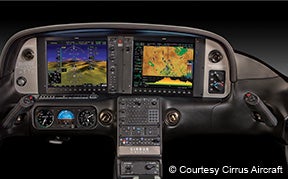 Already one of the most advanced glass-panel systems, the 2012 Garmin Perspective adds integrated satellite phone, global weather and SMS text messaging, along with the new GMA 350 audio panel with 3D audio. Already one of the most advanced glass-panel systems, the 2012 Garmin Perspective adds integrated satellite phone, global weather and SMS text messaging, along with the new GMA 350 audio panel with 3D audio. |
That was before the brand-new SR22 charmed me like Audrey Hepburn riding her Vespa scooter in that scene from Roman Holiday. The Cirrus seduced me over the course of a San Francisco adventure, slowly transforming each of my objections into a chin-rubbing understanding of why this airplane deserves a place right next to that venerable Cub.
Along with me for this mini odyssey was Cirrus’ own Matt Bergwall and Plane & Pilot editor Jessica Ambats. Both are experienced Cirrus pilots, so I felt out of place as they offered the left seat to me. Our flight would take us from John Wayne Airport in Southern California up to the Bay Area for a photo session around the Golden Gate Bridge. The next day, we would return home. My biplane-honed skills would be fairly useless on this flight, and I was rusty, to boot. I offered a quick plea to the aviation gods to anoint me with a decent performance as I sat down on the buttery-leather seats and took in the new-plane smell.
 |
By now everyone has seen a Cirrus, and the company recently celebrated their 5,000th airplane. One of the most impressive features of the SR22 is the enormous cabin. When Cirrus conceived the airplane, they started with a sphere instead of a rectangle, so the interior vibe is completely different from, say, a Mooney, where the rear cabin can be claustrophobic. I’m not a big guy, of course, but the rear space is positively cavernous. One major enhancement to the 2012 SR22T is the three-seat rear space, allowing three people in back and two up front. In truth, three full-size adults would find it overly cozy, but a couple with a child or three average teenagers would be comfortable. The new LATCH child- restraint system also has been added in 2012.
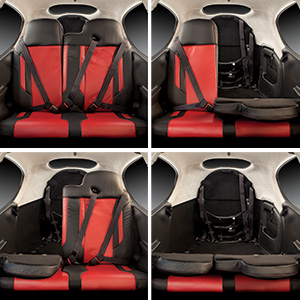 The year 2012 brings a major redesign of the rear cabin. Enhancements include a transition to over-the-shoulder seat belts, 60/40-split reclining rear seats, re-engineered side bolsters to increase cabin area, an additional third seat and LATCH child-safety restraints. The redesign saves 10 pounds over existing models. The year 2012 brings a major redesign of the rear cabin. Enhancements include a transition to over-the-shoulder seat belts, 60/40-split reclining rear seats, re-engineered side bolsters to increase cabin area, an additional third seat and LATCH child-safety restraints. The redesign saves 10 pounds over existing models. |
Speaking of seats, another new feature for this year is the reclining and 60/40-split seat option in the back. The FlexSeating allows for skis, fishing poles, golf clubs and the like, but it was the reclining rear seats that won me over. Besides giving the SR22T ample cargo space for hauling large items by folding both seats (or just one seat) flat, the gaping cabin combined with the reclining seats allow a lounger-like sleeping position.
With the weather providing nothing but blue skies and good visibility across the entire nation that day, we began our trek, and I settled in with the SR22. The Garmin Perspective display is so darned pretty to look at, and its capabilities are nothing short of mind-blowing—transforming the five-seat Cirrus into much more than a mini airliner. From start-up to shutdown, the richness of information provided by the Perspective system is deservedly an enormous part of the Cirrus’ appeal and success.
Immediately on takeoff, as we winged over the Pacific Ocean and its Gold Coast beaches, I was struck by how intuitive everything in the Cirrus is. I also noticed how a large part of the mission of the SR22 is to make the job of piloting easier. For example, our takeoff flap setting was “50%,” the first detent on the simple switch. How many degrees 50% translates to isn’t apparent, and it’s these kinds of contradictions that have some old-timers saying the airplane oversimplifies flying. But understanding the logic of the non-complicated system deflates such arguments. The settings could be in Russian, and all that counts is the proper procedure for this airplane. Sometimes, I think many of us are enamored with flying’s complexity; it’s a sort of a mysterious veil to outsiders. Cirrus is trying to invite outsiders into aviation by removing that veil, and then everybody wins.
 |
I had decided to hand-fly for the first 30 minutes or so to get the feel of the airplane. It’s no wispy featherweight. The Cirrus is maneuverable, but it feels somewhat like the bigger Cessnas—especially in the elevator. The controls are balanced, but the side stick takes some getting used to if you’re new to it. It was strange for me not to have a stick or yoke in front, though I liked the additional space that the side stick provides.
Another example of Cirrus’ commitment to make flying simpler is leaning the SR22T’s engine. The avionics system, turbocharger and MFD display work together to eliminate the complexity of current methods. Just bring the throttle back and match a little blue line on the engine display with an indicator, and you’re flying at lean-of-peak performance for a given condition. Not knowing the technical minutiae took nothing away from the aviating experience. Simple is beautiful on a long trip.
There, above the breadbasket valley of California, my epiphany about the Cirrus began to take form. We were riding at 8,500 feet along a lower part of the Sierra Nevada mountains that seemed to stretch for eons. At our true airspeed of 175 knots, the golden hue of the spring crops nestled against the jade hills reflected in the ample windscreen, we set the autopilot, and Bergwall began to show me more of the SR22T’s hidden charms.
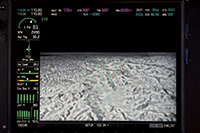 The Enhanced Vision System uses sensors to offer a hyper-realistic view in low-visibility conditions, increasing situational awareness. The Enhanced Vision System uses sensors to offer a hyper-realistic view in low-visibility conditions, increasing situational awareness. |
In 2012, gee-whiz features that Cirrus aficionados already know well were added: 12-inch PFD and MFD screens, Cirrus’ Synthetic Vision and Enhanced Vision System (EVS) for use at night or in limited visibility, Electronic Stability and Protection (ESP), Certification for Flight Into Known Icing (FIKI), Hypoxia check/Automated Descent Mode, Air Conditioning, yaw damper, and a five year spinner-to-tail warranty.
Our 2012 GTS model also had the Garmin GMA 350 audio panel with “3D audio,” which turned out to be a surprise in coolness. The unit separates audio signals into two distinct sides of your headset. For example, you could be monitoring ATIS on one frequency and listening to Approach on another. One channel goes to each ear, and the unit processes the signal, so the effect is unlike anything you’ve experienced before. The resulting communication is unexpectedly distinct and easy to understand, even with both sides transmitting at the same time.
Suspended there, over terrain that looked like giant paper grocery bags crumpled everywhere, the talk turned to the Cirrus’ famous Cirrus Aircraft Parachute System (CAPS).
“If you lost an engine here, would you pull the chute?” we asked Cirrus’ Bergwall. After a few seconds he responded, “Definitely, yes.” The ground below was teeming with tall pines and not a single stretch of open or otherwise flat land. The best you could do here would be to stall it into the trees. Maybe a broken back or leg would be the worst of it; maybe not. But the Cirrus opens a world of chances for you with the ‘chute. Of course, it’s not a substitute for proper flight planning nor an excuse for ignoring weather, but CAPS is unequivocally a lifesaver. “It has been deployed 33 times,” noted Bergwall. “And when pulled within the design parameters, it saves lives.”
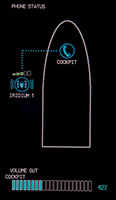 The Perspective Global Connect system includes an integrated satellite telephone, text messaging and worldwide weather. The Perspective Global Connect system includes an integrated satellite telephone, text messaging and worldwide weather. |
Another brilliant option for 2012 is the $14,900 “Perspective Global Connect,” which brings an integrated satellite phone to the Cirrus’ cabin, along with SMS text messaging from the MFD and worldwide weather through a subscription service. We tested the sat phone by calling Michigan while we hummed along nearly two miles above Paso Robles and well out of reach of any cell-phone reception. Imagine the possibilities of flying over Central or South America; the remote deserts of Africa or even the Bahamas, and being able to call or text anybody around the globe or retrieve weather from locations not served by XM.
The descent and landing into San Carlos were easy events, with the SR22 trucking down final in a flat approach and flare. A good dose of practice would get me comfortable, though the side stick still felt a bit alien. The capabilities of the Garmin Perspective go without much comment here, other than it can do just about anything, and the Cirrus’ FIKI certification and supplemental oxygen combined with the Perspective mean there isn’t much the airplane can’t handle.
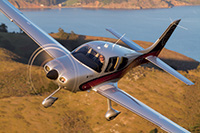 |
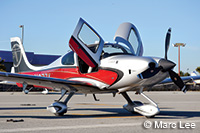
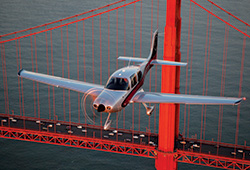
Once the SR22T was prettified for her photo session, we launched for the Golden Gate Bridge with the sun sitting low over our shoulders. Against the backdrop of San Francisco and her radiant bay, the SR22T looked handsome. The year 2012 brings two color schemes: “Carbon” and “Platinum.” The two appointments are targeted at different audiences, with “Carbon” being a more aggressive look, featuring carbon-fiber interior accents, two-tone paint, leather seats and a flat-black spinner. “Platinum” is the conservative (the marketing folks call it “distinguished”) motif, with single-color seats, platinum accents and a polished spinner.
Cirrus feels good to non-aviation passengers. The interior is sumptuous and very un-aviation like, which reduces the shock that non-aviators feel sitting in the back of most GA airplanes. It’s yet another thing Cirrus has done right, and another reason these airplanes sell. Between the air conditioning, big cabin, customizable audio feeds, and three-position reclining seats, flying in an SR22 is downright decadent. I tested that myself on the way back home as Ambats took the left seat and I spread out in the rear cabin, reclined with a book and enjoyed the irony of Carly Simon singing her 1977 hit, “Nobody Does it Better.”
Ok, so the Cirrus SR22T isn’t a perfect airplane—there’s no such thing—but my epiphany stands that this is a supernal cross-country machine when you just want to enjoy the ride. It’s true that if I want a pure, stick-and-rudder, wind-in-the-hair, don’t-screw-up-the-landing, aviating experience, I’ll take out the biplane (or drop the window on a Cub or Husky). But if I want to go to a vacation destination and arrive relaxed, or if I want to bring non-flying friends on an enjoyable flight that beats the airlines in almost every way, I’ll grab the Cirrus keys every time.


