

 |
The world looks different from 41,000 feet. Climb to nearly eight miles above the sea, and you’ll note some dramatic changes compared to the view at lower altitudes. For one thing, the perpetual haze layer that plagues so much of the U.S. often becomes thicker and more opaque. If you look up rather than down, you’ll see a dark-cobalt sky, not the solid black the astronauts report on their journey to orbit, but a deep navy blue.
You’re virtually alone at this altitude. Many airliners can operate at FL410, but only after burning fuel load down for several hours. There are a number of corporate jets that can top 41,000 feet, but all are far more expensive than the Eclipse. Contrails are nearly always below you rather than above.
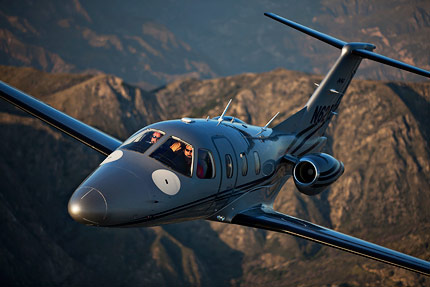
The Avio NG flat panel display before me suggests we’re cruising at 340 knots at this high station, well above most other traffic. As if in confirmation, a twin-jet contrail crosses our path 4,000 feet below. In the distance, I can see the snow-white spine of the Sierra Nevada reaching up for us and falling five miles short. Today’s ride is in Mason Holland’s Total Eclipse demonstrator, a fully completed version of the Eclipse 500, the primogenitor of the very light jet. In truth, the Eclipse created the VLJ market, and today, there are something over 250 of the type in the sky.
Eclipse almost single-handedly redefined the paradigm of “personal jet,” but the original effort wasn’t successful, through no fault of the airplane. In fairness, Eclipse was up against something of a perfect storm of circumstance in the first decade of 2000, a conspiracy of a fickle economy, unpredictable market forces, supply problems, technology challenges (Eclipse was the first to employ aluminum friction stir welding) and management missteps.
That’s all history. When CEO Mason Holland and his partners, Mike Press and Ken Ross, acquired the company out of Chapter 7 bankruptcy, they proved that aviation need not automatically eat its young. Today’s fully refurbished Total Eclipse is a well-finished machine, being marketed worldwide as the first of the VLJs. As mentioned above, Holland’s company, now renamed Eclipse Aerospace, prefer to call their airplane a “personal jet.”
At this writing, the Eclipse is the only real entry in the VLJ class, with something like 261 Eclipse 500s constructed, many of them parked at the Albuquerque manufacturing facility awaiting conversion to Total Eclipse configuration. Shortly after assuming control of Eclipse, Holland initiated a buyback program on the incomplete airplanes and is marketing them as remanufactured Total Eclipse 500s. In fact, there’s probably little to be remanufactured, as most of the aircraft have less than 300 hours on them.
At $2.15 million for a Total Eclipse, Holland’s company is offering the least expensive twin jet in the world by a wide margin. The Cessna 510 Mustang and Embraer Phenom 100 are the only models that come close to competing, and both those jets are much larger and notably more expensive, about $3.5 million for the Mustang and nearly $4.0 million for the Phenom 100.
Once the single-engine Cirrus Vision and Diamond D-Jet are certified, they’ll be serious competition to the Eclipse, both presumably at lower prices but with reduced performance. Jet engines aren’t very economical at 25,000 feet, the presumed max operating altitude for both models. The airplanes’ 1,900-pound-thrust Williams FJ33-4A-19 engine will burn something like 80 gph at FL250 and deliver a cruise just over 300 knots. Meanwhile, the Eclipse 500 is here and now. If you’d like to join the entry-level jet set, Mason Holland will configure a Total Eclipse in roughly 90 days.
Flight To 410
When I met with Eclipse demo pilot Matt Blackburn at Van Nuys Airport, north of Los Angeles, he was on a hectic schedule of demo flights, flying back and forth across the country, to show prospective buyers that the Total Eclipse is now a viable airplane.
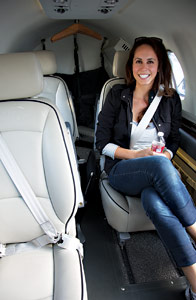
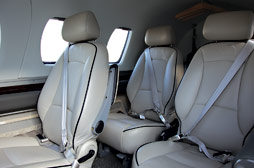
Sitting on the ramp, the Eclipse looks about the same size as a Beech Duke in wingspan and length, but it’s slightly larger than most of the old cabin-class twins on the inside. The cabin is 55 inches across by 50 inches tall, reminiscent of the Aerostar, another airplane that frequently flew with the middle-row left seat removed for easier boarding. (The sixth seat is an option on the Eclipse, by the way.) All seats are now forward facing. Holland’s airplane should be very comfortable for its chosen mission, typically less than 800 nm. More on that later.
 |
||
 |
 |
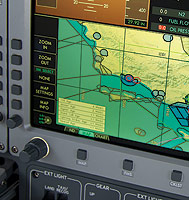 |
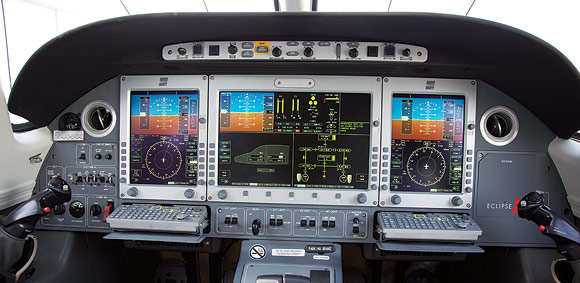
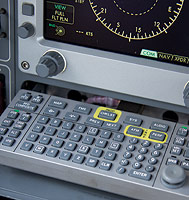
| The Eclipse jet features an Avio NG integrated avionics system, with primary flight displays and QWERTY keyboards for both pilot positions, plus a large multifunction display at center panel. | ||
Several years ago, the National Business Aircraft Association (NBAA) surveyed members to determine the average number of passengers and the typical stage length. You might actually find the numbers surprising—a flight crew plus two passengers on trips of 700 nm or less. The Eclipse was apparently configured to meet those exact mission requirements.
Blackburn allowed me to assume the left seat and demonstrated a trick to get into the captain’s position. He reclines the left-front seatback full down, making it easy to step around the center console and settle into the chair.
Like most of the new generation of flat panel displays, the Eclipse’s Avio NG integrated avionics system looks intimidating at first glance, but familiarity breeds friendship. The jet is fitted with PFDs for both pilot positions plus a large MFD at center panel. I flew the airplane for about 1.5 hours, and some of the Avio NG’s operating procedures were starting to sink in. That’s obviously an important part of the transition training.
 |
From the outside looking in, starting a jet engine always sounds complex, but on the Eclipse, it’s anything but. The Hispano-Suiza Canada FADEC system monitors all parameters during start-up and will automatically abort if any temperature becomes too far out of tolerance. Pilots used to advancing the appropriate condition lever to introduce fuel at exactly the right time, then, monitoring engine temps as they climb quickly after liftoff, won’t need to worry about that on the Total Eclipse. You turn a switch, and the appropriate engine starts automatically.
The current airplane has a max ramp weight of 6,034 pounds against an empty weight of 3,780 pounds on our test machine. That leaves a payload of 537 pounds with full fuel—a pilot and two passengers plus a few pounds of luggage.
Carrying full fuel means burning more fuel to lift the additional weight. For that reason, neither the airlines nor corporate jet operators tanker fuel they don’t need. If your stage length is 600 nm or less in an Eclipse, you could most often fly that trip in two hours. Matt Blackburn flight-plans for fuel burn of 500/400/300 pounds in the first, second and third hour of flight (at max cruise), so 2.5 hours endurance would demand only about 1,050 pounds, well under full fuel of 1,717 pounds. Leave 667 pounds of Jet A in the truck and you could fill the remaining three seats.
Takeoff is always more fun in a jet. The twin P&W 610F turbofan engines generate a collective 1,800 pounds of thrust, enough to provide a satisfying shove into the seat back when you bring the warp core online.
The Eclipse comes off the ground cleanly and starts uphill with no hesitation to catch its breath. Once you’re off the ground and cleaned up, you’ll see an initial 3,000 fpm climb. Accelerate to 180 knots, and the jet will still make 2,500 fpm or better.
For a three-ton airplane, the Eclipse maneuvers with the agility of a Pilates instructor. One owner analogized the Eclipse to “a Mooney with two jet engines.” Handling down low is quick and positive.
 |
The airplane seems to almost mind-meld with the pilot, and while abrupt maneuvers seem inappropriate for an airplane designed to spend most of its life in RVSM airspace where all operations must be on autopilot, the Eclipse is a ball to fly.
Predictably, Los Angeles Center couldn’t give us an unrestricted climb to FL410, so we had to settle for three steps to the high ground. We finally reached max altitude over the Sierra Nevada and settled in for 20 minutes of cruise flight. I removed my headset for a few minutes to sample the noise level, and there was little more than a gentle hiss emanating from the twin Pratt & Whitneys back on the tail.
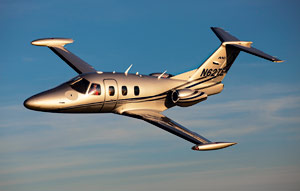
Buyers of turbine aircraft have a slight advantage over piston fans, as turbine manufacturers must guarantee their performance within established parameters. For that reason, I wasn’t surprised that the Eclipse hit all its performance targets on the mark. At FL410, we were leaving our contrail behind at 340 knots. Dropped down to FL360, speed worked out to 360 knots, about Mach .636.
 |
Meanwhile, fuel burn was a relatively meager 59 gph total, confirming Holland’s claim that the Total Eclipse is the most economical jet above the planet. If you needed to stretch range, you could come back a little on the thrust and reduce burn to 48 gph, still truing 325 knots. At that rate, the Eclipse could manage well over 1,000 nm between fill-ups.
Many Eclipse operators will probably fly with two pilots, but that’s not necessary since the airplane is certified for single-pilot operation. There’s nothing difficult about handling in any mode, especially during approach. Stall speed is a slow 67 knots, only eight knots quicker than most single-engine turboprops, so approach speeds are remarkably low.
At our weight, final approach into Van Nuys worked out to 93 knots. That’s slower than typical bug speeds in a Cessna 421 or Aerostar. If you’re right on the numbers, the Eclipse can handle 3,000-foot runways with ease, and the trailing beam gear system is almost guaranteed to make anyone look like a pro.
In fact, virtually every aspect of flying the Eclipse is easier than operating a business twin such as a 421, Duke or Aerostar 700. The cruise speeds are typically at least 100 knots quicker, but the big numbers don’t manifest themselves until you’re at high altitude where they become little more than readouts on the Avio NG system.
On The Horizon
As this is written, Holland still has a number of ground-up Eclipse 500s available for build- up to Total Eclipse configuration at the aforementioned $2.15 M price. These include new paint and interior, FIKI (known icing) certification and a full factory warranty.
After the first of the year, the company will be returning to production, building the Eclipse 550, an updated version of the basic airplane. The 550 will utilize the same engines and configuration but will incorporate a number of operational updates. Performance will be the same as that of the 500.
 Starting a jet engine always sounds incredibly complex, but on the Eclipse, it’s anything but. The FADEC system monitors all parameters during start-up and will automatically abort if any temperature becomes too far out of tolerance.
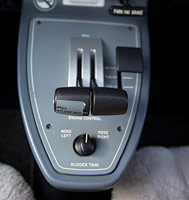
Autothrottles are a feature of turbine aircraft that have been around for longer than you might imagine. The Germans employed autothrottles on the first jet fighter, the Me-262, in 1944. As the name implies, autothrottles are essentially automatic throttle controls that operate in conjunction with FADEC to allow a pilot to command the engines to perform identical operation depending on the mode of flight.
Collectively, they allow the pilot to control engine power, usually by specifying either speed or thrust control.
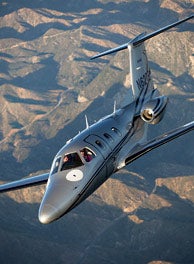 The Eclipse is powered by two Pratt & Whitney PW610F engines and cruises at 362 knots. |
A pilot can select a desired speed, and the autothrottle system will hold that speed through all phases of flight, consistent with normal engine operating parameters.
A pilot may also command a constant thrust for a given phase of flight, such as takeoff, climb and cruise of descent, and the autothrottle system will regulate engine power for each mode. The benefits of such a system are reduced fuel burn and extended engine life while still operating within optimum temperature and pressure limits.
The new model will also feature a new avionics package, including dual integrated flight-management systems, synthetic vision and enhanced vision.
Synthetic vision is reasonably new technology that presents a real-time, GPS-based image of terrain, obstacles and airport features ahead.
Enhanced vision offers perhaps the ultimate Forward Looking Infrared that images heat rather than a straight optical image. It will, for example allow a flight crew to “see” a vehicle or deer crossing the runway ahead in zero-zero fog.
Holland commented there was nothing wrong with the existing Avio NG system, but incorporation of all the new avionics technologies demanded a little more microprocessor horsepower to power the redundant flight-management systems.
In conjunction with its business partner, Sikorsky Aircraft, Eclipse recently signed a contract with the Polish aerospace firm PZL to manufacture the fuselage and wings for the 550. PZL is a long-time Sikorsky contractor and has been producing the S-76 and Blackhawk helicopters for several years.
PZL will ship the components from its Mielec, Poland, plant, and Eclipse will assemble and finish the airplanes at its facility in Albuquerque. Holland said production rate will obviously depend upon the market, but he’s realistic about prospective sales.
“We hope to initiate production at four airplanes a month,” said Holland, “but we could ramp up to 10 a month if there’s strong demand.” List price for the Eclipse 550 will be $2.615 million.
In a sense, the promise of the first VLJ nearly a decade ago has been fulfilled. No one can guess if there’s truly a market for thousands of mini jets, but the Total Eclipse 500 has indeed redefined our vision of a “personal jet.” The upcoming Eclipse 550 should only strengthen that image as the leader in a whole new class of airplane.
