

 ep·icâ â[ep-ik] adj: extending beyond the usual or ordinary especially in size or scope, majestic; impressively great |
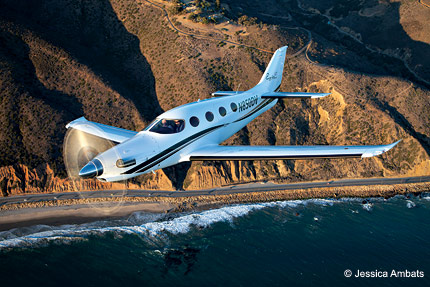
Sometimes, a name says it all, and the story of the Epic LT is nothing if not, well—epic. The story starts when you walk up to an Epic LT on the ramp. It’s big, it’s swoopy, and it’s hard to believe that it could possibly have been built from a kit. With exterior dimensions that seem a bit bigger than a TBM 850, the LT looks way too big to be a “homebuilt” airplane.
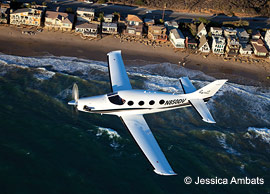
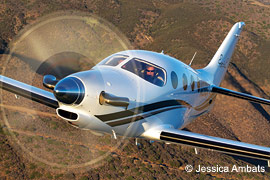
Even from a distance, the first thing you notice is that the LT looks futuristic, fast and beautiful. The front windshield smoothly swoops back to blend perfectly with the curved lines of the fuselage. Come up close and look along the wing. You’ll see that even the leading edge has a gracefully curved sweep with just the right angle of dihedral. Everything is blended and smooth, and I’ve never seen a single LT where the paint, fit and finish didn’t appear to be perfect. I should mention that I see a lot of LTs because my hangar happens to be next door to the Epic Headquarters in the high desert of Bend, Ore. And, even though I see Epic LTs virtually every day, I’ve never had a chance to fly one. So, when an opportunity came up to take a round-trip ride to Sun Valley, Idaho, I jumped at the chance to learn more about the airplane and its story.
 |
Predawn Preflight
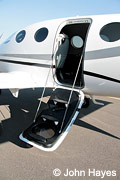
I met Rich Finley, Epic’s flight-test and training pilot on the factory ramp at 5:15 a.m. in the predawn darkness for a preflight tour of the airplane. Preflight is pretty standard for a turboprop airplane: checking fuel, oil, tires and control surfaces. The cabin is entered through a large swing-down air-stair door just aft of the wing. In this particular airplane, the cabin door serves as the only emergency exit, though newer planes also have a window-panel emergency exit on the other side of the fuselage. Large oval windows provide plenty of light, and the cabin feels modern and very large. The four comfortable leather seats in back can be arranged to all face forward or arranged in a club configuration. Ample cargo space behind the last row of seats can accommodate up to 300 pounds with additional space for bags between the pilots’ seats and the middle seats. Fill the tanks with 292 gallons of Jet A (288 useable), and you can still handle an impressive payload of 1,170 pounds in the cabin—that’s six 170-pound adults, each with 25 pounds of bags. This is a true “fill the seats and fill the tanks” airplane.
 |
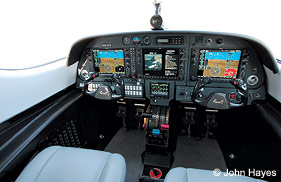
As I settled into the front left seat, I was impressed by the size of the cockpit—it’s comfortable with plenty of headroom and easy access. The large wraparound windshield provides excellent visibility with no side posts to obscure the view. The leather seat was very comfortable, though it was a bit high for me and it had no height adjustment. Which brings up an important point: The LT has evolved rapidly, so aircraft rolling out of the factory have continuously matured over time. Finley emphasized that current airplanes now include fully adjustable electrically actuated seats. Little things like the seat configuration, switch placement or even big things like avionics may vary from one airplane to the next—depending on when the airplane was built. Today, Epic offers a well-equipped “standard” LT configuration, so that buyers will know exactly what they’ll get at the end of the process. This approach also brings a high level of standardization to the fleet.
Our airplane for the day was equipped with a three-screen Garmin G900X avionics suite interfaced to a Tru Track Sorcerer autopilot and an Electronics International MVP-50P Engine Analyzer. Overall, this combination provided everything needed for state-of-the-art navigation, communication and engine management. The only thing lacking compared to the airplanes being built today was a flight director, so everything is hand-flown with “raw data.” Still, I’m comfortable with the G1000, so the G900X system felt right at home.
 Even from a distance, the first thing you notice is that the LT looks futuristic, fast and beautiful. The front windshield smoothly swoops back to blend perfectly with the curved lines of the fuselage.
Another interesting feature in this particular airplane is that the fuel tanks need to be switched manually every 20 minutes or so. It’s not hard to switch tanks—just don’t forget! The G900X is set with an alert to check fuel every 20 minutes.
 |
Taxi, Blast Off And!Wow
Starting the big PTA-67A is standard Pratt & Whitney. First, check to make sure there’s plenty of battery juice. Next, engage the starter motor, ignitors, wait for Ng to pass 12% minimum, then bring the fuel-condition lever to low idle and wait for the power to climb through 50%. The prop then comes out of feather while the condition lever goes to high idle. The whole process normally takes less than a minute. With two standard ship batteries, all of the avionics stay on, engine temperatures stay cool and the start sequence happens quickly. The batteries also provide ample backup power to get back on the ground should the starter/generator fail in flight.
Taxiing feels precise with a “big-airplane” feel, and the castoring function of the nosewheel allows tight maneuvering. Like most turboprops, it’s absolutely necessary to put the prop into beta to reduce thrust so that taxi speeds stay reasonable and the brakes stay cool.
 |
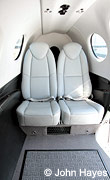 |
| The single air-stair door provides easy access to a comfortable, bright cabin with large windows. The spacious area behind the rear seats can handle up to 300 pounds of baggage. | |
Before we take the runway and push the throttles forward, Finley reminded me that this engine is flat-rated to “only” 1,200 hp for five minutes during takeoff, and that it’s important to watch all of the engine parameters to avoid exceeding any torque or temperature limits. Keep in mind that all that power produces a strong tendency for the airplane to want to go left, so a good amount of right rudder and attention to where you’re going is important while you set the engine power. Finley suggested that we use 80% torque for the power setting and rotate at 80 KIAS. I held the brakes as I ran the power lever up, and we started to roll as torque passed 30%, so I released the brakes while Finley called out torque and I watched the runway. The airspeed reached 80 knots very quickly, and we lifted off while still rapidly accelerating. The gear-up speed limit is 135 KIAS, so I quickly lifted the gear handle as the end of the runway approached. Raising the flaps and lowering the nose a bit produced 170 KIAS with the VSI showing nearly 3,000 fpm. By FL 200, we were climbing over 1,000 fpm indicating 160 KIAS, using 58% torque and 757 ITT. We didn’t work very hard to minimize our time to climb and still reached FL 270 in less than 15 minutes, which is pretty impressive.
Once stabilized in cruise at FL 270, the outside temperature was ISA+5, and we saw a true airspeed of 303 KTAS with torque showing 52%, ITT at a cool 760 degrees C and fuel flowing at 54.3 gph. Bumping the torque up to 58.7% produced an ITT of 800 degrees C (the limit is 840 degrees C), and the speed quickly increased to 315 KTAS with a fuel flow of 60.5 gph. It always takes more fuel to go faster, so if you want speed, the LT will do it. The published top speed is 325 KTAS. At normal cruise power settings, the LT can cover 1,385 nm, and if you pull the power back to long-range cruise (about 270 KTAS,) you can cover a whopping 1,628 nm with reserves. That’s extraordinary performance—kit plane or not.
The ride feels solid, the cabin stays warm, and with noise-cancelling headsets, it’s a dreamy ride. Without headsets, the particular airplane we flew seemed a bit loud up front compared to other single-engine turboprops I’ve flown. Finley explained that current airplanes include additional sound insulation, which cuts noise levels by 4 to 5 db—more than half. So, newer airplanes should be pretty quiet. As in most fast single-engine turboprops, ANR headsets make for a quiet, jet-like experience.
 |
Deice And Pressurization
This kind of turbine flying involves high altitudes and lots of weather. So, the LT is equipped with deice boots on the wings and tail and incorporates the same heated, four-blade Hartzell propeller used on the Pilatus PC-12. The windshield has an effective defrost blower, and the extreme rake angle of the windshield prevents ice buildup. Finley also explained that the engine incorporates a large intake plenum, minimizing the chance of ice-related FOD and the need for an inertial separator. The prototype inertial separator is flying in the newest LT out the door. Of course, as an experimental kit plane, the LT isn’t FIKI certified, so icing conditions must be avoided and operators are advised to exit any unexpected icing encounters. For weather avoidance, the airplane we flew had NEXRAD data supplied through XM satellite downlink. Onboard radar is an option two foreign builders have installed.
The pressurization system holds a 6.5 psi differential, which yields a comfortable cabin altitude of 7,300 feet at FL 280. An inflatable door seal keeps the cabin tight and a built-in bottle supplies oxygen in the event that pressurization is lost, though there were no quick-donning masks in the cockpit. The good news is that they probably aren’t needed since the LT can achieve an impressive 10,000 fpm in an emergency descent. Simply pull the power, point the nose down and run the speed up to Vmo of 280 KIAS (0.64M), and you can get from FL 270 to 12,000 feet in only about a minute and a half.
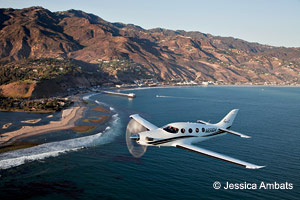
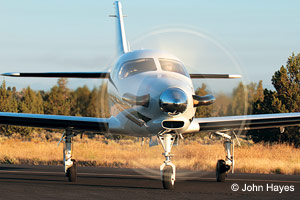 In flight, the LT follows the axiom that if it looks right, it will probably fly right.Both the curved leading edges and turned-up wing tips help the aerodynamics. On the ground, the LT sits high on beefy trailing-link gear reducing the possibility of picking up ground FOD. The exhaust stacks are canted up and outward to greatly reduce exhaust stains on the sides of the airplane. |
Handling And Landing
Once out of the flight levels, we took the opportunity to sample the flying characteristics. Handling in pitch and roll feels conventional for an airplane of this size—a bit heavy but very controllable. The rudder is lighter and provides ample control authority, so it’s necessary to use your feet and pay attention to the ball. Steep turns at 160 KIAS worked fine, though a bit challenging due to the lack of visible cues out the front windshield—the nose is quite smooth and low in the field of view. We didn’t get to try any stalls, but Finley insists that they’re benign and occur at about 63 KIAS. Setting the power to 6% torque and letting the speed come back to about 130 KIAS simulates a prop-feathered best glide. The descent rate settles around 700 to 800 fpm with a very flat flight attitude. At that rate, it would be easy to make a distant airport in the very unlikely event of an engine failure in the flight levels.
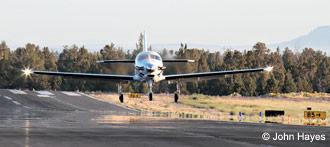
Landing the LT is straightforward using an approach speed of around 100 KIAS on final and slowing to about 85 KIAS over the numbers. Touchdown attitude is fairly flat, and the stout trailing link gear made even my first landing look pretty good. My second attempt wasn’t quite as smooth, but anyone with a little practice will grease it on with no trouble. With prop reverse, there’s almost no reason to use the brakes and the airplane feels very stable even with a lot of reverse being applied. Use the brakes and you’ll clear a 50-foot obstacle using only 1,840 feet of pavement.
 |
Doing It Yourself!How Hard Can It Be?
It seems like there are “kit” pilots and “certified” pilots with little overlap between the two. However, the performance, quality and low completion cost of $1.9 million has made the LT a bridge airplane. The design is stable, the list of standard equipment is extensive, and there’s simply no other “new” airplane of its size and performance available at anywhere near its price. Pilots who never thought they would consider building an airplane take one look and get pulled to the other side. The LT fleet is still small at only 35 airplanes, but today, the factory is full of airplanes working their way through the build process.
Owners typically spend about 14 weeks in the factory checking off 51% of the tasks needed to build the airplane. Note, that doesn’t mean that owners have to spend 51% of the time needed to build the airplane. It also means that builders work at the factory where they’re provided with gobs of expert assistance. Owners typically “finish” a very basic version of the airplane that takes a maiden flight around the pattern after receiving an initial experimental type certificate. After that, the owner can “hire” the factory to do upgrades, which often includes installing things like air-conditioning, avionics, retractable gear, deice equipment, an interior and such. The airplanes I saw in the plant all had exceptional fit and finish. In fact, the paint quality provided by Epic is hands down the best I’ve ever seen on any airplane—anywhere. Epic has worked closely with the FAA to develop and approve the whole process so that everything stays within the rules and owners end up with a high-quality end product.
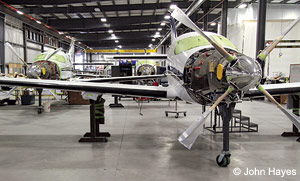
 Today, the Epic factory is full of airplanes working their way through the “production line.” Owners show up everyday on the line as they build their own airplanes. Experts are always available to provide advice or assistance when needed. The resulting fit and finish of every airplane is nearly flawless. |
The Rest Of The Story
It’s no secret that the folks who started Epic produced an exceptional design but struggled financially and ethically when it came to running the company and dealing with the FAA. A very public meltdown and subsequent bankruptcy finally happened late in 2009. In April 2010, after a contested bidding process, a federal bankruptcy judge ordered a settlement between CAIGA and LT Builders Group. That settlement resulted in LT Builders Group purchasing all the assets of the old Epic companies and then licensing limited rights to CAIGA. On March 6, 2012, Engineering LLC, a prominent Russian aviation maintenance and overhaul company, bought out the LT Builders Group. They’re currently pumping funds into the organization with the intent of fully certifying the LT, which will be marketed by the Epic Aircraft company as the “E1000” at a price of about $2.75 million. Epic LT Kits LLC will still sell the current airplane as a kit.
A lot has to happen before the airplane can be certified, but company officials are confident that they’re well along and have set a goal to get it done in about two years. The certified airplane will be FIKI certified with an inertial separator, deiced windshield, standard emergency exit, stick shaker, RVSM certification and the next-generation Garmin avionics suite, among other things. So, stay tuned. Epic, the company, not only lives on, but appears to be healthy and growing. If they can certify an airplane based on the LT, it will be an exciting product that will surely shake up the market and provide a very interesting story well into the future.


