

 |
Someone recently told me that all LSA are “fun” and pretty much fly the same. That notion challenges my beliefs. Everything in life is subjective, even scientific observation. And if you’re the least bit sensitive to your environment, you’ll probably agree that any vehicle, just like any person you meet, has a distinct feel and personality. Call it the Mazda Miata vs. VW Beetle syndrome: Every ride has its own ineffable feel.
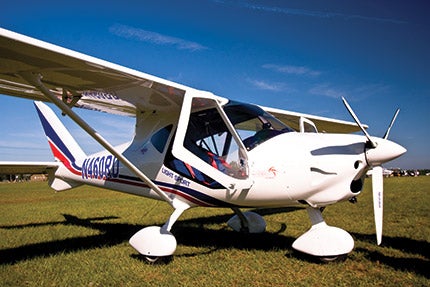
My bias was reinforced when I made my first flight in the MD3 Rider. I didn’t know exactly why initially, but I immediately felt at home in the friendly little airplane. The Rider comes from European sport aircraft maker Flyitalia (www.flyitalia.it), based near Milan, Italy. Designed by celebrated Czech designer Jaroslav Dostal, the S-LSA, which received ASTM approval in April, is conventionally built with an all-metal semi-monocoque airframe and aluminum skin. We’ll get to the design and construction in due course.
Those who volunteer to fly for LightHawk indicate that a certain sense of adventure is an asset, as they never know what sort of flight they may be asked to make. From taking researchers over a river to locate a pollution source to spotting illegal incursions in a forest preserve to transporting a sick dolphin for medical care, if it involves conservation, and an airplane (or helicopter) is an appropriate tool, there’s a good chance a LightHawk volunteer pilot will be asked to make the flight.
 |
The Anatomy Of Feel
Each pilot’s unique aviation background and experience dictates how an aircraft feels. I myself cut my teeth on sport aircraft back in the ’70s with lightweight flivvers, ultralights, sailplanes and hang gliders, so I like comfortable, stable yet responsive aircraft with balanced controls and good power performance.
The MD3 Rider is imported by Space Coast Aviation Services (www.scaviationservices.com), an LSA start-up enterprise located at Space Coast Regional Airport in Titusville, Fla., just a stone-skipping throw west of NASA’s Kennedy Space Center. Founding partners Ron Bearer Jr. and Brad Gutman hope to be major players in the U.S. LSA game, and they’ve made a good start with the Rider.
Later with all that: Let’s go flyin’! With Brad Gutman in the right seat, we get clearance to runway 36, and the first thing I notice is how well the comfortable, semi-reclined seating fits my five-foot, 11-inch, 175-pound frame. The cushions are just right—neither soft nor stiff. Taxiing the Rider is easy thanks to the steerable nosewheel. Brakes are similar to those in many other LSA, actuated by an easily reached lever just aft of the throttle and choke quadrant. The disc braking is good without being touchy. “But it will lock up the wheels if you want it to,” says Gutman.
 Powered by a 100 hp Rotax 912 ULS, the MD3 Rider is a responsive LSA that can climb at 1,200 fpm and cruise at 113 knots. |
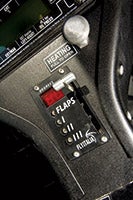
We do the run-up, then select 15 degrees of flaps for takeoff. The panel-mounted electric-flap lever setup is easy to reach and designed well. Flap settings 1, 2 and 3 are set by detent notches; corresponding values are 15, 30 or 38 degrees, respectively. In with the throttle on the 100 hp Rotax 912 ULS, and the Rider accelerates rather smartly off the runway at around 50 knots. Now I know why Gutman calls it a “little rocket ship.”
Flaps up brings little noticeable change in pitch trim—very nice—and soon we’re climbing to 2,500 feet with a handsome value of 1,200 fpm at 60 knots. And that’s on a mid-80s, humid day in Florida with two pilots possessing a combined weight of more than 320 pounds—and full fuel! In fact, the lightweight, sturdy construction and empty weight of just under 655 pounds deliver a useful load of 612 pounds, 456 pounds with full fuel. To quote Darth Vader: “Impressive. Most impressive.”
 |
A No-Drama Queen
The Rider is a natural as a trainer, as stalls both dirty and clean demonstrate. The airplane just doesn’t want to break in the stall, preferring to mush along in a nose-high attitude.
Powering back below 70 knots and selecting flap 1 (15 degrees), I again notice the minimal pitch change—a welcome characteristic for takeoffs and landings. Down and dirty at flap 3 (38 degrees) at 4,300 rpm on the 100 horse Rotax, airspeed slows to around 50 knots. Stick pressure remains firm, but not bicep-curl oppressive. A little electric trim (quick-acting and smooth, a nice feature) helps out. Rudder and ailerons remain responsive as the nose rises to around 18 degrees.
Okay, you can stall now, I think. I wait…and wait. Zippo. The stick is hauled back against the seat, between my legs, and power’s at idle, but it never breaks. Centering up with rudder, the Rider happily drones along, nose well above the horizon, at 38 knots. Descent rate is about 500 fpm.
“You could contact the ground in this attitude,” Gutman opines. “It would be a hard impact, but you’d certainly survive it.” He then forces the break by chopping power and pulling the stick back more quickly. Even then, the airplane wants to hang by its schnozzola. With a last tug aft on the stick, the Rider demonstrates that it’s indeed a conventional airplane. A slight burble, then a gentle drop of the nose is about all the histrionics we get.
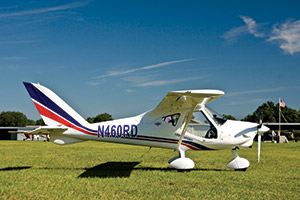
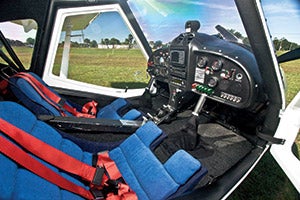 The semi-monocoque airframe and aluminum skin are enhanced by the aircraft’s shark-fin tail (above). The semi-reclined seating (left) provides for a comfy ride. |
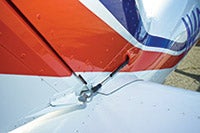
A little forward relaxation on the stick, just a touch of power, and that’s it—a no-drama queen if ever there was one. This is an LSA that flight students and veterans alike should feel right at home in. There’s plenty of power-on performance and smooth and balanced control throughout the speed envelope (the elevator/stick linkage is by pushrods, positive and with no slop), yet it’s extremely forgiving of even the most ham-handed pilotage.
Clean stalls are a similar nonevent. With no flaps and a little power, “you can fly at 40 knots all day long,” says Gutman, and we verify those numbers. Cruise with the 100 horse Rotax at 5,500 rpm brings 105 knots, around 120 mph. The specs call for 113 knots, so we fell a bit short of that. (The 115 hp 914 UL reportedly powers the Rider to the sport pilot–legal max of 120 knots, although I didn’t fly that version.) At 75% cruise and 4,800 rpm, the 100 hp mill delivers 90 to 100 knots (depending on payload weight) at a 4+ gph fuel burn, typical for the Rotax in the LSA class. The $20 hamburger is back.
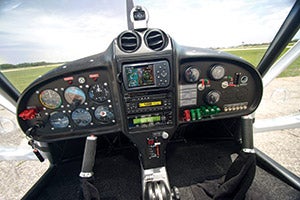 The fully equipped MD3 Rider features steam gauges and Garmin electronics. The electric-flap lever (below) is easily reached and user-friendly. |
Balancing Act
Overall, everything about the Rider feels in balance. Pitch, yaw and roll forces seem equivalent and harmonious. The rudder helps coordinate things, but it isn’t a major factor in comfy flying. Overall, the airplane reminds me of a light touring motorcycle: comfortable on the long haul, but responsive enough to handle the mountain twisties.
Fuel management is a breeze—turn on one wing tank, turn off the other with the rotating toggle levers on the panel in front of you. Cabin visibility is expansive thanks to the wrap-over-top windscreen and low side rails on each door, which give you a steep down viewing angle. There’s also plenty of shoulder room, with 46 inches from door to door—no claustrophobia from this flivver.
Landings are also a snap. Gliding down on short final at 50 knots, my host has me feed in a little power to flatten the glide when my descent rate gets a bit high. Plop, on she settles without histrionics—in the low 30s! After some short-field takeoffs (hold with brakes, flaps at 15 degrees, full power, release—and off we fly in a very short distance), we land on grass. The Rider handles all challenges with equanimity.
Looking back, what I remember most is the ease and pleasure of flying the MD3 Rider. Can’t wait to hop it again, and what higher praise can you give an airplane than that?
 |
A Little Tech Music, Maestro
The Rider’s construction features a fuselage cockpit cage of chrome-moly steel in a triangulated design for max crash protection. Tubes are laser cut and TIG welded into a framework made up of 150 triangles. The aluminum wing and fuselage skins are primary-glued and pop-riveted. The contoured carbon-composite engine cowl and rear canopy fairing lend a smooth, sleek aesthetic that’s enhanced by rounded instead of squared-off fuselage sides—and designer Dostal’s trademark shark-fin tail.
A 13-gallon fuel tank is built into each of the wings. The tricycle gear sports sturdy composite-construction main legs. Aircraft-grade AN hardware, not a standard on all LSA, is used throughout.
The MD3 Rider comes fully equipped with steam gauges and Garmin electronics (SL40 radio, GTX-327 digital transponder with Mode C and color 296 GPS, also intercom, electric flaps, wheel pants and other features) for $115,995.
Basic LSA VFR models without radios go for $93,995 for the 80 hp version, $99,995 for the 100 hp model. A BRS all-airplane parachute system and folding wings are offered as options.
SPECS: Flyitalia MD3 Rider
