

 |
Cruising under power through footless halls of air, Jim Lee and I thread our way between vaulting rises of cotton-edged clouds. Under one big cumulus high-rise with a flat, dark-gray bottom and a wispy penthouse, we feel a promising bump of lift. It’s thermal-chasin’ time!
“Okay, let’s go to idle,” says Lee, head of Phoenix Air USA. He talks me through the beautifully sculpted bird’s five-second engine-shutdown sequence. I reach forward, turn off the radio and transponder so they don’t get an amperage surge, and then, (gasp!) turn the engine key to Off. The 100 hp Rotax 912 ULS stops immediately, as Rotaxes do. I flick the optional electric “prop arm” switch, the two-blade carbon-fiber paddle feathers itself, and the world of mechanical noise fades away.
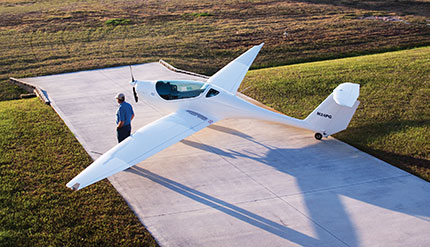
Beyond the long, graceful canopy bubble, the relative wind rushes over our ultraclean airframe. It’s a warmish, balmy east Florida afternoon. Before takeoff, we saw buzzards working the thermals that popped after the morning overcast. Now, no birds anywhere—not a promising sign for soaring. We slow to 60 knots and start hunting. The left wing rises up strong; I move the stick left to turn into the thermal. Over the hissing breath of the wind, we can hear the variometer beep—now faster, indicating climb, now slower, to a low monotone: That’s sinking air, stay away from that!
Lee talks me through a couple of proper high-bank turns to center up in the lift, with a notch of flaps (the manual detent lever selects four positions: -4 for cruise, 0, +5 and +10 degrees) to increase lift and slow to our best minimum sink speed of 45 knots. The rapid vario beeps reward us with the song of climb all the way around the 360. In five minutes, we’ve circled up several hundred feet, completely on the energy of the thermals, though it’s a marginal lift day.
 |
Before long, we’re down to Lee’s personal power-off safety minimum of 1,500 feet. We restart the engine, motor back up to 3,000 feet, and head north to explore under more clouds.
The Ideal “Hybrid”?
I could way too easily spend all my words exulting over the total pleasure of flying the Phoenix. It’s effortlessly enjoyable—under power or turning silently in lift. If a powered sailplane lives in your house of dreams, I’d be remiss not insisting you arrange a demo.
Phoenix is about as easy to land as any LSA, even in the long-wing configuration (plug-on, swappable tips yield a 36- or 49-foot span). I had anticipated needing to stay on top of those long 15-meter wings, but full-span flaperons give you all the roll control you need, right down to flare speeds. Suh-weet!
The 5- and 10-degree flap settings are useful for lowering soaring speeds. Landings are typically done with the effective midwing spoilers, which bestow powerful command over final glide-slope. “Think of it as having a gas pedal,” Jim says. “If you’re coming up a bit short, back off on the spoilers.”
 |
My first landing was surprisingly easy. The Phoenix has a tailwheel like most gliders, but no tailwheel endorsement is required since it’s classified as a glider. Regardless, the nose angle right at three-point touchdown and during taxi is modest: It’s no sweat seeing over the panel glare shield. A hand brake on the stick is effective and intuitive to use. Lee describes three-pointers as “autoland.” The 40 pounds of downforce on the tailwheel gives sufficient control up to crosswind speeds he says you wouldn’t want to fly in anyway.
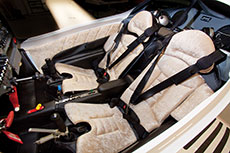
The cockpit is soooo comfortable: The reclined, thigh-supporting seats fit well and optimize both power-cruising comfort and the need for low-frontal-drag soaring aerodynamics. Phoenix can cruise 900 nm (eight hours!) at 118 knots (36-inch wing) at 5,000 rpm on one 26-gallon tank-up (two wing tanks of 13 gallons each)—better than many leading power-only LSA. Even with the 15-meter span, you get 114 knots!
 |
Best Of Both Worlds |
| Powered airplanes must land when out of fuel. Sailplanes must land when out of lift.
But a motorglider like the Phoenix—ah, the simple, sophis-ticated genius of it—frees you from the prime shortcomings of both. Motorgliders let you motor up to the lifting air, shut the engine down, feather (streamline) the prop, then soar as long as you want without burning a drop of fuel. At day’s end, or if the lift peters out, restart the engine and land…or go hunt for another thermal or wind-facing ridge. Pure heaven! Advertisement
Motorgliders have captivated designers’ and pilots’ dreams for decades. They free pilots from the confinements of tow planes, winch launches, remote landing retrievals, and the need to stay close to airports on marginal days. There are two basic types: touring motor gliders (TMG) and self-launchers. TMGs compromise between conventional airplanes and sailplanes. They typically have extended wingspans and can be power-flown for hundreds of miles. They also soar, engine-off, reasonably well. Self-launchers (and their subgroup, sustainers,) exhibit higher-soaring performance, but carry only small engines with retractable props that stow in the fuselage for soaring. Self-launchers can climb. Sustainers can only fly level or extend glide, and are typically towed aloft. Several features make the Phoenix special as a TMG, most notably its variable wingspan, thanks to two separate plug-on wingtips. Advertisement
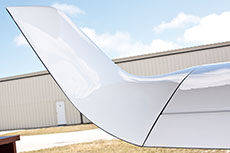
The “short” tips provide a 36-inch span for typical powered cruising flight and makes hangaring easier. The longer “soaring” tips give Phoenix a full 49.38-foot span (15 meters), which promises solid soaring performance. The wing and sleek airframe deliver, too, with an excellent 32:1 glide ratio and 200 fpm sink rate. Not that long ago, the top unpowered sailplanes couldn’t perform that well! |

Phoenix can climb as high as any sailplane (service ceiling is over 20,000 feet, Lee tells me), assuming you have a glider rating, which two CFIs can bestow after appropriate training. And since it’s both LSA and glider, it can be flown with the private, sport pilot or glider ratings. Older rated pilots, take note: You can legally fly the Phoenix even if you’ve lost your medical…because it’s classified as a glider. “It doesn’t matter whether the engine is running or not,” says Lee, “it is always a glider.”
Burnishing its worthiness as a cross-country power plane, Phoenix’s baggage potential of 100 pounds (and eight cubic feet of storage area) also beats many nonsoaring LSA. Its useful load of 612 pounds means two average-weight male passengers (say, 165 pounds and 200 pounds = 365 pounds) can still carry full baggage and enough fuel for a five-hour flight! And cockpit width is “American-sized” at 43.5 inches. Flying with Lee, who’s close to my 5′ 11″, 175 pounds, was downright comfy.
At flight’s end, pull off Phoenix’s sleek, removable wing extensions, and you’re down to 34 feet of span, narrow enough to fit most hangars.
The airplane is well appointed. You get cabin heat; dual pushrod control sticks for solid, instant feel; dual cable-actuated rudder pedals; good, effective air ventilation; cabin heat; tinted canopy with defrost; and a Magnum Ballistic Parachute System (standard)! There’s even a “music-in” jack for playing your tunes.
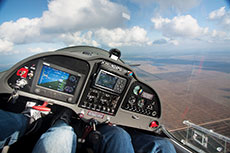 |
The panel’s low profile supports the soaring mission well, while still offering plenty of real estate for about any instrument desired. The version I flew sported a TL Elektronic Integra EFIS, Garmin 496, tidy little Becker COM and transponder units, autopilot, a Tasman electric variometer, PS Engineering PM 3000 intercom, a couple of steam gauges (altimeter and airspeed) and circuit breakers—with room to spare.
Built To Fly
There’s more to appreciate about Phoenix’s cockpit setup, but let’s get back to the fun stuff: its sophisticated aerodynamics.
The all-carbon-fiber-composite construction helps deliver that large wingspan without skimping on payload. Czech Republic designer Martin Stepanek deserves kudos for optimizing interior space, overall strength (+4 to -2 Gs useful load), sumptuous flowing lines, docile handling under power, excellent and responsive control while working lift, and sublime power-on performance.
Letting your eyes linger on the airframe informs the diligence applied to minimizing drag. As Lee notes on his website, the clean, curving flow of the cowling continues without disruption through the line of the clear canopy, and the cockpit area tapers fluidly into the boom-like aft fuselage.
Cowling wraps elegantly around the beautiful engine installation that Rotax guru Dean Vogel praised…and he’s seen a lot of them. Even the gear legs flush up with the bottom of the fuselage, and as Lee says, “The legs themselves are clean and strong.” Nothing seems to have been overlooked in the quest for minimizing drag.
Quest For Air
Lee graced me with two separate flights totaling more than two hours. The short-wing (36-inch-span) version felt very much like a top-line LSA cruiser. In the afternoon, he plugged on the 15-meter extensions, and we spent an hour thermaling in the weak lift. Turns, climbs and descents for both versions were smooth and solid. The controls are well placed and feel just right. It’s just a wonderful airplane to fly in either mode.
We pulled stalls, straight ahead in climb and descent, and in high-bank turns typical of thermaling speeds. Stall behavior? Nominal, with no nasty habits. Phoenix really holds onto a tight bank, great for rising up in tight-cored thermals. The onset-stall-warning buffet is easy to distinguish, and recovery is typical of any quality nonsoaring LSA—just feed in some forward pitch, and you’re flying again.
Roll rates are surprisingly brisk, even for the long wing: a bit over three seconds, 45 degrees to 45 degrees. And the shorter wing? Downright snappy at two seconds! Thank the full-span flaperons (both short and long wings).
If the adventure of sailing the living energy between earth and sky using both gas and sun-fueled power is calling you, don’t even hesitate: Contact Jim Lee and treat yourself to this dream-come-true work of aerodynamic art.
