

 |
Cleveland Center, ciao! Avanti 180PA checking in, flight level 280.”
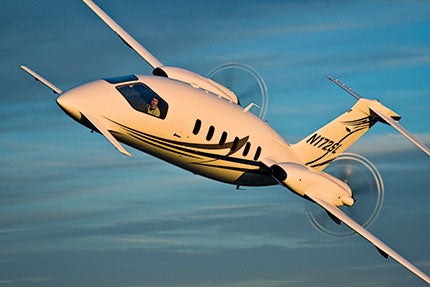
It’s almost too easy to call the Italian Avanti II the Ferrari of the skies, and from the moment I floored the Avanti this morning on a wintry runway in Halifax, Nova Scotia, Canada, I was plastered into my seat like I was in a Ferrari 430 Spider with the top down, stiff breeze mussing what’s left of my hair, pealing away from a red light that lasted a few seconds too long. The only thing missing was the squeal of Pirelli tires and the smell of a heated clutch and scorched rubber.
Of course, tires do me no good on the jet route we’re making serious tracks down, and it seems the engineers at Genoa-based Piaggio Aero Industries SpA left one item off the Avanti’s checklist—adrenaline on.
I got my first shot of Avanti adrenaline about a year and a half ago in the skies above Portofino, on the Italian Riviera. The plane I flew then, an Avanti I model emblazoned in Maserati colors, was as much an object of desire as the exotic Italian supercars that share its bloodline.
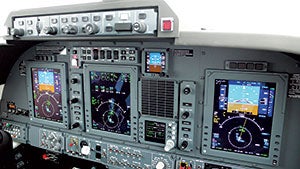
This morning, when I clambered into the factory-fresh Avanti II in Halifax, I was greeted by a new panel, the Collins Pro Line 21; new and more-powerful-at-altitude PT6A-66B turboprop engines; and a new max gross weight of 12,100 pounds, up from the Avanti I’s 11,550. With this allowable weight increase, the Avanti II’s owner can now fill the tanks, fill the seats, add some bags and go.
 |
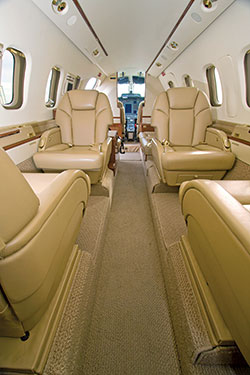
The P.180 I’m flying for this report is “green” in more ways than one. Piaggio’s Bill Hauprich, with whom I’m flying today, began his trip a couple days ago at Piaggio Aero’s base in Genoa, and arrived in Halifax yesterday after stops in Edinburgh, Scotland; Reykjavik, Iceland; Narsarssuaq, Greenland; and Goose Bay, Labrador, Canada. Because all Avantis bound for North America get their interiors at Piaggio’s U.S. base in Denton, Texas, the slick bird we’re flying south has no interior behind the flight deck. But this Avanti is also that other green, as in the most ecofriendly and efficient turboprop aircraft on the market today. It’s also the only turboprop to break 400 knots carrying eight people in midsize cabin-class comfort while burning up to 40% less fuel than any of its competitors—but more on that in a minute.
 |
Wanna Race?
The P.180 Avanti II says ci vediamo, or see you later, to all VLJs, besting the Eclipse by a touch above 30 knots and the Citation Mustang by about 60 knots. It leaves the Citation CJ1+ behind by 13 knots and trails Cessna’s CJ2+ by only about 15 knots—and it does that with a larger cabin than all of them. Fly the fastest King Air, the 350, at its optimum altitude and lightest weight, and the Avanti II still dusts it by more than 85 knots.
A lot has happened with the “green” movement since my sortie in the skies over Portofino, just south of Piaggio Aero’s headquarters in coastal Genoa. As I sit to write this, representatives from over 189 countries have recently wrapped a huge global-warming conference in Bali, Indonesia. At that conference, fuel efficiency was one of the top issues. On that front, the Avanti doesn’t disappoint. So while the high-achieving, sophisticated and discerning operator of an Avanti will find the plane compelling in performance and striking in ramp appeal, his or her accountant will be impressed by significantly lower fuel bills.
A snapshot comparison of fuel flows to a Citation CJ1+ shows considerable fuel savings at similar speeds. At FL370 under standard, ISA conditions, the Citation, at midcruise weight and normal cruise power, scoots along at 385 knots burning 787 pounds of fuel per hour. Conditions and altitude being equal, to see the same number as the CJ1+, push the Avanti to maximum continuous power, and the P.180 will clock 380 knots, just five knots slower than the Citation, but burn only 598 pounds of Jet A per hour to do it—an hourly savings of 189 pounds.
I’d expect nothing less from the artisans and alchemists of Piaggio. Perhaps because I lived in Italy for two years, it comes as no surprise that to the Italians—who gave us drool-worthy autos from marques like Ferrari, Maserati, Lamborghini and Alfa Romeo; the achingly elegant Wally Yachts; and the cute little Fiat Cinquecento (500), recently updated and reintroduced—producing a boring and ordinary aircraft would be assolutamente impossibile. If anything, I’ve never known the Italians to do anything in a boring way—at their own pace, yes, but never boringly. That would be like the Swiss running their trains at their leisure and tourists finding only delicious food in London.
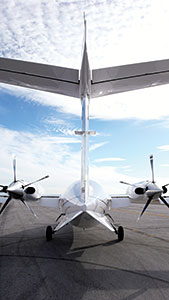
If the sky were an ocean, and in reality it is, an ocean of air, and since air is a fluid, then the organic and almost aquatic shape of the Avanti contributes significantly to its efficiency. Though the Avanti reminds some of a catfish, I like to think of it more as a hammerhead shark. Those unfamiliar with the P.180 might think at first glance that the Avanti is a canard aircraft constructed of composite materials, not unlike the Beech Starship, a Burt Rutan design that was literally scrapped not long ago.
On the contrary, the Piaggio is about 90% aluminum, with composite and titanium comprising the balance, and that front flight surface—it’s called the front wing. When I sat down in Genoa with Enrico Sgarbi, head of media relations at Piaggio Aero, and a few company test pilots, I learned that the Avanti was designed as a three-lifting-surface aircraft. Therefore, the front wing isn’t a canard, because it has flaps only and is otherwise a fixed surface.
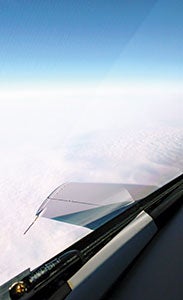 |
In another departure, the P.180’s conventional horizontal stabilizer provides positive lift, as opposed to negative lift in conventional aircraft. Sporting laminar-flow airfoils developed using NASA-proprietary methodology in a collaboration with Dr. Gerald Gregorek of Ohio State University, this three-lifting-surface design allows the P.180’s main wing surface area to be 34% smaller proportionally than in a conventional aircraft, thereby increasing efficiency, reducing drag and offering a high-wing loading, similar, I’m told, to that of a Boeing jet.
Piaggio Aero also broke new ground in how the Avanti is constructed—essentially from the outside in, where the outer skin is held fast in a vacuum-powered jig as interior structure is installed. Tolerances are thusly very tight, the external skin is composite-like in smoothness and contour, and fit and finish is what one would expect in an aircraft of this price point.
Sgarbi told me that Piaggio has been ramping up and streamlining production to make more of a dent in their 100-plus aircraft back order. This adjustment to lean manufacturing, for which they were consulted by Porsche, is being incorporated into Piaggio Aero’s new, state-of-the-art manufacturing facility, set to come online this year in Villanova d’Albenga, outside of Genoa, where final assembly will remain. About 70% of production heads for America with fractional-operator Avantair, Piaggio Aero’s biggest customer. In 2008, according to Eric Hinson, Piaggio America’s CEO, from a total production of 37 aircraft, 22 will be delivered Stateside.
Somewhere over western New York and making a serious beeline toward a pit stop in Bowling Green, Ky., Hauprich mentions that Piaggio spent five years on the design of the P.180, which first flew in 1986. Two decades later, the future is finally catching up with the Avanti II. Besides bolting new, deeper-breathing PT6A-66B engines into the lightweight titanium engine mounts, the incorporation of the Collins Pro Line 21 electronic-flight instrument system (EFIS) brings the Avanti II squarely into the 21st century.
While I have considerable time on integrated flat-panel displays, the Collins system was new to me. Excepting the alphanumeric flight-management computer, the Pro Line 21 system is intuitive and easy to use. It only took a few hours for me to get mostly up to speed on its knobology and find my way around the flight deck. The Avanti’s Pro Line system comes standard with what pilots expect—L-3 TAWS terrain avoidance and TCAS I active traffic systems, Collins turbulence-detection radar, and options for XM Satellite Weather, enhanced map overlays and electronic charts for the MFD. Mix in the Avanti’s fine flying qualities and some time studying the P.180 at FlightSafety, and a pilot stepping up from, for example, a Socata TBM 850, where I have the lion’s share of my turbine time, should have no problem. The Avanti II isn’t a low-workload airplane, but it’s easily single-pilot.
After an ILS to runway 03 at Bowling Green and a quick refueling through the P.180’s single-point pressure fueling system, Hauprich and I say “ciao” to the friendly folks of BWG and taxi for takeoff. The Avanti II has two stearing modes, Taxi and T/O, which are controlled by a switch on the pilot’s control wheel and annunciated on the pilot’s PFD. With carbon brakes (interestingly, ABS isn’t available) that can be touchy but work better when heated, and steering-by-wire that’s rather sensitive in Taxi mode, the P.180 takes a deft touch on the ground. Lining up for takeoff from BWG and cleared to go, I throttle up to ballpark about 90% or 95% torque and click off the T/O steering mode at 60 knots, relying on aerodynamic steering for the rest of the dash to rotation speed, 106 knots. With ram air bringing our power up to 100% torque, I smartly tug the control wheel to about seven degrees and then relax pressure a bit to keep from over-rotating, and we accelerate to our best climb speed of 160 knots indicated and 2,500 fpm through FL150. Our climb rate decayed to 1,600 fpm through FL280. Had I rotated to 13 degrees alpha, we would have been on the express elevator to the flight levels at 3,300 fpm, at the cost of much forward visibility. As it was, we were level and accelerating to cruise speed about 12 minutes after departure. I was limited on my flights to FL280 and below because P.180s flying over from the factory for completion in the States aren’t yet RVSM capable; they get that in Denton.
 |
With that in mind, the new engines in the Avanti make their rated 850 SHP to a higher altitude (FL240) than engines in the earlier model. As it is, the sweet spot for speed in Avantis, and most other turboprops, is between FL260 and FL310, where the P.180 will crack 402 knots true at its lightest weights with 95.4% torque, the power drain of ice protection off and props full-forward at 2,000 rpm, while burning 794 pounds of Jet A per hour. In a turboprop, that’s really moving, but it’s also a bit noisy. When I was down at FL280, in high gear and cruising to Denton, Texas, torque was set at 95%, propellers were turning at 1,995 rpm, true airspeed was stable at 380 knots or Mach .668, and fuel exited the tailpipes at 395 pounds per hour per side.
Back in the cabin, to get jet-like sound levels and smoothness, dial the props back to 1,800 rpm. At FL310 in standard ISA, setting 96.6% torque will get you down the road at 385 knots true burning 736 pounds total, which is still not too shabby. Up at FL410, the Avanti II will still true out to about 325 knots, but burn only 412 pounds per hour total. Contrast that with the King Air 350, which according to Beech, will true out at 310 knots burning 604 pounds per hour at FL310. Avanti pilots consider the P.180 similar in cost per hour to the King Air, but since leg times are shorter, cost per trip is rather less.
In addition to the jet-like speeds and sound levels that passengers enjoy back in the midsize cabin, the Avanti’s 9.0 psi pressurization system ensures passengers and crew a sea-level cabin up to FL240 and a 6,600-foot cabin at the Avanti’s max altitude of FL410.
Bringing the Avanti on home, the P.180’s high gear- and flap-extension speeds, 181 and 170 knots, respectively, facilitate slowing the speedy bird and setting up a stable approach profile. The weather in the Dallas area was clear and calm as the Texas sky transitioned from bright orange in the west to a cobalt dusk. Landings in the Avanti—I went up and did some airwork and a series of touch-and-gos the next afternoon—are a nonevent. The Avanti is as honest as they come in its handling and around the airport. Keeping your speed up at 140 knots on downwind and decelerating on final from 130 to 120 over the numbers will reward the Avanti pilot with sweet touchdowns—it worked for me. The biggest problem I found with the Avanti came after my flight. After about seven hours flying an exotic Italian speedster, there was no Ferrari waiting to whisk me away to dinner in Dallas. Maybe that’s an option Piaggio should consider.
