
 |
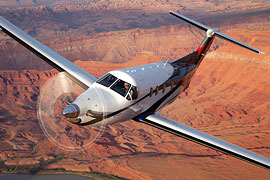
It only takes one low-level flight through southern Utah to see why many consider it to be one of the most beautiful places on the planet. It’s not just one spot, mind you, but, the whole southern half of the state. We’re talking about Zion, Bryce Canyon, Grand Staircase-Escalante, Canyonlands, Arches, Capital Reef, the north rim of the Grand Canyon, Monument Valley, the LaSal Mountains, Kodachrome Basin and everything in between. There’s a good reason that there are five national parks, multiple national monuments, numerous state parks and a wide scattering of recreation areas in this small region. Whether the spectacular hiking, technical rock climbing, whitewater rafting, backcountry roads, mountain biking, canyoneering or raw scenic beauty draws you, there’s no better way to get around and take in the vast scenery than by airplane. So, when the invitation arrived to fly a brand-new PC-12NG around the wilds of southern Utah with Vaughn Olson of Western Aircraft (www.westair.com), I jumped at the chance to check out the new airplane while doing some sightseeing over my favorite desert stomping ground.
We agreed to meet at the Canyonlands airport (KCNY) outside of Moab. Even though the airport is non-towered, it’s served by Great Lakes airline service, and there can be a lot of traffic—particularly when the jump zone is active and sightseeing aircraft are operating. The 7,100-foot runway looks recently resurfaced and is in great shape. The friendly folks at Redtail Aviation provide fuel and parking; Enterprise offers car rentals. Just keep in mind that the airport is about 16 miles from Moab, so you’re in the middle of nowhere when you step out of your airplane. Still, Moab is the gateway to Arches and Canyonlands National Parks, as well as a common put-in for numerous white-water rafting trips on the Green and Colorado rivers. Moab can get overbooked when the weather is nice in the spring and fall, so it’s best to make reservations ahead of time—even for the campgrounds.
 |
The PC-12NG
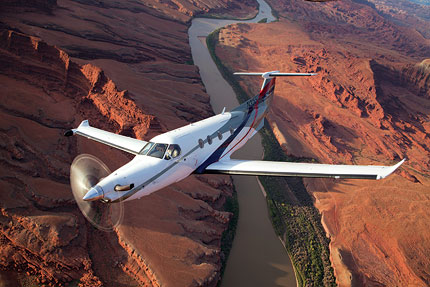
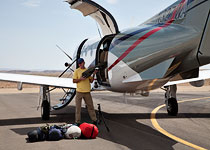
As Vaughn pulled onto the ramp, it was hard not to be amazed by the size of the PC-12NG—it’s indeed a great big airplane. With a wingspan of over 53 feet and a length of a little more than 47 feet, the PC-12 occupies similar ramp space as a King Air 250 or a Citation 3. The large forward airstair and high-gear stance combine to create a stately presence. Walk around the airplane, and you’ll quickly notice that there’s nothing lightweight about the PC-12NG. Everything from the trailing-link gear to the cabin doors up through the T-tail is built hell-for-stout with near-perfect fit and finish. The large 52×53-inch rear cargo door made it easy to load a full compliment of camping and climbing gear along with a couple of inflatable kayaks—just in case!
The Pilatus PC-12 is a remarkable airplane, so I was eager to try it out on a sightseeing run. Whether you need to get to a distant business meeting or into the backcountry with four friends, a couple of mountain bikes and supplies for three weeks, the PC-12 can make it happen in style. This Swiss-made overachiever is built to handle the rigors of short dirt strips in the backcountry and yet mix it up with jet traffic back in the city. With a single, highly reliable Pratt & Whitney PT6 turboprop engine, the speed, range, load-hauling capability and operating economics of the PC-12 are hard to match. Still, Pilatus has taken the new PC-12NG to a new level of performance and capability with the addition of even more horsepower and the SmartView synthetic vision system.
 |
Cabin size and versatility have certainly played a key role in the success of the PC-12. Pilatus offers multiple seating and cargo configurations, and the brand-new airplane we flew is equipped with the six-seat executive configuration. Six widely spaced, large leather seats, five with foldout tables, provide unsurpassed comfort. Each seat is on a swivel and can slide sideways so that it’s easy to get comfortable and stretch out. While it’s not quite a stand-up cabin, the 330 cubic feet of space feels quite spacious with tasteful wood trim, recessed lighting and window shades. Each seat is equipped with a backlit entertainment system outlet. The size, fit and finish of the cabin is on par with the highest-level business jets—many costing more than the $4.6 million price of the Pilatus. The large netted baggage area in the rear of the fuselage can accommodate up to 40 cubic feet and 400 pounds of baggage. As an added bonus, the newest /47 series of the PC-12NG now boasts a 530-pound increase in useful load over the earlier /10 series models. Immediately behind the cockpit, there’s a full-width lavatory that’s handy on longer flights.
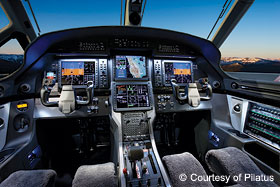
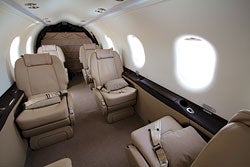 The capability of the Honeywell Primus Apex avionics system provides features found in many business jets. WAAS, synthetic vision, keyboard input, trackball cursor control, charts, data link weather and multiple screen redundancy make data management easy. The executive cabin option features a spacious interior with a flat floor and six large leather seats that can swivel and slide to the center of the cabin for increased shoulder room. |
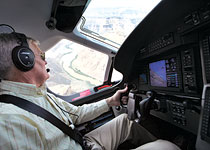
As Vaughn closed up the doors, I moved into the cockpit and took the front left seat. It felt like I was settling into a transport category jet—it’s huge! The cockpit has plenty of shoulder and headroom with excellent forward visibility. The Honeywell Primus Apex avionics system features four 10.4-inch diagonal high-resolution screens—two PFDs and two vertically arranged MFDs. Gear enunciation is displayed on the lower MFD, and engine gauges and comm frequencies appear on the side of each PFD. The center console contains a data-entry keypad, flap controls, power levers and a hand rest with a trackball cursor control device. With two main ship batteries, starting the big turboprop engine couldn’t be easier. Simply throw the starter switch, and when the gas-generator speed (Ng) passes 13%, put the condition lever into ground idle, and that’s it. All the avionics stay on during the start. There’s no prop RPM control lever, so it’s a single power-lever operation eliminating the need for any run-up.
The PC-12NG boasts the new P&WC PT6A-67P engine with 1,744 thermodynamic hp, flat-rated to 1,200 hp. It’s important to understand that turboprop engines work like non-turbocharged piston engines, losing power as they climb. By limiting or flat rating the engine to a power well below the maximum possible power, it’s possible to produce full flat-rated power during the climb.
Most turboprop engines are limited by maximum torque values at low altitudes but become temperature limited during the climb as the engine has to work harder to compress thinner air. The new -67P engine features single crystal alloy turbine blades with higher temperature limits for increased thermodynamic power. This provides additional power during the climb and during cruise over the previous -67B engine. At gross weight, the NG climbs at over 1,900 fpm and boasts a maximum cruise speed of 280 KTAS. Climb to FL 300, and at maximum power, you can cover 1,560 nm with NBAA reserves. Slow down to around 250 KTAS, and you can go nearly 2,000 nm on a full tank of 402 gallons of Jet A. For our mission, this kind of range makes it easy to hop between numerous unattended fields all over southern Utah before even coming close to running low on fuel.
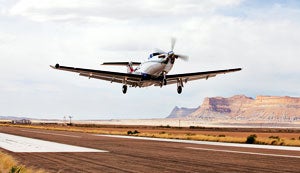 PC-12/47NG takeoff and landing performance is remarkable. At max gross weight, the takeoff ground roll is only 1,450 feet, and a 50-foot obstacle is cleared in only 2,650 feet. At max landing weight, only 1,830 feet is required to clear a 50-foot obstacle and get stopped. With reverse and maximum braking, the landing ground roll is an astonishing 945 feet. |
Steering the PC-12NG on the ground is completely conventional through the rudders, and taxiing felt completely familiar, though I was careful to watch those long wings. As we lined up on the centerline of runway 21 and brought the power lever all the way up to the stop, things began to happen fairly quickly. The amount of right rudder needed to keep the roll straight seemed considerably less than other single-engine turboprops I’ve flown. We did a short-field takeoff, and it was amazing to see firsthand how effortlessly the airplane flies off at very low airspeeds—we were airborne at around 70 KIAS. That just seems way too slow for an airplane of this size; but the PC-12 handles it quite easily.
From the beginning, a unique safety feature of the PC12 has been the use of an angle-of-attack (AOA) indicator. The Honeywell Primus Apex system makes it particularly easy to fly optimum AOA for each phase of flight by simply lining up indicator carrots. If you like, you can forget about recommended airspeeds and simply fly AOA to achieve the proper airspeed for any weight and configuration. If you really aren’t paying attention and you do manage to get close to stalling the airplane, the PC-12 is equipped with a stick shaker and pusher to help even the most inattentive pilot keep the AOA within safe boundaries. So as we climbed out, I merely held the AOA at the optimum value for the climb.
In a few minutes, we leveled off at 10,000 feet, and in cruise, the airplane is a delight to fly. With the NG model, Pilatus has added servo tabs to the ailerons to improve the heavy roll forces characteristic of the older PC-12s. This change helps produce much more harmonized controls. Still, it takes more than a light touch to move the controls, but that’s pretty normal for an airplane in this category.
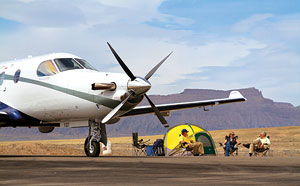 There’s no need to sacrifice speed and comfort to have some serious fun—this is close to a “take-it-all” airplane. The PC-12/47NG can accommodate bicycles, motorcycles, jet skis, kayaks, and of course, gobs of camping gear. |
From Canyonlands, we headed to the nearby unattended Green River Municipal Airport for some practice landings. If good landings are how your passengers judge your skills, you’ll look like a superstar in the PC-12. Add the first notch of flaps, lower the gear, go to full flaps, open the inertial separator, and you’re ready for the approach. The beefy trailing-link gear makes for a smooth arrival with only a small flare. Even though the winds were howling across the narrow runway, my first touchdown still felt smooth and under control. The brakes are conventional without anti-lock, so it’s important to be careful about touching the pedals while the plane is still light on the gear. We had plenty of runway, so I lifted the throttle past the gate and applied reverse to slow our speed before touching the brake pedals. As with all turboprops, some care is needed to avoid kicking up ground debris into the engine, so it’s best to use wheel braking below about 40 knots.
As we pulled to a stop, shut down and stepped outside, empty desert stretched to the horizon. Which brings up a point about being prepared when flying into the backcountry in this part of the U.S. This is the desert, and it’s essential to have an adequate supply of water and to let folks know where you’re headed in case you get stuck somewhere. Don’t forget that density altitude can become a huge factor in the summertime, so a little planning goes a long way.
 |
 |
A Little Sightseeing!And Terrain Avoidance
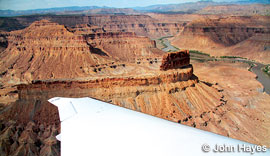
After some photo work on the ground, we departed for some airborne sightseeing. We stayed low to weave our way through the wide, rugged canyons carved by the Green River as it winds its way south toward Canyonlands, where it joins the Colorado before entering Arizona and the Grand Canyon. In the distance, the snow-covered peaks of the LaSal Mountains sparkled in the late afternoon sunlight. The Green River looked a bit like it sounds—a grey-green color with banks lined with ribbons of green trees that contrast with the red canyon walls.
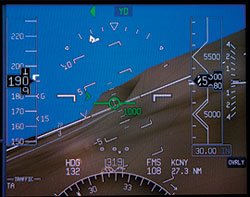
It was late in the afternoon, and desert thermals made for a bumpy ride, damped somewhat by the high wing loading of the big Pilatus. Still, it was a good opportunity to see how the new SmartView synthetic vision system performed as we wound our way through the twists and turns of the canyon. One unique feature of the SmartView system is that it displays path-based flight information referenced to a zero-pitch reference line, which makes it easy to achieve level flight at all times. To test the synthetic vision system, we leveled momentarily the see the zero-pitch reference line showing where we would impact the far wall if we maintained the present altitude. It was an impressive demonstration of the capability of the new synthetic vision system and the improved situational awareness it can provide with respect to terrain and any desired flight path.
Even with all the cool equipment in the cockpit, it was hard to keep my eyes inside. The scenery in the area was just too spectacular to miss. With the sun sinking low in the west, we finally turned back toward Canyonlands airport, where we planned an evening camping under the stars just outside of Moab. Sightseeing over southern Utah in any plane, not to mention a brand-new PC-12NG, is a trip you’ll never forget. It just doesn’t get any better than this.
Southern Utah Flying Adventures |
|
| Moab Area If you’re interested in camping in the Moab area, the BLM provides a website with a list of maintained campsites at www.discovermoab.com/campgrounds_blm.htm. The hiking and scenery at Arches National Park is unforgettable, and be sure to take the drive out to Horseshoe Point in Canyonlands National Park. The view over the confluence of the Colorado and Green rivers is one of the most spectacular in the world. Owned by Rod and Paula Tangren, Caveman Ranch Resort (www.cavemanranch.com) is 20 miles down the Colorado River from Moab and features a 3,000-foot gravel airstrip. Ground-based activities include river-jet boat rides, Jeep tours, skeet shooting and gold sleuthing.
Bryce Canyon National Park Zion National Park |
|
| Western Aircraft | www.westair.com | |
In addition to providing first-class FBO services, Boise-based Western Aircraft is an FAA-certified service station and has been an authorized Pilatus PC-12 dealer and service center since 1996. In 2004, Pilatus Business Aircraft named Western as the “Dealer of The Decade” for selling more PC-12s than any other PC12 dealer in the first 10 years of PC-12 production, and in 2005 as the “Service Center of The Year.” In 2005 and 2006, Western was the top PC-12 dealer in the U.S. The company has delivered over 165 new and 30 pre-owned PC-12s. The PC-12 experts at Western can arrange demo flights, answer questions and arrange service for existing owners. |
|