

 |
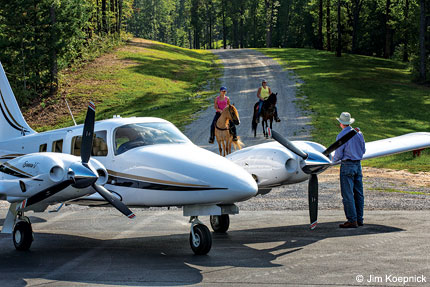
Scott County Airport (SCX) in Oneida, Tenn., was readying for its ninth annual autumn air show, and vendor trucks and booths were starting to fill the perimeter of the ramp. The buzz of excitement extended all the way into the Big South Fork Airpark (BSFA), which has through-the-fence access to SCX, and whose property owners typically gather from primary residences in locations stretching from the Dakotas to Florida to enjoy the air show and each other’s camaraderie. The owners’ eclectic fleet ranges from a Piper J-3 Cub to King Air C90, and includes composite, fabric and aluminum airframes, and both certificated and experimental aircraft. Obviously, there’s no consensus here on the best Residential Airpark Airplane (RAA).
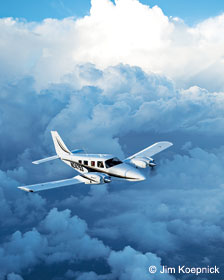
But just about any RAA needs to do several things well: have decent cargo-carrying capacity and commuting capability, be comfortable operating in remote areas, and provide simple, economical and reliable performance. A twin-engine Piper PA-34 Seneca V delivers all that with aplomb. But you can be excused if you didn’t have this essentially 40-year-old model (the Seneca was introduced in 1971) on your short list of best RAAs. Even Piper hadn’t given much thought to the Seneca in recent years.
“We took this airplane for granted,” Bart Jones, chief pilot for Piper Aircraft, said as we admired the airplane after his arrival at SCX from company headquarters in Vero Beach, Fla. “We were still building it and selling it, but not really saying, ‘Hey look, this is a nice airplane.'”
We repaired to BSFA’s Welcome Center to discuss our evaluation mission. The rustic and stately edifice serves as the BSFA’s clubhouse, and sets the tone for the fun and fraternity that permeate the development. The 450-acre development features richly forested land with plenty of privacy between the spacious home sites.
“Our vision has always been to develop an environment for an airpark where you had access to the world-class airport we have, but not feel like you’re in an airpark,” said B.A. Armstrong, one of BSFA’s three developers. “You have a neighbor, but not see your neighbor.”
 If you hadn’t given much thought to the Seneca lately, the aircraft will look like an old acquaintance you haven’t seen for awhile, who seems smarter and more sophisticated than you remember.
The airpark is in its first stage of development. Most of the property owners plan to make this their permanent residence, but for now they commute—a common situation for property owners at many residential airparks. Thus, an RAA needs the legs to handle travel to and from, while also being unfazed by weather that may develop in the hilly or mountainous environments where a good number of residential airparks are sited—BSFA included. “I’ve noticed from flying up and down this area for years, there’s always weather over these mountains,” Jones said. “They’re not very high, but these things are weather generators like you wouldn’t believe.”
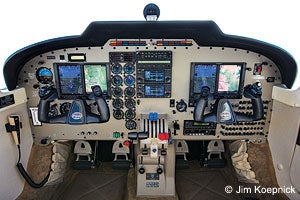 The panel in the Seneca comes standard with a Garmin G600 avionics suite. |
An RAA should also be eager to play, and have enough room at the bottom of its operating envelope to poke around backcountry areas low and slow, whether for flightseeing or to drop in on a turf field. The property owners at BSFA, which abuts the 125,000-acre Big South Fork Recreation Area in the scenic Cumberland Plateau, certainly indulge in that activity—whether in their own airplanes or another resident’s. As Lamar Parker, who commutes with his wife Marilyn in a twin-engine Cessna 414, said, “Some of our neighbors in the airpark have small airplanes like Piper Cubs, and are kind enough to take us up at a slow pace. I keep talking about getting a slower-moving airplane, but it’s a lot easier to buy my neighbors a steak than to buy a new aircraft.”
If the Seneca V could handle both these missions, it would establish the air cred needed to contend for Best RAA honors. For the commuting test, we planned an IFR flight to Chattanooga and back. A mere 91 nm, but sufficient to demonstrate the Seneca’s cross-country performance and the workings of its Garmin G600 digital avionics suite, introduced as an option in 2010 and now standard equipment, thrusting the almost half-century-old airframe design firmly into the 21st century. (Keep in mind the Seneca is a derivative of the Cherokee Six, which entered service in 1965.) After our return to SCX, we planned to check out some of the natural wonders and scenic points of interest of the Cumberland Plateau from the air.
The weather cooperated for our IFR flight the following morning: IMC with ceilings reported at 1,000 feet, no rain. If, like Piper itself, you hadn’t given much thought to the Seneca lately, the aircraft will look like an old acquaintance you haven’t seen for awhile, who seems smarter and more sophisticated than you remember. Maybe it’s those three-bladed props or rakish paint scheme (a two-tone design in DuPont Imron with a choice of metallic or nonmetallic colors). The wings hold 122 usable gallons; each wing has one filler port that feeds three interconnected tanks. This simplifies fuel management, but the eight fuel drains make sumping a little more time consuming than most pilots are used to. When filled, the Seneca still has 605 pounds of payload available.
 |
The cabin interior features four-place club seating (leather), accessible via double doors on the port side, providing plenty of room for loading and unloading people, luggage and other gear. The nose locker holds an additional 100 pounds of gear. Storage space behind the forward-folding rear seats, an entertainment console and foldout table give the cabin a look of sleek comfort.
Outside, not much has changed on the Seneca V, which debuted in 1997, over previous iterations. The cowls were redesigned and, most significantly, the engines upgraded to the Continental TSIO-360-RB 220 hp turbocharged engines. (The automatic waste gate and intercooler eliminate concerns about overboosting.) But the cockpit, dominated by the G600 panel, looks nothing like Senecas of yore. Along with the G600, Synthetic Vision, S-TEC 55X autopilot with altitude preselect, dual GNS 430W nav/com/GPS, GTX 330 transponder and GMA 430 audio panel come standard.
N24753 is also equipped with optional GWX 68 Weather Radar, KTA 870 Traffic Advisory System, and PiperAire air-conditioning. Among useful add-ons not onboard: full de-icing group and built-in oxygen system.
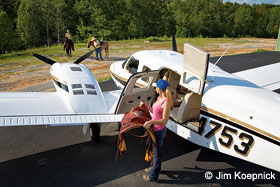 |
With its access to the 5,506-foot runway at SCX (BSFA was among the handful of residential airparks the FAA visited before approving existing through-the-fence operations), there are no challenges to using the runway, as may exist at airparks with shorter, narrower or unpaved runways. We did, however, keep an eye on the Seneca’s ground-maneuvering characteristics, which Mart likened to “the Queen Mary.” There’s no control tower at SCX; Jones quickly secured our clearance to Chattanooga and we back-taxied on runway 23 for departure.
Takeoff and landing speeds are akin to those of a high-performance single, so pilots stepping up should have a relatively easy transition. Rotation speed is 75 to 80 knots. With a best rate of climb speed of 88 knots, we aimed for about 98 for more margins in the unlikely event of an engine failure. But another big plus for the Seneca: The engines are counter-rotating, eliminating the critical engine limitations of other light twins, and making the Seneca easier to control in the event of an engine failure—a definite plus that extends far beyond the RAA world. At 1,000 feet agl we reduced power from 38 to 35 inches, and the rpm from 2,600 to 2,500, climbing at 110 knots and about 1,250 fpm to our assigned altitude of 8,000 feet, and emerging into sunlight at about 6,000 feet. Once en route with engines set for cruise power (30 inches and 2,300 rpm), we engaged the S-TEC autopilot and sat back to enjoy the Seneca cross-country experience. We were burning 22 gph and TAS was 168 knots. We could expect to gain two knots of airspeed with every 1,000 feet of additional altitude.
Approaching Chattanooga, the G600 installation demonstrated its value. The glide slope for the active runway, 20, was inoperative—not a calamity with the ceilings at 1,000 feet as they were today, but more importantly not a calamity at almost any ceiling with the digital avionics suite aboard. We requested the RNAV 20 approach, using the system’s LPV (localizer performance with vertical guidance) capability to create a glide slope.
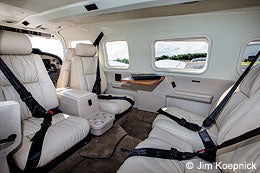 The Seneca’s cabin features four leather seats in a club-seating arrangement, accessible via double doors on the rear left side. The rearmost seats can be folded forward to access additional storage space. |
After spending as much time as it takes to taxi back to the active and receive the clearance for our return flight, we were back in the air. Jones, who has flown every aircraft in the Piper fleet produced in the last 50 years or more, reflected on where the Seneca fit in the Piper pantheon.
“It’s really an underappreciated airplane—a beautiful airplane to take a trip in,” Jones said. “When you first fly one, you don’t go, ‘Man, I love this airplane.’ But when you fly it for awhile you say, ‘Man, I love this airplane!'”
With its ability to keep the airplane out of trouble, the optional onboard weather radar could enhance that pilot’s passion—as long as it’s used properly. “It’s a great tool for flying in weather, but you need to spend time learning how to interpret it,” Jones said, particularly in mountainous areas where the ground can be mistaken for weather returns. “Sometimes it’s hard to determine, ‘Is that a buildup, or the side of a hill?'”
 |
Now in VFR conditions, we pulled the right engine back to zero-percent thrust, simulating an engine out, but leaving the propeller unfeathered. Even so, handling was very docile, and very little rudder trim required to center the ball. “If you’ve got a little speed and a little bit of altitude, losing one [engine] is not a big deal,” Jones said.
Basic instructions for entering the pattern: Pull back power, aiming for 140 knots, and put in a notch of flaps. Gear speed is 128 knots; after extending, put in second notch of flaps at 120 knots, reduce power to 105 knots. Jones recommends using only two notches of flaps when no passengers are in the back. Don’t be harsh if the landing feels a little hard; Piper twins don’t finesse themselves onto the runway, but once down they tend to plant and stay there, as couple of additional circuits confirmed.
Eager to explore Big South Fork that brings so many visitors to the area, we reviewed points of interest and planned a route over the landscape. BSFA has developed aerial tour routes to help introduce residents to the area, but we planned to hopscotch around in leisurely fashion—no point-to-point commuting on this flight.
The Big South Fork National Recreation Area encompasses the wildest and most rugged territory on the Cumberland Plateau, cut by 600-foot deep gorges and capped by massive escarpments. This is literally BSFA’s backyard and a real distinguishing feature of the development. Residents have quick access to all its splendors, and regularly head out in groups on foot, four-wheeler or horse. BSFA, after all, has a stable and horses that can be saddled up and brought to residents’ homes should they wish to ride. But the region can be enjoyed from the air, as well.
At 2,500 feet, or about 1,000 agl, the plateau appears like a carpet of trees veined by deep cuts with shiny ribbons at the bottom of each. From on high we saw waterfalls, a historic old railway bridge, the confluence of the New River and Clear Fork Creek that create the Big South Fork of the Cumberland River, and even the now-shuttered Brushy Mountain State Penitentiary, once home to a litany of notorious inmates. In the winter, when the leaves have fallen, flightseekers can view some of the hundreds of natural bridges found throughout the region, and see roaming wildlife. We yanked and banked, went hither and yon, and throughout, the Seneca acted like an oversized but very responsive kid—even though the fuel tanks were two-thirds full—happy to play along with us in the spirit of a wilderness explorer.
That night, BSAF residents who had come in for the air show gathered at the Welcome Center. Over the blazing fire on the deck fireplace, I solicited more opinions on the ideal RAA, and where the Seneca would fit on the list. Keith Petrie, who commutes to BSFA from Sioux City, Iowa, formerly owned a twin-engine Beech Baron, and highly approves of the twin-engine solution for an RAA—especially if it would be less expensive to fly and maintain than his Baron, which the Seneca undoubtedly would be.
Lamar Parker, who owns the Cessna 414, used to own a Piper Aztec, so he’s clearly onboard with the Piper Twin RAA. “I flew a Seneca early on when I was working on my twin-engine rating,” he said. “The Seneca’s a beautiful airplane.”
It’s an underappreciated airplane— beautiful to take a trip in,” Jones said. “When you fly it for awhile you say, ‘Man, I love this airplane!Meanwhile, I was thinking of something Jones mused while we were cruising along at 8,000 feet, something that seemed just as relevant here on the ground as I thought about the jewel of an airplane that would fit perfectly in this setting.
“This is Seneca life,” Jones had said. “It’s not bad. Not bad at all.”
An Ideal Residential Airpark Airplane |
| P&P is on a grand quest: to identify the ideal aircraft for the residential airpark lifestyle. Maybe that’s not on a par with finding the meaning of life, but it’s a holy grail for many a pilot nonetheless. Meanwhile, in the course of our research, it appears we’ve identified an ideal residential airpark: Big South Fork Airpark (www.bsfairpark.com), adjacent to the Big South Fork National Recreation Area in northeast Tennessee, which was hosting our mission to name the Best Residential Airpark Airplane (RAA). Our candidate aircraft ranged from an LSA (the Tecnam P2008) to a light twin (Piper Seneca V) and a single-engine turboprop (TBM 850 Elite). We put the aircraft through their paces flightseeing and commuting, and talked to the experts—BSFA property owners—on what to look for in an RAA. |


