

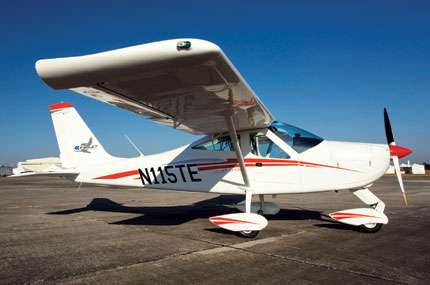
 The truly wonderful thing about events like the recent Sebring U.S. Sport Aviation Expo is that you have the fun, and the scheduling challenges, of flying many different types of aircraft at one sitting. “Sitting” is a key word. I came to regard it as an aviation smorgasbord—for my tush. Of course, such an avian feast feeds other visceral, spiritual and intellectual appetites too, but sitting comfort in an airplane is also important, yes? You betcha.
Take the Tecnam P92 Eaglet. Peering into its well-appointed cockpit, I commented to my hosts, U.S. distributors Lynne and Michael Birmingham (www.tecnamaircraft.com), on the nicely upholstered, thick-cushion seat.
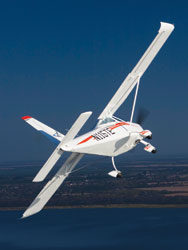 A couple of LSA I had previously flown at the show left me wishing for thicker seat padding, while Eaglet’s seat proved manifest: firm but pliant, supportive without over-cushiness. In a word, reassuring.
I’m setting you up a bit here: The seat critique serves as metaphor for how I felt about the airplane after an hour’s flight introduction. I would indeed sit in this airplane any day of the week, feed in power, lift away from the tarmac and feel equally at home shooting T and Gs or ranging out on a five-hour cross-country flight. The Eaglet is an airplane you feel at home in the minute you match buns to bucket.
It’s ideally suited for flight training—think LSA comes to Cessna Town. But its roomy (46 inches wide), comfortable cabin and good, solid cruise speed (114 knots at 75%) mean you also can visit your aging hippie Aunt Skyflower up in the hill country. And the view en route? Fabulous. The overhead, Citabria-like windscreen extension lets you look ahead during high-bank turns, important for a high-winger. And since, for most pilots, eyes are below the wing bottom, side, down and back views through the large door windows are most appreciated.
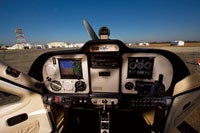 The cabin in the Eaglet, which cruises at 114 knots at 75% power, is a roomy 46 inches wide. |
There are clear reasons for Eaglet’s broad appeal and performance. First, it’s an all-metal airplane; therefore, it’s not as bump-twitchy as all-composite, non-flex-airframe birds can be in washboard chop.
Next, it’s smooth but responsive: You can rack it over into a steep bank without bicep training on your home Bowflex—yet it’s not sports-car zippy. You won’t involuntary snap roll if you sneeze while holding the padded control stick.
Force resistance to control input is comfortably damped. It’s also not spring-aided. What you feel is what the control surfaces feel aerodynamically. Set it up for long-reach, full-tank flights, and it’ll fly straight and true until you politely but firmly request a change in attitude, or dinner before 7 p.m. Or as Michael Birmingham says, “I don’t need an autopilot with this airplane. I just trim, then fingertip fly it.”
 |
 |
| The 6.5-inch AF-3400 glass avionics from Advanced Flight Systems can be configured as an engine monitor (top), which continuously monitors and displays engine data, or as a dual EFIS/map, which displays the standard “six-pack” instruments and derives position from a GPS signal (bottom). |
Third, the pretty airplane is hardly a slowpoke. I poured the plunger to the 100-horse Rotax 912 ULS2/S (two throttles, center and left), trimmed up, and the Eaglet politely responded with 120 knots indicated, straight and level at full power. Airframe vibration levels were a wee noticeable but not out of conformity with the Rotax-powered LSA genome. The Eaglet felt solid and stable.
One thing Sebring 2009 demonstrated with gusto: The LSA industry has impressively matured in the short four years since the sport pilot rule was invoked. Many aircraft on display showed a level of sophistication, finish and functionality. Is this the “Change We Can Believe In” for general aviation? Hmmm.
On the ground, toe brakes are easy to use and work great, but you don’t really need them for navigating the asphalt. I tried a tight rudder-only taxi turn that brought us right back onto our original line. Eaglet turns on the proverbial dime, nice for students and for plain old comfort. There’s that word again.
As for good manners coming down the home stretch, Michael, a 30,000-hour pilot with lots of stick time under his weathered paws, let me shoot a couple landings on the slightly thermally Florida afternoon. He talked me down through the pattern and, though frankly bleary-eyed from working Sebring, I found landing the Eaglet to be a breeze. The strong spring-steel gear helped with that. Both descents ended with decently smooth touchdowns…let’s use the word “nominal” to keep my hat size manageable.
And isn’t that what you want in a training airplane—confidence that quickly grows from the first flight? Works for me.
 Electric trim controls are located on the padded center control sticks. |
Likewise, climbing out at 80 knots, showing 800 fpm or so, the airplane felt both solid and responsive. Max climb performance by the way is impressive: I saw 1,200 fpm, and 1,000+ was routine at near-Vy speeds. That was with me, Michael and full fuel aboard, and neither of us are competing for NutriSystem Man of the Year honors.
When we did a stall series, I was gratified to see how the airplane retains considerable aileron control even near stall, without dropping off on a wing. Again, ideal for training as well as for text-messaging in slow flight. Just kidding about the texting.
As Michael puts it, “I can give students a lot more room to make mistakes, then get themselves out of trouble, without having to physically take control as soon. It’s a forgiving airplane that gives lots of notice when things aren’t right.”
Demonstrably so: In departure and approach stalls, Eaglet offered plenty of force feedback and subtle, progressive shuddering as we neared stall, just like that wonderful old Cessna 150 you may have spent some yoke time in.
Indeed, stall recovery is a real yawner. Whether or not you’ve fed in flaps with the electric toggle (max barn door setting is 38 degrees), you pretty much just relax the stick, ease in even a small amount of power and you’re either in stabilized descent or climbing out again, depending on throttle setting.
The Birminghams praise the bird’s superior crosswind-landing control, although conditions didn’t support a demonstration. “Early customers asked for more rudder effectiveness,” says Lynne, “which led to Tecnam using the larger tail from the P2004 Bravo. It brought balance to the overall control feel and more crosswind capability too.”
Michael demonstrated Eaglet’s rudder authority by flying a box pattern with just his feet. Cool!
Rolling in and out of turns takes a touch of rudder to keep things copacetic. Climb out likes right rudder as well. It felt like I needed proportionately less left foot for powered-down descents.
As happens way too often, enthusiasm overruns word space. We haven’t even talked about the Dept. of Justice using two Eaglets rigged with infrared sensors and other tech gear to patrol D.C.’s skies during the presidential inauguration. Or how Tecnam’s Italian-born and -bred pedigree of well-built airplanes numbers 2,500 LSA sold worldwide. Or how the Birmingham’s mission to place the Eaglet in flight schools across the country is helping to change the face of general aviation training.
But I will close with this: Eaglet is spin-certified in the United States in the flight-training environment. Its famed 80-something designer, Luigi Pascale, does loops and rolls in it—at 1,000 feet AGL yet! Heck, Luigi, you had me at 80-something.
In your search for whatever LSA ultimately fits you just right, I’d bet on this: You’ll end your flight in the Eaglet with a genuine smile of appreciation on your face. It’s one very comfortable airplane.


