

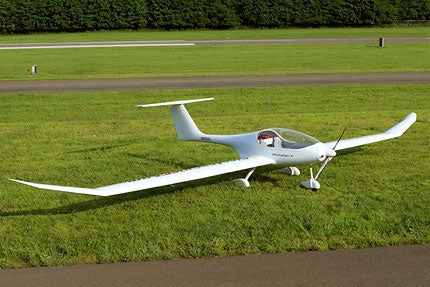
 ELECTRIC INNOVATIONS: Randall Fishman’s cutting-edge, pioneering designs include the Electra Flyer, the ElectraFlyer C and the ElectraFlyer X. |
In 2007, a man no one in aviation had ever heard of walked onto the field at Oshkosh, strapped himself into a motorized hang-glider trike and took off. No big deal, right? Trikes have been around for decades.”
Ah, but a trike powered solely by electricity, that flew a 200-pound pilot for more than 1½ hours? That was completely new. So when Randall Fishman, a retired jewelry maker with a keen mind and a tinkerer’s passion, flew on silent wings, we knew the future had arrived.
That seminal event quietly retold a story as old as time: One person with true vision can shift the world. It also won him EAA’s coveted 2007 Grand Champion Ultralight and a Special Award for Innovation. The very next year, he rocked the burgeoning world of electric flight again with the ElectraFlyer C, a modified Moni kit motorglider. With 1½ hour’s endurance, it could partially recharge batteries in gliding flight through the spinning prop, cruised at 70 mph, and had a top level speed of more than 90 mph!
That accomplishment earned Fishman the Stan Dzik Memorial Award for innovation and the Dr. August Raspet Memorial Award for “outstanding contribution to the advancement of light aircraft design.” That year, he got a visit from a previous winner: the Great One himself, Burt Rutan, who congratulated him. Rutan had also won the Dzik award previously. Birds of a feather and all that.
In 2009, a cash grant from the Lindbergh Foundation helped fund ongoing work. Randall Fishman flew hang gliders from the early ’70s. Then came ultralights. “I really liked ultralights,” says Fishman. “I really didn’t like all the noise and vibration. We accepted it then, although an hour flight left your whole body buzzing.”
He’s one of those smart guys who knows how to invite the right people into his projects. After the exciting debut of the Trike, it was time for something more ambitious. “Joe Bennis, a natural pilot who’d been my glider instructor at the Wurtsboro, N.J., airport, was very helpful,” explains Fishman. “I told him about the C model. He said, ‘I’m on board,’ let me use his hangar, and became the test pilot for all the test flying. Joe was a big, big help. I don’t think I could have done it without him.”
Flash-forward: What is electric flight’s Steve Wozniak up to these days? Fishman hopes to have ElectraFlyer X, a lightweight, two-seat composite/carbon-fiber motorglider in development for three years, ready for Oshkosh. He’s also testing his own electric motor and controller designs, and prototyping an electric ultralight. Meanwhile, his Trikes are available for purchase.
“The recession has made this not a great business right now,” admits Fishman. “I’ve done okay because I’ve kept it small, selling a few complete trikes and many propulsion kits, meters and electronic controllers for people to modify their own ultralights.”
The X model is, for now, intended as an experimental homebuilt kit to be flown as a light-sport aircraft. “Once FAA gives us the okay for electric propulsion, we’d like to sell it as a turnkey S-LSA aircraft.”
His take on competing electric projects? A few well-funded efforts (which shall remain nameless) appear to be too heavy and inefficient aerodynamically to be workable. He believes the key to success—electric aircraft that can be produced and flown right now, not five years down the road—lies in maximizing the technology we already have.
 The key to success—electric aircraft that can be flown right now—lies in maximizing the technology
we already have.

A fully charged battery is equivalent to a tank of gas. Energywise, it takes around 72 pounds of fully charged batteries to equal the energy potential of one pound of gasoline. When you factor in the efficiency of an electric motor, about 90% compared to the best gasoline engine efficiency of 23-25%, the ratio narrows, but it’s still around 20:1 in favor of gasoline power.
Batteries remain the performance technology bottleneck that electric scientists and engineers are working on. That dictates light, very efficient airframes to maximize the electric power we currently have.
“If we got a tenfold increase in the specific energy density of batteries,” says Fishman, “then we could do lots of things modern airplanes do in terms of performance.” Today, practical electric airplanes need to follow a simple equation: Multiplying weight times sink rate tells a designer how much raw power is needed to keep the airplane up.
“People who say, ‘I want to fly fast, I want to fly high,’ on electric power are up against the physics of flight: Twice as much speed takes four times as much thrust. By starting out with an airplane weighing 600 pounds all up and a sink rate of 150 feet per minute, you don’t need much energy to keep it flying.
“That’s the key right now for electric aircraft: It has to be efficient, it has to be light,” continues Fishman. “Current technology won’t work for a heavy, high-sink aircraft like a Cessna or even a short-wing kit sport plane. My aircraft do work well because they’re light and efficient. They don’t need much power to stay up.”
That’s why so many electric aircraft projects like the Lindbergh LEAP award-winning Pipistrel Taurus Electro, solar-powered Sunseeker II and Solar Impulse globe-hurdling project, and the new two-seat eGenius sponsored by Airbus are, in essence, motorgliders.
Who does Fishman think will succeed at bringing viable electrics to the market? “Yuneec certainly could. They have a lot of irons in the fire. The Cri-Cri uses four model aircraft motors. It’s cool. But merely getting something to fly electrically is not the thinking you need.
There’s no new technology there; it’s not leading us anywhere.
“There are projects like Elektra One that use a nice big outrunner motor, but at more than $140,000, I don’t see it doing much. We want to sell something at around $40,000.”
Fishman adds, “The 20-meter-span Antares 20E motorglider is terrific. But it’s not what I’m going for. I want something a regular pilot can operate out of a regular airport or field.”
Fishman’s take on the imminent future of electric flight: “Everybody who drives locally should use an electric car. If you want to go cross country, take your SUV. It’s the same with electric planes. For local flying, go electric. Fly cheap, enjoy your flying. My ElectraFlyer C costs 75 cents for a full charge!
“I see electric flight as much closer to the pure dream of flying. The experience is so much better. It’s the closest thing to being a bird, without eating the worms. Right now, you can take off, fly around for hours, soar when there’s lift, and with almost no noise. What’s better than that? It’s a fantastic way to fly!”
Now, how’s that for a vision?


