

 |
What’s the next big leap in aviation? I think about this stuff all the time. One of the benefits of having worked with so many extraordinary people in my lifetime is that it has opened my mind to the myriad ways to solve a problem. My work with the X PRIZE Foundation has led me to realize that even if I don’t have the skill set or knowledge to create a solution to a problem, I can create a mechanism with which I can help to accelerate a solution by others. At X PRIZE, we get together regularly to look at problems and “stuck areas,” and investigate whether we could design a prize that would stimulate a breakthrough. This is an amazing process of seeking out problems as potential opportunities that has resulted in several game-changing examples (Ansari X PRIZE, Lunar Lander Challenge) of how prize philanthropy can work. Imagine creating a generation of students who are motivated to seek out problems as potential opportunities!
Aviation was developed primarily by two things: warfare and prizes. The London Daily Mail prize was awarded to Louis Blériot for the first crossing of the English Channel in 1909. The Schneider Cup, offered for the fastest seaplanes, had an interesting effect—for a time in the early ’30s the fastest aircraft in the world were seaplanes! The Bendix Trophy, designed to spur development of faster and more reliable aircraft, attracted such notable pilots as Jimmy Doolittle, Amelia Earhart and Roscoe Turner, and was won by both Louise Thaden and Jacqueline Cochran, arguably the greatest female pilot of all time.
In 1919, Raymond Orteig put up a $25,000 prize for the first nonstop flight between New York and Paris (in either direction), and a funny thing happened. Seven teams spent $400,000 trying to win the prize. So Orteig leveraged his money by a factor of 16, and all that research and development went into long-distance air travel. My grandfather Charles Lindbergh won the prize using off-the-shelf technology, so it wasn’t really a technical breakthrough as much as it was a psychological one. Before he flew across the Atlantic, people who flew airplanes were known as barnstormers, daredevils and flying fools. After he flew across the Atlantic, people who flew in airplanes were called pilots and passengers. While he was inspired by the cash prize, he wrote in his Pulitzer Prize-winning book, The Spirit of St. Louis, that his true motivation was to prove that aviation could be used for commercial purposes.
I believe we’re at a similar time in the history of aviation. Electric aircraft are just beginning to fly, but they aren’t very practical—yet. The energy density of batteries just doesn’t allow a flight profile similar to a gasoline-powered aircraft. However, energy storage technologies are advancing at a rapid pace across multiple industries, and some are forecasting a magnitude of order improvement within the decade. This development would make the performance of electric aircraft practical for many GA applications.
|
|
Thinking over several of the threats facing the aviation industry for the last several years, I couldn’t help but set my mind to action working on solutions. As the pilot population shrinks, it leads to smaller markets for companies serving those markets and results in falling profits. As we lose airports to noise complaints, we lose infrastructure that’s critical for access to aviation for new pilots and for the consumer services and lifesaving functions that serve the public. The increasing costs of gasoline, insurance and maintenance mean that the aviation industry is becoming less and less accessible to the average person. Once we reach a critical point it will collapse, leaving us with the frightening prospect of an aviation industry as it currently exists in Europe—severely restricted by regulations and cost. We’re so fortunate to have the freedom here in the U.S. to fly just about anywhere at just about any time. But make no mistake—we’re losing ground. As pilots, we need to take the initiative to find viable alternatives for the future of aviation.
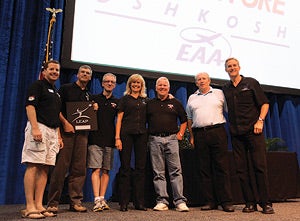
A few years ago I created a container—a nonprofit organization—to work on these issues. Last year that organization began work on LEAP—the Lindbergh Electric Aircraft Prize. And on July 30, we awarded the first set of LEAP prizes. Yuneec won Best Electric Aircraft for the design and engineering of the E430, an aircraft with significant commercial potential. Sonex won Best Systems Technology for the design and engineering of the E-Flight Initiative electric propulsion system architecture. Axel Lange won our Individual Achievement Award for his leadership and vision in the development of the Antares 20E, which is the world’s first certified production electric aircraft.
Our awards were part of a larger event—the all-day World Electric Aircraft Symposium at AirVenture 2010. This year saw the introduction of the first prototype electric helicopter from Sikorsky. General Electric Aviation also had a significant presence, sponsoring the Aviation Learning Center and the Symposium, and presenting their efforts in electric aircraft development. Note that of our three winners, one is an American company, one is a Chinese company and one is a German company. We’re on the cusp of the electric aviation revolution in this country and around the world. That’s why we’re bringing our LEAP awards to Aero-Friedrichschafen in April 2011, as the next step to create a visible and viable tie between the electric aircraft industries in the U.S. and Europe.
Electric aviation is a perfect area for prize philanthropy, but even better as a focal point for the real payload of LEAP—education. We need to engage students with topic areas that intrinsically motivate them to learn. Flying did it for me. At LEAP, we’re developing a fascinating curricular framework for kids to seek out problems as potential opportunities.
To prototype this curriculum, we had a team of students and educators from Aviation High School in Seattle join us at AirVenture. This group spent several months preparing for the trip, learning all they could about electric aircraft. Their mission: to film a video about the electric aircraft industry by interviewing the pilots, inventors, entrepreneurs and industry leaders. This group arrived a bit shy about the project. By the second day, however, they were scheduling their own interviews and seeking out more. Watching these students blossom in self-confidence, enthusiasm and maturity as they came to own their project was extraordinary. They knew that they were having a once-in-a-lifetime experience. Each day brought new adventures, new people and new ideas. I can’t wait to see the video that they create from this adventure. And, more importantly, I can’t wait to see where this experience takes each of those students.
When I think about the potential for electric aircraft, I see hope for the future of general aviation. But I also see a way to bridge the aviation communities of the U.S., Europe and around the globe. And I see the enthusiasm in the next generation as they explore what aviation might look like for them and where they want to take aviation. For it’s truly this next generation that will shape the future of aviation. Now that’s powering imagination!
Erik is a social entrepreneur and founder of the Creative Solutions Alliance and the Lindbergh Electric Aircraft Prize. He also serves on the board of directors of the X PRIZE Foundation and the Aviation High School in Seattle.
