

 |
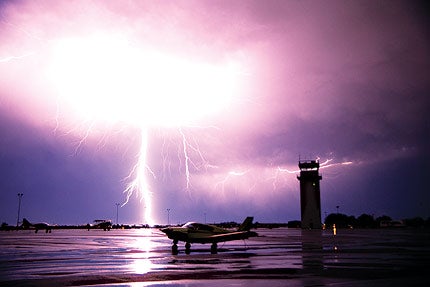
On April 13, 2012, United Airlines flight 930, a Boeing 777, took off from San Francisco International Airport en route to London. The airplane was struck by lightning, and the flight crew elected to return to San Francisco. On May 7, 2012, a Boeing 777 operated by Emirates Air as flight 407 was flying near Melbourne, Australia, on a flight from Auckland, New Zealand, to Dubai when it was struck by lightning. The flight crew made an emergency landing at Melbourne, failed to find any damage and resumed the flight. On May 15, 2012, a Dassault Falcon 7X jet carrying French President Francois Hollande from Paris to Berlin was struck by lightning and returned to Paris. President Hollande was transferred to another plane. Coincidentally, on May 18, 2012, the NTSB issued a Safety Recommendation calling for the FAA to install upgraded technology so that controllers see lightning strikes on their screens, thus providing additional information to help them keep aircraft away from storms.
The Safety Board wants the FAA to study the technical feasibility of presenting, through the use of existing weather and radar processor systems or other means, real-time total lightning data on controller displays in use now at both centers and TRACON facilities, and on the displays that will be used when the NextGen system is deployed. The Safety Board also points out that the new avionics the FAA wants aircraft operators to install would have enough capability to handle real-time lightning data, and it would make sense for the FAA to include lightning data in the weather information it plans to transmit for pilots to use via broadcast data link.
The NTSB notes that existing ground-based lightning detection technology can retrieve information for both cloud-to-ground and cloud-to-cloud lightning with a high degree of location accuracy. It’s accepted that lightning activity correlates with areas of convective turbulence, and also can help identify vertical development of some thunderstorms and microbursts at the ground. Because lightning detection networks and weather radar operate independently, lightning information may help detect thunderstorms in regions of the National Airspace System where weather radar coverage doesn’t exist or is spotty. Lightning information supplements weather radar because it can reflect possible convective activity in airspace where precipitation returns from weather radar don’t appear to be significant.
According to the National Weather Service, nearly 16 million thunderstorms occur around the world each year, with 1,800 occurring at any given moment. In the U.S., there are an estimated 100,000 thunderstorms each year. A study by Texas A&M University indicated there were 16.9 million lightning flashes in the U.S. during calendar 1991.
The value of lightning activity as a means to identify and avoid hazardous weather started to become obvious in the aviation community on June 10, 1976, when Paul A. Ryan and Nicholas Spitzer filed their patent application for a device called the Stormscope. This was a storm mapping system using electrical activity as the basis for making a visual display of significant weather. The distance of the weather was inversely related to signal strength, and the azimuth could be determined by the relationship of signal strength to directional antennas. Their invention went on to become a significant presence in aircraft lacking weather radar, and a popular addition to the equipment on aircraft having radar capability. Now, 36 years later, the NTSB says it’s time for FAA controllers to have that same type of tool available.
Given the huge number of thunderstorms, lightning strikes and aircraft, it’s noteworthy that only one or two lightning strikes a year may rise to a level requiring an NTSB investigation. A common rule of thumb is that each aircraft in the U.S. air carrier fleet is going to be struck by lightning once a year, with strikes affecting general aviation aircraft being relatively rare. Even though electrical systems and avionics have become more complex over the years, the vulnerability of aircraft to damage from lightning has decreased due to better design and airframe bonding to safely dissipate the high current and voltage. This is true of both aluminum and composite structures.
The first aircraft to be destroyed due to a lightning strike is believed to have been a German Zeppelin that was venting hydrogen gas on September 3, 1915. A lightning strike had the predictable effect on the hydrogen. The crash of a Ford Tri-Motor in New Mexico on September 3, 1929, is believed to be the first fixed-wing fatal accident caused by a lightning strike. All eight people on board were killed. In its Safety Recommendation, the NTSB made reference to a number of more recent incidents.
Boeing 757
On August 14, 2011, US Airways flight 1209, a Boeing 757 en route from Philadelphia, Pennsylvania, to Philipsburg, St. Maarten, was struck by lightning at approximately 16,000 feet. The crew reported smoke in the cockpit, declared an emergency, and diverted to Baltimore, Maryland, where the airplane landed without further incident. At the time of the incident, the flight was under control of the Washington ARTCC. When the pilot first contacted the center, the controller advised of moderate rain and turbulence along the airplane’s route. About three minutes later, the pilot reported that the airplane had sustained a lightning strike and requested to return to Philadelphia “with priority,” later changing the destination to Baltimore. The pilot added that the airspace the flight had just traversed contained “!moderate to possible severe!” turbulence, with multiple cloud-to-cloud lightning strokes.
Embraer 145
On January 24, 2012, the flight crew of American Eagle flight 3376 en route from Dallas/Fort Worth, Texas, to Madison, Wis., declared an emergency after a lightning strike at about 17,500 feet near Farmersville, Texas. The crew immediately requested to divert to Little Rock, Ark., where the airplane landed without further incident. Weather radar data recorded along the airplane’s flight path showed convective activity in the immediate region and significant lightning along the aircraft’s flight path for at least 15 minutes before the emergency declaration. The controllers involved in the incident told investigators that the ability to depict lightning data on ATC displays would be useful in helping pilots avoid areas of hazardous weather.
Although not referenced in the NTSB’s Safety Recommendation, these general aviation items from the NTSB’s files are noteworthy.
Cessna T210N
On January 30, 2005, a Cessna T210N was struck by lightning near Glendale, Ariz., while on approach to the Scottsdale, Ariz., airport. Although the commercial pilot and three passengers weren’t injured, the airplane was substantially damaged. The flight originated at Carlsbad, Calif. The airplane was in instrument conditions on an IFR flight plan.
The pilot was given radar vectors and told to expect a visual approach to Scottsdale. The flight proceeded northbound, and entered intermittent IMC a few miles north of Luke Air Force Base. The pilot stated that the clouds were dark and contained precipitation, but there was no significant turbulence. The pilot saw lightning to the east and reported it to ATC. Shortly thereafter, ATC instructed the pilot to turn to a magnetic heading of 040 degrees, and descend in preparation for a visual approach to Scottsdale.
The pilot said that shortly after turning northeast, an airplane on the same frequency experienced a stuck mic, and the pilot was blocked from radio contact with the controller to whom he had been talking. The flight was in IMC at the time, and the pilot called controllers stationed at Luke Air Force Base and Scottsdale tower for additional approach instructions. The pilot stated that the controllers were unclear as to what they would be capable of providing. As the airplane got closer to Scottsdale airport, its propeller was struck by lightning. The lighting traveled through the airplane’s structure to the left wing, fragmenting the rib structure and separating part of the left wing tip. The pilot was able to communicate with ATC on a backup communication radio and declare an emergency. The flight diverted to Glendale Airport and landed without further incident.
Sabreliner
On August 14, 2000, a twin-engine Sabreliner jet crashed in woods about three nm northeast of the Gogebic Iron-County Airport (IWD), Ironwood, Mich.. The airplane was at Flight Level 318 about seven nm north of Ashland, Wis., when the ATP-rated captain radioed, “Mayday, Mayday, Mayday, eight five delta whiskey lost both engines.” A controller replied, “…the Ashland, Wis., airport is aaahh, one o’clock, one thirty and about ten miles.” The captain radioed, “Okay, request a vector, we got hit by lightning.”
ATC heard the captain declare, “We’ve lost navibility up here, so we’re relying on your vectors.” They were in solid IMC. The controller asked if they wanted emergency equipment standing by. The pilot replied, “Absolutely, affirmative, give us vectors down, cause we don’t have any navibility at all. We’ve lost it all.” The aircraft’s radios would soon quit transmitting, and the transponder would be lost from radar.
The cockpit voice recorder recorded the captain saying, “Okay, we’re done… we got nothin’.” The copilot said, “We’re losing electrical.” The captain said, “Okay, okay, we’re gonna dead-stick it here,” followed by, “I’ll take an airport. I’ll take a freeway. We got the gear down, three green.” The copilot said, “Got a good descent, get below before we lose our gyros.” The captain said, “There’s the ground. Suggest a left turn.” The CVR recorded one of the pilots saying, “There you go. One seventy on the speed. You got it?” One of the pilots said, “Left turn, left turn, standard left turn.” The CVR recorded one of them saying, “…over there, left turn 90 degrees. Left turn.” Also recorded were, “Is that a clearing? Are you sure?” and, “Seat belts on? Put your seatbelt on,” and, “I have mine on.” No further voices were recorded. The two pilots were killed and the two passengers received serious injuries.


