

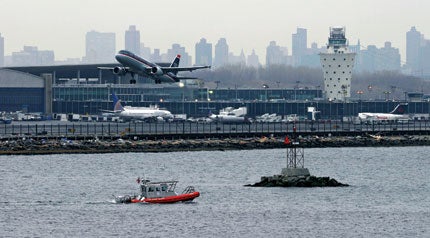
 OVERWATER DEPARTURE. About three minutes after it took off from LaGuardia Airport, US Airways Flight 1549 was in the water. Pictured above, an Airbus A320 departs from the Queens County airport. Photo by Phil Derner |
Without diminishing in any way the heroic actions of the pilots, flight attendants and passengers on US Airways Flight 1549, which was successfully ditched in the Hudson River after a bird strike on January 15, it’s important to note that most ditchings actually have a high survival rate. That’s true across a variety of aircraft types, even when the pilot’s ditching training is minimal, and even when the body of water is the Hudson River between New York and New Jersey, which is notorious for swift currents, murkiness and nasty debris. Ditching, by definition, includes at least some planning on the part of the pilot and implies that the aircraft remains somewhat under control during the process of landing on water. Ditching differs from a runway overrun or uncontrolled descent that happens to terminate in water.
On January 30, 1973, a Cessna 150G was en route from Providence, R.I., to Monmouth, N.J., when the engine quit while the airplane neared the Hudson River. The 28-year-old private pilot, the only occupant, wasn’t instrument-rated. His total time was 308 hours (with 304 in Cessna 150s). After electing to ditch in the Hudson, he escaped from the airplane and swam to shore. The plane wasn’t recovered and the reason for the engine failure wasn’t determined.
On November 1, 1985, an instructor and student took off from Morristown, N.J., on a night/VFR flight. The instructor had logged 3,756 hours, with 224 in type. The two headed toward New York City, then south over the Hudson until they were two miles from New Jersey’s Liberty State Park. As they made a left turn to stay over the water, they detected an unusual odor and the propeller pitch decreased, causing the engine to surge. The instructor noticed that the oil-pressure gauge had dropped to zero. He radioed controllers at Newark International Airport and declared an emergency. As they started flying toward Newark, the engine seized. The instructor elected to land in the river; both occupants were rescued by the Coast Guard. The engine’s crankcase was found to have cracked, resulting in a loss of oil
On July 31, 1997, a Piper PA28-181 landed on the Hudson River, near Jersey City, N.J. The pilot had flown from New Jersey’s Teterboro Airport to Lakewood, N.J., where he landed before taxiing for another takeoff. He flew inland over New Jersey, then headed northeast over the Hudson River, about 800 to 900 feet above the water. He proceeded north, which would have allowed him to avoid Newark International Airport while returning to Teterboro. As he reported, “On my return flight to Teterboro Airport, in [the] vicinity of the Statue of Liberty, my engine started fluttering intermittently. Shortly after, [I] lost engine power completely. Immediately, I started emergency procedures. Some hesitant restart occurred with pumping of throttle, all the while controlling the airplane by establishing appropriate glide speed. Notified Teterboro Tower of my intention to ditch!” The pilot was rescued by a person on a Jet Ski.
The 57-year-old private pilot wasn’t instrument-rated and had 498 hours, with 386 in type. He stated that the fuel tanks were full when he visually checked them before departure. He didn’t change the position of the fuel selector during the flight. The plane had operated a little over two hours before the engine quit. After the airplane was recovered, investigators found that the right tank was full of fuel, but the left tank had five gallons of water. The fuel selector was set to the left tank.
On January 2, 2006, a PA28-161 took off from Mount Holly, N.J., destined for Lincoln Park, N.J. A flight instructor and private pilot were onboard. Part of the flight was to be devoted to operating in the VFR corridor that exists over the Hudson River, allowing VFR traffic to transit New York Class B airspace without a clearance. The airplane was in cruise flight at 900 feet, traveling north of the George Washington Bridge. When past Yonkers, N.Y., on the river’s east side, the plane turned around and headed south, at which point the engine sputtered and quit. The instructor took control of the airplane and issued a “Mayday” call. The pilot of a Delta Air Lines flight heard the call and alerted ATC. Attempts to restart the engine were unsuccessful. The instructor ditched the airplane in the river a half mile from the Yonkers Municipal Pier. Both occupants got out before the airplane sank.
Two of the very few ditchings involving U.S. airliners occurred in 1956. Coincidentally, both involved Boeing 377 Stratocruisers, four-engine prop aircraft that had helped bring state-of-the-art luxury to long-distance air travel.
At 8:06 a.m. on April 2, 1956, Northwest Airlines Flight 2 took off for New York City from Seattle-Tacoma Airport in Washington. Onboard were 32 passengers, three cabin crew and the pilot, first officer and flight engineer. The airplane climbed to about 1,200 feet, at which point power was reduced and the flaps were retracted. The airspeed had settled at 145 knots when severe buffeting shook the airplane; it kept wanting to roll to the left. Because the problem started when the flaps were retracted, the captain thought that the plane might be experiencing a split flaps condition, with one side extended and the other retracted. He tried reducing power, but that didn’t help. Tower was advised, and the flight was cleared to return to the airport, but the captain decided against that because of the control difficulties. Instead, he proceeded to McChord Air Force Base in Tacoma. The buffeting and control problems became worse, and the aircraft was losing altitude, so the captain elected to ditch in Puget Sound.
The airplane touched down on smooth water about 4.7 nm from the end of runway 20. The speed was about 120 knots. The captain and first officer made sure everyone was out, then exited through the cockpit windows. The airplane sank in 15 minutes. Five people drowned.
The airplane was pulled from about 400 feet of water for examination. Investigators found that the cowl flaps on all four engines were fully open. The Civil Aeronautics Board determined that the flight engineer hadn’t closed the engine cowl flaps to their takeoff positions, and it was the open cowl flaps that had disrupted proper airflow, causing the buffeting and control problems.
On October 16, 1956, a Pan American World Airways flight ditched in the Pacific Ocean between Hawaii and San Francisco. All 31 people onboard were rescued, but the airplane wasn’t recovered. After departing from Honolulu at 8:26 p.m. on October 15, the B-377 was cleared to fly at 13,000 feet until reaching a fix over the Pacific, at which point, it would climb to 21,000 feet. Around 1:05 a.m., the fix was reached, and the climb was initiated.
When leveling at 21,000 feet, the airspeed was allowed to increase to 188 knots, and power was reduced to cruise settings. The #1 engine began to overspeed, so power to all engines was further reduced and the flaps were extended to slow the plane. The #1 engine had to be shut down. The prop couldn’t be feathered, and it continued to windmill. The airplane was losing altitude at 1,000 fpm. The extra drag, lack of power and excessive fuel consumption meant that the flight wouldn’t be able to reach San Francisco or return to Honolulu. It was calculated that the airplane could fly only 750 miles, while the distances to San Francisco and Honolulu were more than 1,000 miles. The captain radioed the U.S.
Coast Guard Cutter Pontchartrain, alerting it to the possibility that they’d have to ditch. The Coast Guard kept a vessel on station at a location called “November,” midway between Honolulu and San Francisco. Radar on the Pontchartrain determined that the airplane was approximately 38 nm away, on a bearing of 256 degrees. The flight crew altered course and followed a radio signal to the ship. The crew managed to stop the descent at 5,000 feet while holding a 135-knot airspeed. They discovered that, at full throttle, the #4 engine would only produce partial power. Shortly after 1:30 a.m., the airplane arrived over the Coast Guard ship. The captain decided to descend to 3,000 feet. The ship had fired flares and set out electric lights in the water to establish a ditching track. Because the airplane was maintaining altitude, the captain decided to circle the ship and wait until daylight to attempt the ditching. During the extra time, the passengers were given additional instructions on ditching and evacuation procedures.
A pathway of foam was put down by the ship on a heading of 315 degrees for the ditching. At 6:15 a.m., the airplane touched down with full flaps, at an airspeed of 90 knots with the landing gear retracted. The first water contact was light and was followed by a severe impact, during which the airplane went under water, then bobbed up and stopped. The fuselage broke apart aft of the main cabin door. Everyone got out of the airplane and into rafts. The aircraft sank 10 minutes after touchdown.
Peter Katz is editor and publisher of NTSB Reporter, an independent monthly update on aircraft accident investigations and other NTSB news. To subscribe, write to: NTSB Reporter, Subscription Dept., P.O. Box 831, White Plains, NY 10602-0831.


