

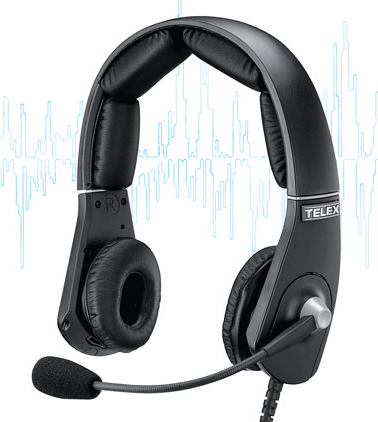
 An impressive feature of the compact jet-style headset is that the noise-cancelling electronics are powered through the microphone circuit in the airplane. |
Among turbine pilots, Telex makes some of the most popular headsets in the world. The newly introduced Ascend headset is aimed squarely at this market, where simplicity, audio fidelity and comfort are key. Telex introduced the Ascend with the realization that, “In the world of aviation headsets, the skies are crowded with choices,” and it’s clear that they worked hard to create a new ANR headset that would stand out among discriminating owner-pilots of turbine aircraft.
The Ascend can be ordered in one of three headset-frame options, which allow it to be configured as a single-sided headset (without ANR) or as a double-sided headset (with or without ANR). Right out of the box, the first thing you notice is that the Ascend features a clever modular design that allows the headset to be reconfigured in one of two ways. It can be used as a conventional double-ear-cup headset with the speaker boom installed on either the left or right side, or it can be set up as a simple headset with no speaker boom for listening to music through an iPod or other in-flight entertainment system while sitting in back.
One of the most outstanding features is that when the speaker boom is installed, the noise-cancelling electronics are powered through the microphone circuit in the airplane. Just plug in the mic, turn on the ANR power switch, and voilà , everything gets quiet! There’s no need for spare batteries and no chance of losing power at the worst possible moment due to dead batteries. A rechargeable-battery module powers the unit when configured as a pure-stereo headset or when using the microphone with the avionics powered down (if you so desire). Swapping modules requires no tools, so it’s quick and easy to reconfigure the headset to meet your needs.
Let’s Go Flying
I had a chance to try out the Ascend on a two-and-a-half-hour flight in a Citation Mustang jet to see how it performed. The first thing that jumps out is how light and compact the headset is compared to most full-ear-cup GA headsets. The fully adjustable ear cups sit on top of your ears so that glasses won’t interfere with the speaker seals. Each speaker rotates to allow a comfortable angle with respect to your ears and to allow a perfect seal. At less than eight ounces, the headset is very light, and I almost forgot that I had it on—even after two hours. The clamping pressure is light as well, and I never felt the headset strap across the top of my head. The top of the headset has a very low profile, so that it’s unlikely to ever catch on low ceilings.
My ability to hear everything in the airplane during the engine start was immediately evident. Since the audio panel powers the ANR system, noise cancellation is active only after you bring the avionics online, so you hear everything loud and clear during startup and shutdown. As an added bonus, it was easy to talk with my passengers before startup even while wearing the headset. The Ascend addresses the needs of pilots who want a basic, inexpensive, high-quality headset, so don’t look for Bluetooth phone links or music inputs when you’re using the microphone. Aside from dip-switch settings, there are no volume controls, so you’ll need to set the volume through your audio panel and radios. In my airplane, I had to crank up the volume quite a bit to achieve an acceptable volume. Once adjusted, I found the audio fidelity to be very good.
I only had a few minor issues with the Ascend. One that I couldn’t solve during my flight was the lack of a side tone—I simply couldn’t hear myself through the headset. Controllers confirmed that my transmissions were loud and clear, so I let it go. Back on the ground, I spoke with the folks at Telex, and learned that the Ascend is TSO certified so all of the volume levels are preset to FAA- specified values. After resetting the volume- dip switches in the microphone module to select the maximum-gain level, I could indeed hear a low-level side tone. With a little adjustment of the aircraft intercom system, I could bring the side tone up to standard levels, and make the Ascend work and sound just like any other headset I’ve ever used.
 |
The level of noise reduction definitely reduced much of the ambient cockpit noise, but my sense was that the Ascend is designed for cockpits that already are pretty quiet. Compared to a piston or even a turboprop, the Citation Mustang is very quiet; but, compared to many larger jets, the Mustang is pretty noisy. It’s a small plane, and the cockpit just isn’t very far away from the engines. The Ascend worked well in the Mustang; but, I probably would want more aggressive ANR performance in any cockpit much louder than the Mustang. Having said that, the Ascend seems to be somewhat more effective at muting higher-frequency noise than what I’ve experienced with other headsets. Telex may have tuned the Ascend for the turbine market where low-frequency rumble isn’t much of an issue.
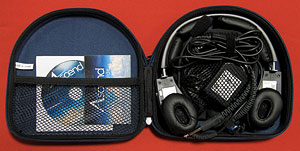
The Ascend meets a long list of FAA-mandated compliance rules under FAA TSO-C139 for aircraft use. It’s also rated for use under a wide range of temperatures, and has been tested to withstand being dropped from a meter onto a concrete floor a dozen times, so it’s a pretty rugged headset. Overall, the construction quality appears to be excellent, and the unit comes with a nice hard-body compact case. The manual, which is supplied on a CD-ROM, is well written and complete. The package includes a recharger with a U.S.-style plug adapter; other international adapters are available as an option. Internet pricing for the Ascend ranges from about $550 to $650.
With the Ascend, Telex has produced another winner in the TSO-certified, turbine-headset market, and I can recommend it to anyone looking for a simple, versatile and compact jet-style headset. Visit wwww.telex.com/ascend for more information.


