
 |
Like so many aeronautical adventures, this was a quest for a signature. I was going to do my biennial flight review and an instrument proficiency check through an FAR Part 142 school—a simulator school. In other words, I was going to be put through the paces in a “virtual world” and never touch a real aircraft just to see what this experience was like.
To set the stage, I’m a multi-engine instrument-rated commercial pilot and a certified flight instructor with 1,900 hours in my logbook. In the “analog” world, I own and have some 700 hours in a Columbia 350 with the Avidyne instrument panel that obtains its information from two Garmin 430s. With those parameters, the Recurrent Training Center in Savoy, Ill., was selected as the most appropriate school for this adventure.
RTC (www.rtcpilot.com) was founded in 1988 by a former air-traffic controller named John Killeen, after he realized how successful simulator training was in reducing accidents with commercial airliners. He was convinced that he could achieve the same results in general aviation, and bought his first simulator. His current operation is housed in a spartan building containing a complement of Advanced Aviation Training Devices (AATDs) and Flight Training Devices (FTDs), including simulators for Beechcraft King Airs, a Baron/Bonanza, a Piper Seneca, a Piper Navajo, a Cessna 300/400 series, a Cessna Skymaster and, finally, the Cirrus SR22 simulator, which I would be flying. RTC can handle 10 to 11 students per day, and is generally booked up for a good two months at a time. To date, they’ve trained 11,000 students.
In The Classroom
Upon arrival, I met my first instructor, Chuck Burmeister, and quickly realized that he’s passionately committed to Killeen’s vision of safer general aviation through simulator training. I found Burmeister’s drive refreshing. Like most pilots, there are signatures in my logbook from instructors who saw me as a vehicle for free flight time as they waited for their slot to open up with an airline. Burmeister was light years away from that and truly cared that I was learning the information being presented to me.
My first questions were all about the legality of Part 142 schools and the differences between the value of the signature from a Part 142 school versus a Part 141 school, or even a Part 61 school. In a nutshell: A Part 61 school means that school is qualified to meet the minimum requirements in the FARs for flight training. A Part 141 or Part 142 school means that a representative of the FAA has personally approved every area of the syllabus to be utilized and each piece of equipment. The difference between the two is that Part 141 is an actual school with aircraft. Part 142 means “flight center,” and this facility has no real aircraft, i.e. FlightSafety or SimCom. There’s a general belief that students trained in 141/142 schools are better prepared for the rigors and challenges of aviation. What I didn’t realize was that this all matters more to insurance companies than it does to the FAA. Going through 141/142 schools can significantly lower your insurance costs. For some aircraft, you can’t even obtain insurance without a 141/142 signature in your logbook.
 He gave me a couple of undaunted approaches to get my confidence up. Then, he attacked. He failed system after system on each approach. At times, there were multiple failures per approach.
Once the preliminary questions were answered, Burmeister and I discussed the benefits of simulator training over the advantages of training in the air. “Basic instruments are where pilots fail,” Burmeister stated. “A lack of understanding basic attitude flying is where most of the accidents in aviation happen. That can be solved and the level of safety increased with the right instruction given by the right instructor. In this modern world, the biggest problem in aviation is that pilots are getting into their aircraft, taking off, turning on the autopilot and hitting GPS Direct at 400 feet. They don’t turn off that autopilot again until they’re down to 400 feet on the other side. Pilots are losing their basic six-pack steam-gauge attitude-flying skills. They get in trouble. Get out of whack and don’t remember how to save themselves. My job is to bring them back to those primary skills. Airplanes are not killing people. It’s the decision making of the pilot that’s killing people. You cannot buy safety. You have to practice it and exercise it.”
In The Sim
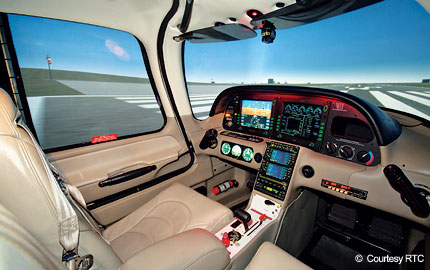
From the classroom, we moved on to the simulator, a series of linked computers, projectors and a very large 15-foot-high wraparound screen that gives a 180-degree moving view from the mock cockpit of the shell of a Cirrus SR22 (which I’m told had once had an actual flying life as a real aircraft in Europe before becoming a simulator). Although I only have four hours in a Cirrus in the real world, from what I could tell, there’s no difference from this mock-up in terms of feel and placement of controls and switches than a flying aircraft.
Burmeister is dogmatic about checklists. “All good pilots have a structure. This is where structure starts,” he said, as we went through the checklist to fire the machine up. The first experience, taxiing, is a little bit nauseating. While “on the ground” objects, i.e. hangars and buildings, moved across the screen so fast and apparently so close that I had to close my eyes to compose myself. Each of the instructors told me that they’ve gotten sick by standing just to the right of the mock-up.
A couple of radio calls and a few more items on the checklist, and I was lined up on the runway 14R at Champaign/Urbana (CMI). I was cleared for takeoff, gave it full throttle, and by 75 knots, I was climbing. At this point, the nausea factor decreased significantly. Once “airborne” for all intents and purposes, this was an aircraft, and I had work to do. Like any introductory flight, the first tasks were level turns followed by climbing and descending turns just to get a feel of the aircraft.
The overpowering emotion of, “This feels real,” was quickly surpassed by, “What do I have to do next to fly this aircraft better?” The thought that I was actually sitting on the ground and not really moving quickly dissipated. Everything directly in front of me, the Avidyne panel, Garmin 430s and all the back-up gauges were all reacting exactly as they do in my Columbia. As far as the exterior visuals go, I wasn’t there to see the ground. I was there to be in the clouds—and I promptly was. Gray white looks the same in the virtual world as it does in the real world. Entering and retrieving data from the Garmins is exactly same in the simulator as the real world.
This experience had become a real flight lesson, and there were tasks to complete in order to pass the course. Time to learn new skills and strengthen old skills. Simulators are humbling, and I was humbled. This aircraft was designed and set to be overly sensitive. I over-corrected at pretty much every control input.
There are only two grades at RTC. A “C” means that you’ve completed the tasks and can advance to the next lesson. An “I” means incomplete, and you have to go back to the starting point or even an earlier lesson. When Burmeister told me that we were done with the first lesson and I was receiving a “C,” I looked at my watch. Two hours had gone by. And here I thought that this had been the most exhausting 20 minutes of my life.
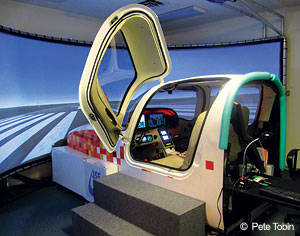 In addition to the Cirrus SR22 simulator, RTC offers training in simulators for King Airs, Bonanzas, Senecas, Cessna 300/400s and more. In addition to the Cirrus SR22 simulator, RTC offers training in simulators for King Airs, Bonanzas, Senecas, Cessna 300/400s and more. |
After a catered lunch, Burmeister and I were back at it with him teaching me his personal philosophy of professionalism, which included reading the definition of “professional” from the dictionary—“one who conforms to the standard of a profession or trade.”
The next lesson was going to be instrument approaches with a whole lot of socked-in weather. My instructor for this was a patient man named Bill Goebel. He gave me a couple of undaunted approaches just to get my confidence up, and I flew a perfectly functioning aircraft to the runway. Then, he attacked. He failed system after system on each approach. At times, there were multiple failures per approach. For some of the approaches, the only thing that saved me was that I popped out of the clouds and could see the ground with enough altitude left to recover the aircraft.
As far as the realism goes, my shirt was dripping wet with sweat by the time I was told that I was receiving a “C” for that lesson. This time, two hours seemed like a lifetime.
For the second day, I would be working with Kyle Lyons, the school’s manager. Ground school was all about being a prepared pilot and how all successful pilots have a structure in prepping for every flight. One of the school’s mottos is that checklists aren’t “to-do” lists, but tools to ensure that you’ve done all of your work and when it needs to be done.
Then back to the simulator for more abuse. Even with all the other tasks going on, Lyons set me up with a catastrophic engine failure while solidly in the clouds at 7,000 feet with the bottoms of the clouds at 200 feet above the ground. With this being a Cirrus simulator, the proper choice was to pull the red handle above my head, firing the rocket, which pulls out that big ol’ giant parachute…and I just couldn’t do it. I’m a pilot. I was going to fly that plane down to the ground. I knew that with a gliding descent of 500 fpm, emerging from the clouds at 200 feet will give me a good 20 seconds to find a solution somewhere in front of me. I put the Cirrus into a farmer’s field at 65 knots with wings level and received a “C.”
But I was there for the whole experience. I had to see what it’s like to pull that handle. Lyons hit the reset button, and I flew the same scenario again. Yeah, I pulled the red handle. This mock-up really simulates the whole experience—right down to the pendulum swinging under the chute all the way to the ground.
As we came to the last lesson of the course, I knew that I really wanted to test the graphics on my home turf. Although my last cross-country was supposed to start from Midway (MDW), Lyons let me start it from Chicago Executive (PWK) so that I could fly the Chicago lakefront, a route that I fly in the real world once or twice a month. The graphics are impressive. Each of the buildings of Chicago’s famous skyline is the right size, shape and color and in the right location. The shape and various angles of the lakeshore are completely accurate. Neither Navy Pier nor Belmont Harbor exists in this virtual Chicago. And, most disappointing, there’s no Wrigley Field. But the whole simulation is real enough that I found myself worrying about busting Midway’s Delta airspace and the consequences of that action before I once again realized this was all pretend.
The Benefits
The central advantages to simulator training are obvious. Fuel (100LL) has quadrupled in price since I did my basic instrument training. There’s no “reset” or even a “freeze” button in a real aircraft. A student can do and re-do the same approach over and over again until they get it right, all with the push of a button—all while practicing the sequences and building muscle memory of the flow of his/her aircraft. In my airplane, I’m constantly worried about shock-cooling my engine. Hence, I’d never allow for the rapid power changes required for proper training in engine-out scenarios.
And let’s be honest. Planes get banged up in training. Accidents do happen. There’s no way for a student to break an airplane in a simulator. Consequently, there will be no repair bills for the student to pay. And the FAA has never once been called in to investigate the crash of a virtual aircraft.
A proper instrument scan is the foundation to all instrument flying. Every pilot you know is capable of fixating on a single instrument. The only way to break that tendency is proper training and continued practice. Simulators are the single best place to develop and improve a scan. First, because a student is never really in danger. According to the FAA’s Aviation Instructor’s Handbook, on pages 1-7: “The element of threat doesn’t promote effective learning. In fact, fear adversely affects perception by narrowing the perceptual field.” You’re not as likely to fixate in a simulator because in the back of your mind, you know that you’re going to survive so you can be free to develop a scan that moves from one instrument to the next. Second, because of what’s called the Law of Primacy (meaning whatever you learn first has the strongest imprint on your brain), when in danger, all pilots will return to the skills taught in their original basic instruction. In plain English, when everything turns to crap, no matter who you are, you’ll revert to the pilot you were in training. Learn the scan right the first time. And the best place to learn and develop a life-saving scan is in a simulator.
The advantages to simulator training are obvious. fuel has quadrupled in price since I did my basic instrument training. There’s no “reset” or “freeze” button in real aircraft. A student can do and re-do the same approach until they get it right. Simulators can fail systems and train you for emergencies that wouldn’t be practical or safe to train for in the real world. For example, one scenario that RTC sprung on me was a catastrophic elevator failure. I was able to successfully land the aircraft with only the throttle and rudder. Now granted, this is a rather unlikely failure. But I personally have had a rudder cable snap on me in a Piper. Should anything similar happen in my Columbia, I now have the confidence that if I keep my wits, I can survive this situation by controlling pitch with throttle only.
There’s an old adage that says, “The only way to develop good judgment in aviation is to survive the experience of having had made bad judgment.” Simulators afford you the luxury of surviving bad judgment. All but one of the times I crashed at RTC came down to the exact same mistake. I was flying in instrument conditions with a failed autopilot. I could handle the situation and emergencies like a trooper right up until the point where I had to divert my focus from the instrument panel to look up information on the charts or approach plates. The main thing this simulator experience taught me is that if the S-Tec 55 autopilot in my Columbia ever breaks, I now have a VFR-only aircraft until a trip to the mechanic’s hanger. It’s plausible that bit of information may someday save my life.
The advantage I hadn’t considered before this experience was the freedom simulator-based training offers the instructor. For a flight lesson in the real world, some 80% of the instructor’s brain is taxed by making sure that student, instructor and aircraft will complete the lesson safely. In a simulator, the instructor knows that the student will be alive at the end of the flight, so he/she can focus on exactly how much information the student is processing or where he/she is fixating.
“A flight instructor’s primary responsibility is to keep the student and the aircraft safe,” said John Killeen. “When I teach in a simulator, my only job is to teach.”
With a U.S. pilot’s certificate, flight reviews and proficiency checks are an unavoidable cost. Doing your checks in an actual aircraft with today’s fuel prices could cost you in the neighborhood of $2,000 to $2,500. Accomplishing the same goal at RTC will cost you $1,599 plus hotel and transportation.
The Recurrent Training Center offers several packages for flight training, from a basic instrument rating all the way up to King Air Recurrency. If you elect to do your basic instrument through a 142 school, the FAA will still require you to do a minimum of 10 hours in a real aircraft, and the unusual attitudes portion of your checkride will have to be performed in the analog sky. To complete your entire instrument rating with RTC from day one to checkride passed and certificate in your pocket in their Cirrus program will cost you $5,999. That includes 30 hours in the Cirrus simulator and 10 in an actual aircraft. (Passing the instrument written exam is a prerequisite for the course.) The same goal in a Part 61 school could cost you upwards of $10,000.
According to Mary Strauser, RTC’s Customer Service Manager, over 80% of RTC’s business consists of return customers. Based on the volume of information I was able to digest and professionalism I received while there, I don’t find that hard to believe at all. I’m quite confident that I will return to Savoy, Ill., again in one year to take the whole course over again.
Of course, this was the quest for a signature. I now have Lyons’ signature in my logbook. According to my insurance agent, completion of this course will most likely be rewarded with a reduction in my insurance fees when it comes time to renew. But the primary advantage to that signature is that I’ve strengthened old knowledge and obtained new knowledge to make me a safer pilot in the analog sky.


