

 |
I was introduced to an angle-of-attack indicator back in the early ’80s. I was ferrying a V35B Bonanza from Atlanta, Ga., to Palo Alto, Calif., where it was to be fitted with one of Victor Aviation’s balanced, blueprinted, Black Edition engines. When I climbed aboard at Charlie Brown Airport in Atlanta, that particular Bonanza was an impressive machine. It seemed to have every piece of avionics there was. It also had 2,050 hours since engine overhaul, 350 past TBO.
The AOA indicator (or in this case a Lift Reserve Indicator, same instrument, different name) was a tiny, two-inch gauge tucked away on the far-right panel—and it looked to be the oldest instrument in the airplane, a tired, circular gauge with an area marked in faded red, presumably meaning, “Danger, Will Robinson,” a small, yellow/white region in the center and the main space marked in green.
To be honest, I wasn’t impressed with AOA on my two-day trip across the country to California. I wasn’t flying the V-tail anywhere near the bottom of the envelope, where an AOA does its best work. (A few years later, I was again faced with an AOA, this time on a new 36 Bonanza headed across the Atlantic and Mediterranean to Israel. I came to know it slightly better and gained a greater appreciation for its several talents.)
The state of the angle-of-attack art has come a long way since then. The instruments have improved dramatically, and AOA devices of all descriptions have become more and more common on the aftermarket.
 |
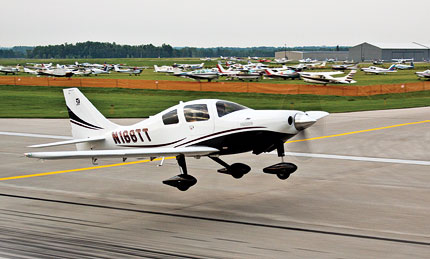
Perhaps of greater significance, aircraft and avionics manufacturers have begun to realize that AOA indicators could help improve the safety record of new general aviation aircraft right out of the box. By definition, experimental aircraft are usually built on a budget, and that often excludes such semi-exotica as AOA instruments. Forgive the selective statistic, but some 45% of all experimental-aircraft accidents are the result of the dreaded stall/spin syndrome. The numbers aren’t so bad for certified aircraft, partially a result of more docile airfoils, less enthusiastic stall response and more conservative pilots who probably don’t fly so close to the edge.
Mark Korin of Alpha Systems (www.alphasystemsaoa.com) in Ramsey, Minn., has long been an evangelist for angle-of-attack indicators, not just because his company makes some of the best systems on the market, but because he’s convinced the devices could help reduce the incidence of stall-spin accidents.
As Korin will be happy to explain to anyone willing to listen, tracking angle of attack is a far superior method of measuring proximity to a stall than is an airspeed indicator. We’re all introduced to airspeed indicators as student pilots, but what we’re sometimes not told is that, perhaps ironically, ASIs are least accurate in the range where they’re needed most.
 |
An airspeed indicator assumes a cumulative error that’s inversely proportional to speed. In other words, error increases as speed decreases. Finally, when an airplane is flying very close to stall, an ASI may be practically useless, a quivering needle bobbing near the bottom of the gauge, reading anywhere from five to 30 knots slow. Conversely, angle-of-attack indicators provide a continuous readout of margin above stall right down to the actual event.
Technically, AOA is the angle between the airfoil chord line and the wing’s direction of motion relative to the air. In simpler terms, you could say AOA is the angle between where the wing is pointed and where it’s actually going.
Contrary to what you might imagine, AOA instruments go back about as far as possible in aviation history. The original 1903 Wright Flyer had only one “flight instrument,” if you want to call it that. It was a primitive form of angle-of-attack indicator, little more than a stick with a piece of yarn attached, mounted on the “aeroplane’s” nose.
The men generally credited with the first powered flight used this device to determine the Flyer’s attitude with reference to the relative wind. There was no airspeed indicator. Wilbur and Orville referred to their primitive AOA indicator to monitor the airplane’s proximity to stall. This was essentially pure flight, little more than modestly powered hang gliding, so instruments were an unnecessary redundancy.
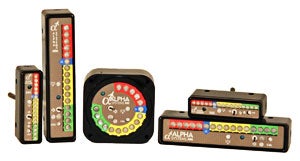 Alpha Systems offers a variety of displays to track angle of attack. |
Considering what the Wrights went through to achieve their goal, pure flight was a worthwhile accomplishment in 1903, but it’s hardly good enough if you’re trying to operate an airplane a century later. Even modern airspeed indicators don’t tell the whole story.
Angle of attack does, and it’s pretty much immutable. Whether you’re flying right side up, upside down, straight up, straight down or any attitude in between, angle of attack ignores airspeed altogether—true, calibrated, indicated, groundspeed or any other kind—and precisely defines the wings’ margin above stall. An angle-of-attack indicator is a virtually foolproof device for determining your attitude with reference to the critical stall angle of attack.
Higher angles of attack result in higher lift but also generate more drag. Airplanes trimmed for cruise flight present their lowest angle of attack to the relative wind and therefore their lowest drag profile. All other factors being equal (which almost never happens), this results in the best possible cruise speed.
Pull the airplane into a climb, and speed bleeds off as AOA and drag increase. When the wing reaches the critical AOA, about 15-18 degrees on most general aviation airfoils, the airflow detaches from the wing’s top surface, and the wing stalls. On aircraft designed with positive stability, the wing will typically pitch forward in an attempt to continue flying.
An angle-of-attack indicator simply (or not so simply) monitors the wing’s pitch with reference to the relative wind and reports that angle to the pilot, often in the form of a graphical, color readout on a horizontal or vertical instrument in the cockpit. The AOA can therefore accurately predict when the aircraft is approaching stall, regardless of airspeed, attitude or weight. (There’s one instance where the AOA range of a given wing will change, and that’s with the application of flaps. Lowering flaps modifies the configuration of the airfoil and produces a corresponding change in the chord line.)
Fortunately, the instrument can do much more than predict stall for those willing to study its capabilities. Properly used, an AOA can identify the exact pitch attitude for best angle or rate of climb. It also can indicate the optimum long-range cruise pitch attitude. It can serve as an instantaneous wind-shear detector, immediately suggesting a solution for any dramatic increase or decrease in wind velocity or direction. An angle-of-attack instrument will indicate the proper approach speed under all conditions of weight, CG, flap position, air density, turbulence or angle of bank.
Everyone can benefit from use of AOA rather than airspeed. The military adopted AOA early on to compensate for the demands of constantly changing weight. Military jets not only burn huge amounts of fuel, many of them depart on their missions with heavy weights of ordinance, then drop their loads and return at half their original weight, introducing major variations in stall speed and CG.
Navy and Marine pilots coming aboard a carrier use AOA religiously to maintain the proper attitude so they can snag one of the ship’s four arresting cables. In fact, the Navy found the switch to using angle of attack rather than airspeed saved lives. When Navy aircraft were fitted with AOA indicators in 1957 and pilots were taught how to use the gauge, the fatality rate plummeted 50% in one year. Today, all military fighter aircraft use AOA in one form or another.
Similarly, bush pilots often fly on the ragged edge of stall during approaches to abbreviated runways. Without an AOA on the panel, the only method of monitoring approach speed is exactly that, watching airspeed and maintaining the proper number. Nothing wrong with that, but it’s a little imprecise.
Imprecise can work well in the right hands. Bush pilots often fly their aircraft strictly by feel, sensing when the wing is on the ragged edge of stall and adjusting power to keep the airplane flying to the threshold. (Back in the ’80s when I used to deliver Maules to the West Coast, the late Dan Spader of Maule Aircraft in Moultrie, Ga., demonstrated this technique, flying the Maule in a constant nose-high attitude actually in the stall, and adding a blast of power to cushion the touchdown. We stopped in less than 100 feet.)
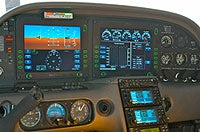 Mark Korin of Alpha Systems believes that his company’s angle-of-attack indicators, seen here installed on a Cirrus SR22, can help to reduce the incidence of stall-spin accidents. |
Most of the rest of us mere mortals need help in identifying minimum approach speed. Many general aviation pilots with a need to land short or on a precise point use a formula approach speed of 1.1-1.2 Vso. Through long hours of experience with a specific airplane, a pilot may know that his aircraft stalls at 50 knots IAS in full dirty configuration. This usually means an approach at 55-60 knots.
Trouble is, if conditions aren’t exactly as planned at 1.1 and circumstances have raised the airplane’s stall by only two knots, they may be flying as slow as 1.05 Vso without knowing it, operating with essentially no margin above stall. For that reason, some pilots mount an AOA indicator on the top left panel, so it’s practically in their line of sight during the approach. No matter what the load, the temperature, the wind or the CG, pilots can monitor the AOA indication during approach and maintain a proper margin between approach speed and stall. They can adjust the needle or light position during the approach and move higher or lower on the scale depending upon conditions.
If angle-of-attack indicators are basically foolproof, they lack glamour. Prior to the advent of light displays, they were typically small, innocuous gauges with no or few numbers. AOAs suffered from not showing us what pilots live by, numbers. They lacked the excitement of airspeed indicators that informed us of the magical speed with which we were traversing the planet.
It has taken a while for Mark Korin’s message to catch on, but the advent of the glass cockpit has made a color display of angle of attack the most logical of instruments. Prior to the advent of flat-panel displays, AOA indicators were separate gauges, often mounted in the panel itself or on top of it. That situation may be about to change big time.
At least three major aircraft manufacturers and the world’s largest glass-panel company have contacted Korin regarding the possibility of incorporating an AOA readout as part of the airplane’s PFD. These displays already include colorful representations of attitude, altitude, airspeed, groundspeed, vertical and horizontal position with reference to a GPS or VOR, the phase of the moon and Vegas odds on the World Series, so AOA could only improve positional awareness.
The plan would be to make the Alpha AOA system standard equipment, presenting visual warnings in the pilot’s peripheral field of view, plus audio advisories, so pilots would have the benefit of angle of attack, regardless of their knowledge of its operating principles.
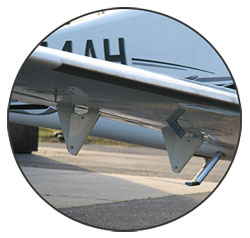
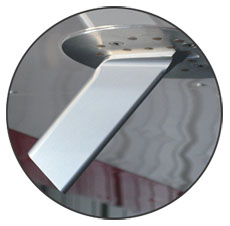
Korin’s Alpha Systems presents AOA information in a variety of visual and audio formats, offering military chevron displays, horizontal or vertical light displays or a needle on a sliding scale. Perhaps best of all in this age of avionics that can easily cost $50,000 or more, Alpha’s instruments are relatively inexpensive, typically costing under $1,500 plus installation. The system utilizes an independent, nonmovable probe that requires virtually no maintenance and should last as long as you do.
Glass panels such as the Garmin G1000 and Avidyne R9 have dramatically revised the way pilots fly both VFR and IFR. Scan problems have diminished exponentially, since so much information is now available on a single screen. In the near future, a pilot may be able to monitor his aircraft’s precise margin of stall on the same instrument.


