

 |
One of the most basic tenets of journalism is that we’re all either the beneficiaries or the victims of our sources. The problem, of course, is learning to differentiate between the two. My friend Tom Watson was a wonderful source. Virtually anything he said you could take to the hangar. Tom had done it all—flown everything, from open-cockpit biplanes to DC-2s (yes, DC-2s) before the war, piloted P-38s and P-47s in Europe during World War II, flight-tested jets and finally retired after the war flying Connies.
Instrument flying was simpler then, or perhaps more difficult, depending upon your point of view. When the weather was down, IFR approaches demanded a combination of pilot skills and primitive radio-navigation aids. In those days, all instrument procedures were nonprecision. They were so imprecise, in fact, that many pilots invented their own techniques for landing “blind.”
As one who had improvised as necessary to get the job done, Tom had less than glowing things to say about the old A-N radio ranges. Flying IFR by ear, with reference to an often confusing series of faint, barely audible Morse code dots and dashes, often masked by crashing static through an ill-fitting headset, was two parts skill, one part experience and at least one part blind, dumb luck. (The A-N range offered course guidance by broadcasting a Morse “A”—dit dah—when an airplane strayed left of course; an “N”—dah dit—when right of course; and a solid tone when on course.)
Then, there was the NDB approach. Radio beacons were used extensively as navigation and approach aids, and again, pilots often ad-libbed as necessary to get the job done, sometimes using commercial AM broadcast stations as homing fixes. ADF was better than the A-N range, but at best, the signal was only moderately reliable, and even the most accurate approach flown to an NDB, was a hit-or-miss operation.
Somehow, Tom Watson survived it all and died in bed a decade ago, though even he was a little amazed at his overall good fortune. Predictably, he regarded the current IFR system “almost too simple.”
 |
Today, we have GPS overlay approaches to ILSs that allow most pilots who aren’t totally asleep to complete a landing to any airport that has weather above about 200 and ½. (The airlines can fly to 0-0 on category III approaches with all three autopilots operable.) The majority of ILS procedures are flown straight-in to an outer marker following radar vectors from a controller. Precision approaches have become more the rule than the exception, and at a few airports, you can even fly GCAs (ground-controlled approaches) with nothing more than a COM radio and a willingness to follow directions.
Yet, the primary point of general aviation is to go places and do things the airlines can’t. We often operate to destinations outside the mainstream where there may be nonprecision procedures or none at all. Nonprecision approaches may be installed at airports where geographic obstructions or other ground obstacles make an ILS impossible. The ground-transmitting equipment for an NDB or VOR approach is a lot cheaper than for an ILS, and that can make it attractive to an airport operator.
A nonprecision approach can guide an aircraft to minimums as low as a 350-foot ceiling with ¾-mile visibility. NPAs also include localizer and VOR procedures that can provide reasonably accurate course reference to the airport but no vertical guidance.
The message is that the feds want a pilot to have a greater margin of error on a nonprecision approach. Without the benefit of a glideslope for vertical reference, the workload increases exponentially. Flying the airplane should always be Job One, but on an NPA, the pilot can feel overloaded with all the tasks necessary to find the ground.
A close examination of the approach plate is obviously the first requirement on any instrument approach, but it’s even more essential during an NPA. You may have a choice of approaches, and you should be especially knowledgeable about the one that will serve you best so you can ask for it in case it isn’t offered.
Most pilots regard a localizer as the optimum choice, followed by a VOR, an NDB and a DME arc at the bottom of the list. (Don’t automatically disdain the back-course approach, by the way. It’s true that reverse sensing is counterintuitive, but if your airplane is equipped with an HSI, you can simply set the front course heading on the OBS and fly the procedure with normal sensing.)
Traditional wisdom has it that all approaches should be timed, but few pilots bother to time an ILS. Conversely, timing is absolutely essential on a nonprecision procedure. The only question is how to time an approach and what time should be used for the termination of the effort and the beginning of the miss. More on that later.
While examining the approach plate, check out the times listed at the bottom of the chart and decide at what speed you’ll make the approach. Keep in mind that faster approaches are more difficult to keep on track, so select the slowest approach speed consistent with conditions and your airplane’s capabilities. Unless you’re operating a biz jet, there’s rarely any reason to fly an approach faster than 120 knots, never mind the 747 coming up behind you. Most singles and light twins can handle 90-100 knots with ease. (Interestingly, the recently introduced Cessna Mustang uses a reference speed of 95-100 knots on approach.)
Since you’re unlikely to receive much help from radar in areas where NPAs are the rule, you should be especially aware of the minimum sector altitudes. Make a mental note of the MDA, as well, and any obstacles on either side of the approach course, just to get a feel of the consequences of deviating left or right. (Ketchikan, Alaska’s airport, for example, is built on the south side of a steep mountain. If you wander too far right while flying into runway 29, you’ll never have to worry about doing it again.)
If the atmospherics are near minimums, pay careful attention to the miss procedure well before you might need it. If nothing else, at least memorize the initial heading and altitude. Be familiar with the layout of the airport, especially if there’s a chance you may be required to make a circling approach.
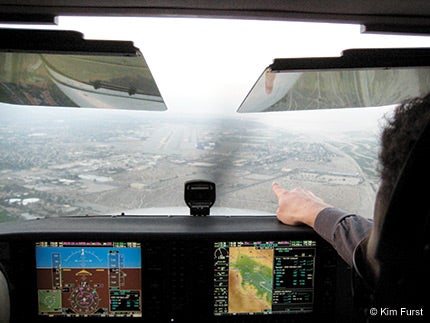
 NPAs can guide an aircraft to minimums as low as a 350-foot ceiling with 3â4-mile visibility, and may be installed where geographic obstructions or other ground obstacles make an ILS impossible.
If the approach does terminate in a circle-to-land, you’ll be expected to maintain at least 300 feet above the ground until you’re lined up with the runway. Circling approaches in hard IFR is bad news, especially when the weather is at or near minimums. Most airplanes don’t enjoy flying slow even in good weather, and the majority of pilots feel the same. A circling situation often sets a pilot up for a fall. He can’t increase his speed too much or he’ll only have to reduce it again for landing. Additionally, he needs to keep his turn fairly tight to stay close to the airport and maintain contact with the runway. Here again, speed control is critical, as a slower speed and steeper bank angle will increase the possibility of an accelerated stall.
As with an ILS, the primary risk is of the dreaded duck-under, but it’s even more critical on an NPA because course guidance is less accurate. Accordingly, the consequences of dropping below the MDA can be considerably more severe than when flying an ILS. There’s far more room for error on an NPA, both because the approach must be timed and flown at a constant airspeed and because the approach aid is often less accurate. Some pilots who fly a regular diet of NPA procedures buy a red, single-hand altitude reminder that adheres to the glass on the altimeter face and can be set to the appropriate MDA.
In emergency situations on precision approaches, pilots have been known to bust minimums and take an ILS all the way to the ground. If you pull it off and walk away without breaking anything, the consequences may be no more severe than a talk with the local FSDO. Like most pilots, I’ve flown ILSs to the flare several times during training under the hood with instructor Gary Meermans in the right seat. Sadly, the reality is that most of us will never be as good as we were right after earning our instrument rating. Flying an actual nonprecision approach to the runway during extremely low weather is about as dumb as the man who drowned while trying to walk around the world.
Two points need to be made about approach timing. You can’t expect to arrive at the MAP (missed approach point) at the proper time unless you start the clock when you cross the FAF (final approach fix). Similarly, you must fly the approach at the planned speed, or the time becomes irrelevant.
The first task sounds simple enough, but Murphy’s Law often manages to get in the way. Like most instrument pilots, I was taught the seven Ts of an IFR approach, especially apropos to a nonprecision effort: time, turn, tach, track, trim, tune, talk. After you say it a few times, it has a certain symmetry that makes it easy to remember.
Note that “time” is the first priority. When passing the FAF, be sure to punch the stopwatch immediately after you pass the fix. If it’s a VOR, wait for a definite flag flip; if it’s an NDB, wait for a full needle reversal. Since you’re flying into an airport environment which, by definition, should be flatter than the surrounding terrain, you need to arrive on time, but if not, it’s probably better to be a few seconds late than early.
Once the clock is running, make any necessary turn to an on-course, inbound heading. If the approach is a straight-in, that heading will always be within 30 degrees of the runway alignment; otherwise, the approach will be designated as circling, and higher minimums will apply. “Tach” refers to a power adjustment to start down toward the MDA. (This more accurately might be labeled “throttle,” since airplanes with constant-speed props may show little change in rpm.)
“Trim” is self-explanatory and may be automatic if you were taught to always minimize elevator pressure. “Track” is merely a double-/triple-check of what’s happening to the nav needles. Are you holding course, or is a correction necessary?
“Tune” refers to the need to switch the radio to tower or Unicom frequency, and “talk” is the least important of your priorities, announcing that you’re inbound from the FAF.
Defining the proper speed to accomplish all these tasks is a little more difficult. As mentioned above, slower is nearly always better. If it were a simple matter of holding the published airspeed from the FAF to the MAP, the task wouldn’t be too difficult. But keep in mind, your time will be based on groundspeed, not indicated airspeed.
This means you may have to correct indicated airspeed for the wind. If you’ve listened to the ATIS, you’ll have a rough idea of what that is on the ground. Since most approaches are flown into the wind, you often can assume you’ll be slightly short of the MDA when the time expires unless you make a groundspeed correction. Also, remember that the wind at 1,500 feet may be different from that on the ground. If you have DME or GPS, you can make a mental note of the headwind and plan to fly with a reasonable correction, say five knots faster. (Without a glideslope, some form of distance measuring may be mandatory. Narsarsuaq, Greenland, has an unusual NDB/DME approach with a mandatory 5.6 degree descent, compared to 3.0 degrees on the normal ILS.)
There are two methods of descending from the final approach fix to the missed approach point—drift down slowly to arrive at the MAP when the time expires or descend to the MDA as quickly as possible so you can be established on track and ready to look for the airport when time runs out. The drift-down is perhaps the more favored method, as it’s a stabilized procedure. The zip-down is more difficult to time as it requires additional power adjustments when you stabilize at the minimum descent altitude.
Either way, the goal is to fly right up to the MAP at an altitude no lower than the minimum descent height, look for the runway, and if it’s not there, proceed to plan B, the missed approach. Don’t fly beyond the MAP at low altitude, hoping something will show up. Even if it does, you may be too far along and too high to effect a successful landing.
A safe landing is, after all, the bottom line of any instrument approach. Nonprecision approaches can be nearly as safe as the precision variety if the pilot follows the rules to the letter. Remember, however, that NPAs provide less electronic guidance and have a reduced margin for error. If the weather is really “grundgy” and you’re rusty on your approach techniques, you might be wise to divert to an alternate with a full ILS, or better still, look for an airport that’s still VFR.


