

 We’ve finally reached the end, my friends. In “Wingipedia, Part I” [March 2008], we covered “acrobatics through “induced drag.” And in “Part II” [May 2008], we took care of “Jenny” through “roll.” It has been fun, but our aviation version of Wikipedia has reached the end of its line. Wikipedia, which asserts that its name is “a portmanteau of the words wiki (a type of collaborative website) and encyclopedia,” is an online encyclopedia that’s written and edited by its visitors, i.e., people like you and me. As this is a print publication, it’s hard for us to offer the same access with Wingipedia. But, as always, you’re encouraged to comment and add your two cents online at planeandpilotmag.blogspot.com, where the fun never stops. Cheerio!
S
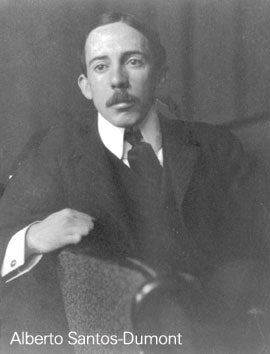
Santos-Dumont, Alberto
Brazilian-born Alberto Santos-Dumont was an aviation pioneer who lived in France and made the first public European flight of an airplane in Paris in 1906. Long before the Wrights did, he routinely launched his aircraft without the aid of catapults. His dainty little Demoiselle of 1909 might well be considered the first practical lightplane.
Spin/snap roll
A spin and a snap roll are both full-stall maneuvers, with yaw imparting an autorotation. A snap roll is a horizontal, high-speed stall, while the spin is vertical and entered at the aircraft’s normal stall speed with lots of yaw. The snap roll can be mind boggling; the spin generally isn’t.
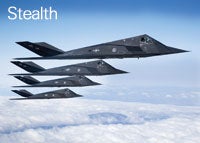 Stealth
New-generation military aircraft now depend upon increasing levels of “stealthiness,” rendering planes invisible to radar-targeting systems. This is accomplished with extreme attention to external detail to absorb or diffuse radar return signals.
STOL
Short takeoff and landing. How short is short? Generally STOL airplanes are mission-specific and are designed specifically to get off extremely short runways (as opposed to fairly short runways, in which case they’re utility aircraft). A Cessna 180 is not STOL, but a Helio Courier is. A stock 150 hp Super Cub might be, but a modified 180 hp Super Cub definitely is.
T
TAS
True airspeed: The indicated airspeed corrected for density altitude effects. It’s always higher than indicated airspeed and is the speed most quoted by the pilot because it makes the airplane appear faster.
Tach
You can spot aviation newbies by their use of the entire word tachometer. The tach serves dual purposes by letting us know how fast the engine is turning over (which, in a direct-drive engine, is also the propeller rpm) and keeps track of engine run time.
TBO
Time between overhaul: The hours you can reasonably expect an engine to run before it needs to be rebuilt. To ensure that an engine runs to TBO, fly it often, change the oil often, then fly it some more. If either or both of these are missing, your engine is unlikely to make TBO.
Turbofan
The turbofan could be considered a turboprop with very short blades. It uses a conventional jet engine to turn a cowled fan section that extends out past the diameter of the engine itself. It has proven to be the most fuel efficient form of high-speed propulsion.
U
UAV
Technically anything, from a kite on up, can qualify as an unmanned aerial vehicle. UAVs are essentially exotic radio-controlled models, some of which are huge, armed and dangerous. Planes in Iraq can be controlled from as far away as Florida. They’re rewriting some of the rules of warfare.
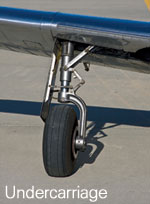 Undercarriage
The original name for landing gear. Very British in origin and still part of a GUMP check.
Unicom
Unicom stands for “universal communication,” and sometimes it’s a little too universal. Although its purpose is to sort out traffic at uncontrolled fields by making everyone aware of one another, sometimes it turns into the aerial equivalent of a CB radio.
Useful load
The term says it all: It’s that part of the plane’s allowable gross weight that’s actually useful to you, meaning you added it, and it’s the difference between the gross weight and the empty weight. It includes things like gasoline, pilots, baggage, pets, handbags, cosmetics, charts, pencils!you get the picture.
V
VASI
The visual approach slope indicator is the civilian’s version of the “meatball” landing system on a carrier. If you’re right on glideslope, the first set of lights appears white and the second set appears red. If both look white, you’re high; if they both look red, you’re getting low.
Vector
Technically, a vector is a quantity having both a direction and a magnitude, e.g., wind is from 30 degrees at 10 knots. An airplane on final has both a downward vector (500 fpm at straight down) and a forward vector (80 mph at horizontal)—the resultant of the two is the glide angle at the glide speed.
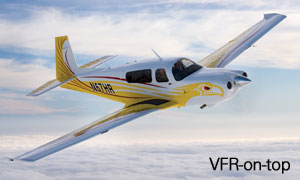 VFR-on-top
“Visual flight rules” means you have the required minimum visibility and cloud separation to fly without an instrument clearance. VFR-on-top means you can see well in every direction but down. Above the clouds, VFR-on-top is one of those places where sphincters tighten up.
VOR/VHF
The omnirange navigation system: A system in which a ground station sends out signals like the spokes of a wheel, with a spoke for each degree. The receiver tells the pilot which spoke he’s on and whether he’s going to or from the station. It doesn’t give airplane heading and is being rapidly supplanted by GPS.
 W
W
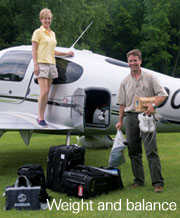
Weight and balance
This is the mystical art of telling whether you have the load distributed in such a way that the airplane can safely fly or not. Inasmuch as ignoring the weight and balance of an airplane can, if allowed to go far enough out of bounds, kill you, it’s an art worth deciphering.
Wristwatch
A wristwatch, in aviation terms, must be big, heavy and terrifically complex. It can include GPS, satellite communicator, popcorn maker, etc. If it tells the time accurately, that’s a plus, but that doesn’t really add to the gee-whiz factor. Jeez, a watch that tells time: How provincial!
Whiskey compass
The name comes from the liquid in compasses that was originally part alcohol (we’re not sure if that’s true, but it sounds good). It’s the one navigation instrument in the cockpit that will still be working when the electricity goes out or the batteries go dead.
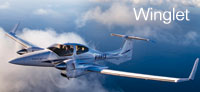 Winglet
No, the winglet, the vertical fin at the end of a wing, wasn’t invented by Burt Rutan, but he’s certainly the one who proved that it worked. The winglet redirects the wingtip vortex, thereby greatly reducing tip losses, and makes the wing think it has a higher aspect ratio, which gives more lift with less wing.
X
X-band
This includes the radio frequencies that lie between approximately 8,000 and 12,500 MHz, which is considered the microwave range. It’s used for some satellite communication and for radar imaging systems.
Xcvr
A transceiver combines the abilities to both transmit and receive radio communication signals in the same unit. As opposed to a NAV/COM unit that bundles a navigation unit with a transceiver, a transceiver is a stand-alone, single-purpose unit.
Xmit
The act of transmitting in aviation is the same as it is in any other segment of society: It entails the movement of information via radio waves that can be read by a receiver on the other end.
X-mark
X marks the spot on the sectional indicating where you’re supposed to be but probably aren’t. The proper decoding of a misplaced X-mark generally leads to much sweating, accompanied by eyeballs constantly scanning the countryside while comparing landmarks with those on a badly wrinkled chart.
Y
Yankee
In the aviation alphabet, “yankee” is a fancy way of saying “Y,” but southern aviators don’t use it unless coerced, preferring “y’all” instead.
Yaw
Yaw is the movement of the aircraft about the vertical axis, resulting in the nose moving sideways, the ball going off center and usually the outside wing coming up. Or it’s the positive response to a controller questioning whether your gear is down and locked.
 Yoke
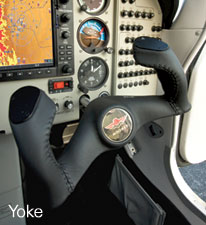
Yoke
Although everyone knows what a control yoke does, no one seems to know where the term came from. From controlling yaks, maybe? Although it controls an airplane as well as a joystick, it’s easier to understand the derivation of the word joystick.
Z
Zero time
A zero-timed engine is one that’s “rebuilt” by the factory (or its designated representatives) to new tolerances throughout and is therefore allowed by the FAA to show zero time in the logbook. An “overhaul” isn’t required to be done to new tolerances, only to “service limits,” and can’t be considered zero time if it has been overhauled to new tolerances by someone not designated by the factory.
Zero-zero
When applied to weather, zero-zero means almost certain calamity if you try to fly in it because zero ceiling is combined with zero visibility. You won’t even be able to taxi. When applied to ejection seats, zero-zero means almost certainly avoiding calamity because the seat will work with zero altitude and zero speed.
Zlin
Although Zlin is both a city and a region in the Czech Republic, within aviation circles, this refers to excellent aircraft, aerobatic and otherwise, that have been produced by Moravian Aviation s.r.o. The most recent was the Z-242/143 touring/aerobatic aircraft.
Zulu time
Greenwich Mean Time, a.k.a. “Zulu time,” is the time standard used throughout the world to set clocks, plan/synchronize major events and determine time zones. Because most of us can never remember how many hours ahead it is, go to www.greenwichmeantime.com, which has a running clock showing the difference from your location.
Though Wingipedia ends with this third edition, the series lives on at our website. You can comment and make additions to our aviation encyclopedia at planeandpilotmag.blogspot.com.


