

|
| Photo by Mike Shore |
My first airplane, a 1947 Globe Swift, purchased in 1966 for $3,700 when I had a whopping 80 hours in my logbook, was a cute little devil. It offered quick handling and was a ball to fling around the sky, but it obviously hadn’t read its own press releases. The stock Globe GC-1B came up short in virtually every performance parameter—it wasn’t nearly as fast as advertised, didn’t climb as it was supposed to, burned more fuel than the POH suggested and couldn’t carry nearly as much weight as it “should” have. I learned the airplane’s true nature by trial and error, probably not the best method in any aeronautical pursuit.
As a new pilot in the age of $0.40-per-gallon avgas, I was primarily interested in going places rather than droning around the local sky in search of the perfect airport hamburger. That was a revelation, too. I learned that a destination advertised as being 346 nm distant might be as much as 10% farther away in practical terms, simply because it’s difficult or nearly impossible to fly so precisely as to prescribe an exact great-circle arc.
I also learned lessons about tailwinds. The tailwind that was promised as a 20-knot component on the outbound leg might rarely reach that speed, at least not until I was headed home in the opposite direction against what had become a headwind. I learned the hard way to be a cynic about every aspect of flight-planning, not because anyone was necessarily lying about the winds or the airplane, but because experience suggested that the reality almost never met the expectation.
 Today, of course, operating handbooks are slightly less optimistic, the science of wind forecasts has advanced exponentially and the GPS has relegated the whole question of flight-planning to insignificance.
Or has it? While it’s probably true that few pilots navigate by pilotage or point-and-shoot anymore, flight-planning is still far from the slam dunk you might imagine it to be.
Weather is the first area in which you may find it necessary to ad lib more often than you think. It’s true that briefers are paid to be pessimists and to intersperse virtually all briefings with comments about “VFR not recommended,” but even when conditions are advertised as good, they may not be that far from bad.
Clear-air turbulence is one common manifestation of unstable weather that can demand special attention. If you’re flying VFR, the best advice during moderate to severe updrafts and downdrafts is to go with the flow (within reasonable limits) and allow the altitude to vary rather than fight the vertical currents to keep the airplane at the same level. Obviously, this won’t work on IFR flight plans or in actual IMC weather, but it can save time and work on most purely VFR flights.
I fly a modicum of hard IFR on international delivery flights (at times operating in all kinds of meteorological misery—icing, heavy glop and other fairly unpleasant conditions), and instrument weather nearly always slows things down five or 10 knots. Much of that’s a function of the wing being less efficient in rough air than in smooth air, but even in soft IFR, it seems any flight in the clouds nearly always requires more time than a VFR trip.
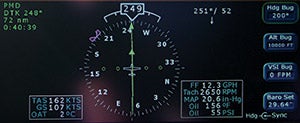 |
| Any wind from a consistent direction will usually be a losing proposition on a round-trip flight because a headwind, such as the 52-knot winds encountered on a leg to Palmdale, Calif., acts on the airplane longer than a tailwind. |
Accordingly, I flight-plan IFR trips longer than VFR trips to allow for weather deviations, ATC anomalies or any other variable that might extend my flight time. I’ve also gotten into the habit of always asking the briefer, “Where is it good?” so that if I decide to forget the whole thing, I’ll have someplace nice to aim for.
Altitude selection is another area where you need to have an open mind. Many pilots planning a long flight tend to concentrate on picking a single altitude for the entire trip, even if they’ll be transiting 700 to 800 nm of terrain. That’s far enough that you may be transiting several weather systems, and the change in flow may dictate variable altitudes for such a flight. You may want to consider starting at 8,000 feet at the beginning of a trip, climbing to 12,000 feet halfway through the hop, then descending to 6,000 feet for the last hour.
It’s true that most pilots are smarter than me and don’t fly across oceans, but if you operate over long distances on a regular basis, you may be well served to have a liberal attitude about altitude. In turbocharged or pressurized airplanes, for example, I’ve sometimes varied my height above sea level by 16,000 feet or more on the 2,160 nm leg from Santa Barbara to Honolulu, starting at 6,000 feet in the prevailing headwinds near the California coast, and gradually ascending to 22,000 feet or higher as I come under the influence of trade winds 1,300 to 1,500 miles out.
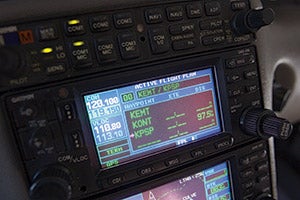 |
| Plugging in a direct-to destination on a GPS unit will give you the great-circle distance from Point A to Point B, but direct flight may not be possible due to airspace restrictions. |
Route distance is another X-factor. If you own any of the great portable or panel-mounted GPS devices, then you know that determining the pure distance to a given destination is simply a matter of plugging in the four-letter identifier and pressing enter twice. Trouble is, that number isn’t quite as telegraphic as you might think. It’ll give you a pure great-circle distance from point of departure to destination, but Class B or C airspace, restricted areas or MOAs may make a direct flight inadvisable.
If you fly above the plains of the Midwest or along the flat beaches of the East Coast, you may be able to travel the direct route pretty much as offered. If there are mountains or bodies of water in the way, however, you may find the GPS distance to be impractical.
Similarly, the advent of data linking in cockpit weather devices has made pressure-pattern flying, e.g., following the optimum winds, more reasonable. If you’re operating in the vicinity of a low-pressure system with counterclockwise flow, you might want to fly to the right of center, with the wind at your back. A high-pressure system suggests flight to the left.
In my Mooney, my little backup Garmin 496 with weather uplink plots those wind patterns for me and allows me to interrogate the winds aloft for the most efficient routes. That’s not necessarily the shortest route, but it may be the quickest, and that’s usually all that matters. Successful pressure-pattern operation is usually contingent on either very tight systems or long-distance travel to make the off-course variations worthwhile.
Speaking of winds aloft, it’s important to remember that any wind from any consistent direction will usually hurt you on an out-and-back mission. (In 42 years of flying, I’ve had tailwinds in both directions exactly twice.) Direct headwinds and tailwinds are the easiest to manage, as they don’t balance each other on a round-trip. Even if a forecast tailwind on an out-and-back mission does materialize, you’ll usually lose speed with wind from any direction on a two-way trip. That’s because a headwind acts on the airplane for longer than a tailwind. To use a simple example, a 100 nm trip in a 100-knot airplane with a 20-knot tailwind requires 50 minutes outbound and 1+15 return for a total of 2+05 (versus 2+00 for the same trip in no-wind conditions).
If you analyze the numbers, you’ll find that any consistent wind is nearly always a losing proposition. Even a direct crosswind costs you speed. In fact, if the wind is from any direction other than the aft 160-degree quadrant, you’ll fly slower.
If you should happen to luck out and encounter tailwinds up high, plan to stay as high as possible for as long as possible to maximize your speed and minimize your time en route. If you normally plan your descents at 500 fpm, consider maintaining altitude longer and plan a descent at 1,000 fpm to your destination with reduced throttle.
Aircraft cruise speed and fuel burn normally don’t meet specs for a variety of reasons, none of them having to do with a braggadocio flight manual. It’s important to remember that your chances of reproducing book specs are poor. Cruise charts are based on highly experienced test pilots with thousands of hours flying new airplanes with perfect engine tune and propeller pitch, optimum CG near the aft limit, all vents closed and a modicum of external antennas.
Fuel burn will rarely equal or “subceed” the charts, at least not if you hope to make your engine last to TBO. Even if you don’t have an engine analyzer, the old traditional wisdom about leaning will allow you to come close to book, but probably no cigar.
When most of us old pelicans learned to fly, often without the benefit of even a single-probe EGT, we were taught to lean the engine to the onset of roughness, then push the red knob forward just enough to ensure smooth operation. On most engines, that will put you slightly on the lean side of peak. If you don’t subscribe to running lean of peak, you’ll burn a little more fuel and find it even more difficult to achieve book fuel flows.
Most airplanes today are fitted with engine analyzers that allow interrogating each cylinder for EGT and CHT, and that makes it easier to lean to the most efficient setting. Even so, you may find achieving book fuel flows to be a challenge.
The choice of power setting is more than arbitrary, no matter what kind of airplane you fly. In my Mooney, I tend to use 75% cruise whenever possible, but there are times when you can actually reduce total travel time by flying slower. A recent trip from Los Angeles to Miami (via Cross City, Fla.) is a perfect example. The GPS distance works out to just below 2,100 nm. If I use max cruise in no-wind conditions on that trip, I’m obliged to stop three times. If I come back to 55%, however, I can eliminate one stop, burn less fuel and make the trip in the same or less time.
In my case, I’m probably not smart enough to do that. I’ll nearly always opt to fly faster, even if it costs me time and money. Some pilots never learn.
| Additional Tools |
|
Bernoulli Aviation’s Destination Direct aids pilots by planning the intended flight path, calculating weight and balance, and determining the effects of winds aloft. The user-friendly, highly intuitive software has a comprehensive design that’s easily customizable for various pilot skills and aircraft types. Among its extensive features is the ability to connect to your GPS, allowing you to view your aircraft as it moves en route and depicting your current position in relation to other airports and navaids. Contact: Bernoulli Navigation, (618) 281-8050, www.flightplan.com. Golden Eagle FlightPrep Software (GEFP) is a result of the combined efforts of CSC DUATS and Stenbock & Everson Inc./FlightPrep. It’s a free flight-planning and weather-briefing (both graphical and text) application that offers flight-planning, NEXRAD overlay and graphical TFRs on both relief and IFR charts. Every 28 days, the FAA publishes an updated set of approaches and charts; the GEFP data is updated on the same schedule. Contact: FlightPrep, (800) 966-4360, www.flightprep.com; CSC DUATS, (800) 767-9989, www.duats.com. Jeppesen FliteStar Version 9.0 includes weather, TFRs, airport information, FBO data, airspace, terrain, weight and balance and cost information for each of your flights. Contact: Jeppesen, (800) 621-5377, www.jeppesen.com. Advertisement
Seattle Avionics Voyager Version 4.0 is a powerful flight software system featuring more than 200 enhancements over previous versions. The most notable addition is the new charting engine, based on Microsoft DirectX technology (which powers Google Earth and Microsoft Flight Simulator); it provides near real-time zooms, pans, rotates and other chart actions. Pilots can show actual FAA-scanned sectionals and IFR charts directly on the main chart. Version 4.0 includes automatic routing based on expected winds aloft and georeferenced approach plates, among other things. Contact: Seattle Avionics, (425) 806-0249, www.seattleavionics.com |


