

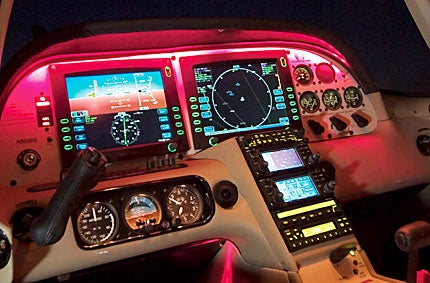
 It has finally happened. While waiting for you to land one day, your significant other saw the advertisement for the new glass-cockpit rental airplane, looked it over and now wants a flight in it. “It’s so much cleaner than those old airplanes you always fly.” Those words stung. “Why can’t we fly the new one?” That didn’t sting. After some serious negotiating on the flying budget—the new airplane wasn’t your idea—you’re off to your first glass-cockpit transition lesson. Ensuring your significant other was at the airport on the day of the flight school’s glass-cockpit open house was a grand idea. Reading this article before the first lesson is another. These FAQs will make your first glass-cockpit flight go much more smoothly.
What Is Glass?
A glass cockpit contains at least two screens that replace the standard six-pack of flight instruments. The first screen, in front of the pilot, is the primary flight display (PFD), which replaces the flight instruments. The second screen, to the right, is the multi-function display (MFD), sometimes called the multi-frustration display. While the MFD may look like the PFD’s identical twin, it has its own personality and functions, such as the moving-map displays and, depending on how many options the aircraft owner purchased, engine instruments, traffic, weather and even instrument charts. The MFD can be considered a backup and an additional information source to the PFD. With the proper options, the weather information includes temporary flight restrictions (TFRs) depicted on the moving map. Imagine knowing about TFRs as soon as they pop into the system, even those that appear while in flight after your weather briefing with Flight Service!
Three of the six familiar flight instruments are left behind as backups. As the average failure time of the black boxes exceed the life span of most airplanes, I figure the backups are there to make “steam-gauge” pilots feel better during the initial transition.
How Do I Learn It?
Glass-cockpit manufacturers do their best to make the glass easy to learn. They’re not expecting you to start studying 15 minutes before your passengers arrive, however. At Gene Hudson Flight Training, for example, pilots understand the use of the PFD almost immediately. The MFD takes a few minutes to explore, but it quickly becomes second nature. Once pilots are exposed to an autopilot that works, that part of the transition is straightforward. The GPS then becomes the most difficult item in the glass cockpit to master, especially for those without any previous GPS experience. Plan to spend some time studying the GPS to make use of its features.
You can make your transition even easier by obtaining and studying the avionics simulators, information manuals and training guides before the first lesson. Garmin has made its GNS 430 simulator available for free download on its Website (www.garmin.com). The Garmin GNS 430 is the brains behind the Avidyne FlightMax Entegra system, and if you’re familiar with the GNS 430, the Garmin G1000 GPS functions are similar. Download the Garmin GNS 430 simulator and go play. Reality XP, an avionics simulation company, has made the Garmin GNS 430 simulator work with Microsoft Flight Simulator 2004 for those who want to practice procedures while maintaining aircraft control. Eaglesoft, another flight simulator company, has released models for the Cirrus SR22 and SR20 for Microsoft Flight Simulator as well. Most pilots give the Eaglesoft simulators high marks for accuracy, detail and authenticity.
Where Is The Airspeed?
Turn on the master switch, and the PFD lights up immediately. It’s designed to withstand the electrical power fluctuations during start and shutdown; no, someone didn’t forget to turn off a switch. You’ll recognize the attitude indicator on the PFD immediately, except now, the sky and ground depiction is drawn across the entire screen, not just two inches. The airspeed, now a “tape” strip, runs on the top left side of the screen, with the current airspeed as the boxed number and trend lines showing increasing or decreasing airspeed. The altimeter is another tape strip on the top right side, with the current altitude as the boxed number, trend lines above or below, and the altimeter setting on the bottom of the tape. The vertical speed has moved from the bottom right to the top right, a tape strip (on the Garmin G1000) or a gentle arc strip (on the Avidyne FlightMax Entegra). The directional gyro, now a horizontal situation indicator (HSI), is bottom center, with your current heading as the boxed number at the top center of the arc or 360-degree view.
The only flight instrument that isn’t immediately obvious is the turn coordinator. Hidden on top of the HSI is the turn portion. The first tick mark is a half-standard-rate turn, and the second tick mark is the full-standard-rate turn of three degrees per second. While a backup attitude instrument might have an inclinometer (ball), the ball is now a trapezoid, hidden under the bottom arrow at the top of the attitude display (See Figure).
Where Is The GPS?
The GPS controls are built into the displays of the Garmin G1000 system. The chapters and pages are fully available through the MFD, and a small set of functions are available in the PFD. The Avidyne FlightMax Entegra system keeps the GPS separate. The GPS can be found as a moving-map display somewhere around the center stack of avionics either in the center of the PFD and MFD, or under the displays.
Where Are The Tips?
Here are some tips that will make flying the glass cockpit much easier:
TIP 1 Fly the airplane. When all else fails, fly it until the last piece stops moving. If the electronics misbehave, let them do whatever they want for a while and just concentrate on flying the airplane.
TIP 2 Avoid distractions. A fundamental glass-cockpit skill is division of attention. The pilot must still aviate, navigate and communicate, in that order. Divide glass-cockpit programming into three-second bites. Program for three seconds, check the flight instruments, then program for another three seconds.
TIP 3 Know your knobs. Read the label around the knob before twisting it. Read the button label before pressing the button. Ask yourself if this is the correct knob or button, then try it. If you pushed the wrong knob, first turn the wrong knob back to where it was, then turn the correct knob. If you hit the wrong button, or type in the wrong identifier or the box simply doesn’t do what you want, start over. Hold the CLR button down for two to three seconds on the Garmin G1000 and GNS 430 boxes, which returns you to page one of the navigation chapter, where you can start again.
TIP 4 Let George fly. Use the autopilot when programming. It’s his airplane until you hit disconnect, so don’t try moving the controls while the autopilot is engaged—the results will surprise you. Remember to adjust power when leveling off from a descent or climb, as some autopilots don’t have an airspeed hold mode and will happily stall the airplane when you’re not looking.
TIP 5 Read your mail at the right time. You can ignore some messages or alerts. If you don’t, the system will nag you about irrelevant items. The system, however, also can warn you about important items, such as black-box failures, or bad weather ahead. Any time you’re not expecting a message, you need to read it and find out what’s going on. It could be quite important. Know when to expect which messages and when you can ignore them.
TIP 6 Your typing teacher was wrong. Button presses per minute is not a scored item in the cockpit. Glass-cockpit programming can lead to mode confusion and keystroke errors. Prevent this with slow and deliberate action regarding the electronics, knowing that only the results count. One of the few exceptions is an autopilot that decides to do a rare hard-over failure. The only fast action is to disconnect it and fly the airplane.
TIP 7 Cheat, but cheat well. If you can’t remember a certain procedure, write it down in checklist format. We use checklists to remind ourselves of important tasks while flying, so why not one for avionics? If your mind goes blank while flying, you can grab the checklist, flip through to the appropriate section and remind yourself how to tell the box what you want it to do. Some pilots claim that using an avionics checklist added an average of only 15 seconds to the programming task, but it eliminated all failed attempts to perform the task.
TIP 8 Look out. The glass cockpits look cool inside. But avoid the head-down-and-locked syndrome by taking the time during each flight to look outside and enjoy flying. When your significant other comes aboard for the first glass-cockpit flight, you’ll be able to point out the scenery that he or she will be missing because, with head down and locked, he or she will be staring at the displays, wondering if it’s time to learn how to fly.


