

 On February 16, 2008, the general aviation community lost one of its members. A single-engine aircraft crashed to the right of runway 10R at Portland International Airport in Portland, Ore., while attempting an ILS approach for the second time in very low IFR (VLIFR) conditions. The pilot sustained fatal injuries and the aircraft was destroyed. Because the NTSB is still investigating this fatal accident, we don’t know if this pilot had Category II authorization. According to the preliminary NTSB report, we do know that conditions two minutes prior to the accident were well below Category I minimums for the approach, with a broken ceiling of 100 feet and a runway visual range (RVR) variable between 800 and 1,600 feet. Without Category II authorization, attempting this approach more than once was an accident waiting to happen.
To be fair to the pilot, a Part 91 operator can attempt any instrument approach even if the weather at the airport is currently reporting a ceiling and/or visibility below authorized minimums for that approach. So there’s nothing inherently wrong with making multiple approach attempts as long as it’s done legally and there’s a premeditated choice to eventually divert and not try to push the envelope. While a single attempt may be within reason, with a ground visibility of 1â8 statute miles and a RVR of 600 feet, there’s nothing that could be gained by a second try, unless you’re executing the approach to minimums simply for training or currency.
When you really don’t want to divert, there’s a temptation to give it one more try, especially when you hear about other aircraft getting in, as was the case in Portland on the day of the accident. It’s important to understand that commercial operators have slightly different rules that can be more restrictive but allow for lower minimums in some cases. This was the case for the ILS at runway 10R, which also had a Category II and III ILS approach. This allowed aircraft with specific flight crew qualifications and avionics requirements to fly to Category II or III minimums.
What’s even more enticing is hearing “cleared to land” issued by the tower controller while you’re still in IMC on the approach; somehow, these familiar words engender a hope of seeing the runway environment the second time around. Nevertheless, some pilots still have the desire to cheat a little bit lower though they lack the proper training and authorization. We don’t know if this was the case in this tragic accident, so we’ll have to wait for the NTSB’s ruling.
| Circle To Land In Low IFR |
| One of the most difficult maneuvers an instrument pilot must make is a circling approach in low IFR conditions. The AIM even weighs in on this by stating in 5-4-20 (f): “Circling may require maneuvers at low altitude, at low airspeed and in marginal weather conditions. Pilots must use sound judgment, have an in-depth knowledge of their capabilities and fully understand the aircraft performance to determine the exact circling maneuver, since weather, unique airport design and the aircraft position, altitude and airspeed must all be considered.” Advertisement
Circling minimum descent altitudes at an uncontrolled field that are below the traffic pattern altitude should be avoided. Even though it’s legal to circle to land at some airports with a 500-foot ceiling, it’s not wise. This is especially important if the airport has a right-hand traffic pattern, which can make the pattern difficult to fly at such a low altitude. Be careful with approaches that have excessive descent gradients on final. The major clue here is that the final approach course is essentially in line with the runway centerline, but no straight-in minimums are published. This doesn’t mean you can’t land straight in, but in a low IFR condition, you may be caught off guard by the excessive gradient that’s required, forcing a last-minute circle-to-land maneuver. |
When the term Category I, or more simply CAT I, comes up in conversation, the first thing that comes to mind is the ILS approach. It’s true that the typical “200 and ½” straight-in ILS procedure is a CAT I approach, but so is a VOR approach with circling-only minimums, although no such label exists on the standard instrument approach procedure (SIAP) chart. (The SIAP chart for Portland is below.) Since 1985, the FAA has referred to all approaches other than CAT II and CAT III as CAT I, for purposes of regulatory authorization.
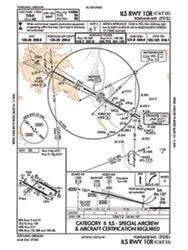 Essentially, CAT I includes any nonprecision instrument approach procedure having minimums not less than 200 feet height above touchdown (HAT) and a RVR not less than 1,800 feet. This means that CAT I includes all precision straight-in, nonprecision straight-in and nonprecision circling approaches. Precision circling appears to be missing from this list. An ILS that ends with a circle-to-land maneuver, however, uses a nonprecision minimum descent altitude that’s higher than the ILS decision altitude. Accordingly, other approaches—such as LOC, LOC BCRS, LDA, SDF, VOR, NDB, GPS and RNAV (and LP/LPV)—are each considered to be CAT I.
Most Part 91 operators are limited to CAT I approaches and their respective minimums. If you want to go lower than 200 feet HAT and 1,800 feet RVR, you’ll need a CAT II or CAT III authorization from the FAA. The CAT II authorization is spelled out in FAR 91.193: “The Administrator may issue a Certificate of Authorization authorizing deviations from the requirements of sections 91.189, 91.191 and 91.205(f) for the operation of small aircraft!if the Administrator finds that the proposed operation can be safely conducted under the terms of the certificate.” Basically, this authorizes a single-pilot operation and throws out the requirement for a CAT II manual, relaxing some of the CAT II equipment requirements.
Getting a CAT II authorization, however, isn’t easy. It’s demanding and requires a great deal of training and concentration. Pilots must complete an FAA checkride with the FSDO, proving that they can safely operate the aircraft to the lower minimums. This requires an intimate knowledge of the ILS system, including the approach lighting systems, runway markings, centerline lights, touchdown zone lights and a slew of other details (dimensions, distances, colors, etc.) that most instrument pilots take for granted. Essentially, the FAA can throw the instrument PTS at pilots, who must be ATP-like flawless.
After a pilot earns Form 7711, the Certificate of Authorization, he or she can’t fly just any IFR-certified airplane to CAT II minimums; the pilot is only authorized to fly to those minimums in the airplane in which the pilot was qualified—down to the N-number. Authorization is valid for a two-year period. Additionally, the straight-in landing runway must also be approved for CAT II operations. A pilot can’t just choose any instrument approach and fly it down to CAT II minimums.
 What are the benefits of getting a CAT II authorization? In the end, it would seem that CAT II authorization doesn’t extend the CAT I ILS minimums much, considering that the lowest CAT II authorization is a 100-foot decision altitude and a 1,200-foot RVR (CAT III is even lower). While this appears like a small step, it’s actually a giant leap, given that many VLIFR events rarely happen below these CAT II minimums. In other words, if you’re authorized to the lowest CAT II minimums, you’ll rarely get shut out of an airport with a CAT II authorized approach.
In many low IFR operations, a missed approach becomes an important review item before executing the approach. The lower authorization just might be enough to get you on the ground without the need to execute that missed and divert to an alternate airport. Even with full fuel tanks, an unforecast widespread IFR event can stretch those fuel reserves. Ultimately, the authorization gives you more flexibility when Mother Nature is showing her bad side.
A CAT II authorization isn’t a pilot rating, but an authorization that adds another dimension to your instrument piloting. A training regiment to prepare for a PTS on a topic like this will provide you with a better appreciation for the challenges of a VLIFR event. It will hone your instrument hand-flying and keep you on your toes, since most CAT II ILS approaches occur at busy airports. Finally, it may give you just enough wisdom to break that important link in the accident chain, thus avoiding a tragic accident.
| Weather Forecast Gone Bad |
| While not likely a direct factor in the accident, the 1200 UTC scheduled NWS terminal aerodrome forecast (TAF) for Portland wasn’t anywhere near what Mother Nature had in mind that morning. Technically, with a departure at 1430 UTC, the pilot wasn’t even required to file an alternate, given a forecast of greater than six statute miles visibility and an overcast cloud deck at 2,500 feet from 1300 UTC through 1700 UTC. Moreover, the forecast beyond 1700 UTC was a meager scattered layer at 3,000 feet with good visibility below. Assuming the pilot received a preflight briefing, he departed Klamath Falls, Ore., at 1430 UTC, thinking the weather was going to be VFR when he arrived at Portland. Advertisement
Seven minutes after his departure, at 1437 UTC, the NWS forecaster issued an amendment to the Portland TAF. This amendment wasn’t a strong signal that bad things were about to happen. The prevailing conditions beginning at 1500 UTC were scattered clouds at 100 feet and scattered clouds at 4,000 feet, along with two statute miles visibility. Additionally, between 1500 UTC and 1700 UTC, the forecaster felt the need to add a TEMPO group, bringing down the ceiling to 100 feet with one statute mile of visibility. Assuming he was monitoring the weather while en route, this forecast might have gotten the pilot’s attention. But he’s already in the air and likely only an hour away by this point. With a strong indication that the weather is trending better with time, what does it hurt to “look and see” at least once or maybe twice? |


