

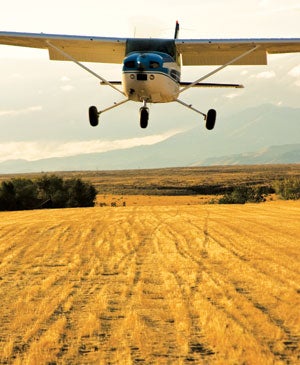
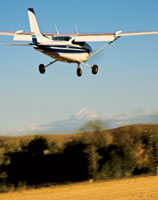
 The runway lights are still on at Friedman Memorial Airport (SUN) in Hailey, Idaho, as the Cessna 182 levitates off the pavement, the pink glow of dawn just spilling over the ridgeline of the Wood River Valley. The harsh, pitted lava plain of the Craters of the Moon lay behind us, and ahead, another day of exploring Idaho’s backcountry and its challenging airstrips. Guiding us is the man who literally wrote the book on the subject: Galen Hanselman, author of Fly Idaho!, Air Baja!, Fly the Big Sky! (Montana) and the new two-volume Fly Utah! Hanselman’s books are the ultimate pilot’s guides to the backcountry, providing essential information on the airstrips and airport environment. Yet, they’re also elegant, miniature coffee-table books that brim with beautiful photography and pithy text covering history, local lore and practical information on what to do and where to go at each location.
The C-182 and the terrain are maintaining equal rates of climb. Ketchum, Sun Valley and civilization fall behind as we sail just over Galena Summit at the head of the valley. Hanselman points the nose down and dives into the wilderness beyond.
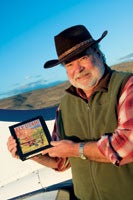
Burly, hale and hearty, Hanselman appears to have been born into the role of backcountry pilot. But he’s a flatlander from Ohio who didn’t start flying until his late 20s—his first lesson was in Hailey—and didn’t start his backcountry exploits for another decade. It was only after he sold his security company—he used to ferry his technicians around the state to install and service security systems—that he had the freedom to do what he wanted, and he decided that meant flying. The interest in backcountry flying came later.
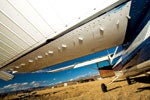 “There was a Super Cub pilot, Ben Hurtig, who talked about salmon fishing in the backcountry and all these wonderful airstrips that didn’t show up on any of the charts,” Hanselman explains. “I was all ears. Then I heard him talking to another fellow about homemade huckleberry pie at Sulphur Creek Ranch. Well, I like huckleberries. So I decided one morning, ’I’m going to go up there and have me a piece of huckleberry pie.'”
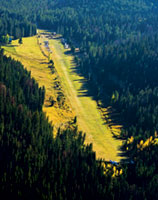
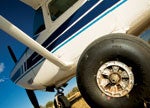 The airstrip at Sulphur Creek Ranch (www.sulphurcreekranch.com), with an elevation of more than 5,800 feet, is at the bottom of a deep bowl. Hanselman, flying a recently acquired C-182, was caught by surprise when it came into view.
“I said, ’Holy moley! I’m at 9,500 feet, and it’s way, way down there!’ So I spiraled down and finally touched down, but there was only about 500 feet of runway left and a wall of trees at the end. I stood on the brakes as hard as I could, trying to get her slowed down. I just made it and pulled off the end of runway. My knees were shaking. I finally got myself out of there and figured ’I better get some instruction,'” he remembers.
 Hanselman honed his technique by seeking flight instructors around the region who were known for their backcountry skills. “It helped tremendously, and I was also getting more experience in my 182, so I became a much better pilot,” Hanselman relates. “Everybody says you become better by getting an instrument rating, but I think you get better by flying the backcountry. You’ve got to do it right every time.”
For example, we landed at Soldier Bar later that morning; it’s a bumpy 1,650-foot strip at a 4,190-foot elevation, and it offers no go-arounds. Once you line up on final, you’re committed to landing. There’s also a sharp dogleg in the strip. On the way out, Hanselman worked the throttle on the takeoff roll so we could negotiate the dogleg before going to full power. “You’ll be airborne in a short distance,” he says, as if narrating a how-to video. “If not, when you hit the cliff at the end, you will be.”
 Hanselman claims he started collecting material for Fly Idaho! just so he wouldn’t have to explain why he spent so much time flying. “People would ask me, ’What did you do today?’ ’I went flying,’ I’d respond. They really didn’t get it, so I started saying, ’Well, I’m working on a book on flying.’ They could understand that. I started writing and collecting data and assembling it into a book.”
Idaho has its share of forbidding landing spots, but many are well-groomed, have campsites and are easily accessible to novice backcountry pilots. “That’s not the case in Utah,” Hanselman says of the airstrips featured in his new book. “Many are badly overgrown. These strips weren’t designed for the long-term. They were built to get supplies, like beer and paychecks, to uranium miners, and a couple of years later, they were gone.”
 Everybody says you become better by getting an instrument rating, but i think you get better by flying the backcountry. you’ve got to do it right every time.
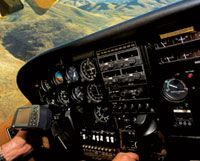 Most of the more than 140 airstrips covered in Fly Utah! include a cautionary note due to some hazard, either on the field or off. For example, a warning for a place called Robbers Roost reads: “Caution: Isolated, remote, cowboy-outlaw country. Don’t attempt to leave this desert maze by any means other than an airplane.”
To help determine whether a landing spot is prudent for a given pilot, Hanselman developed a Relative Hazard Index (RHI), a three-part scale that weighs hazards associated with the approach and departure, with the airport environment (including elevation, runway length and obstructions) and with hazards associated with the runway surface. Hanselman knows these hazards firsthand. In 2004, while collecting data in Utah with son Mark, he landed at Dark Canyon Plateau, a 2,600-foot dirt strip at an elevation of 6,648 feet that was bumpierand softer than he had expected. It sat on a vast, sloping plateau that distorted the horizon line.
 |
| Though he didn’t start flying in the backcountry until his 30s, Galen Hanselman has proven himself as an expert on flying in and out of remote mountain strips. |
“I couldn’t discern that one end [of the runway] was higher than the other, so I decided to take off in a direction to use the bumps to get in the air. I hit the first bump and I didn’t have the airspeed I needed,” Hanselman recalls. “You ever have that sick feeling, you’re in the air but not flying? I did my best to drag it on the prop, but I wasn’t getting altitude. Fifteen hundred feet past the runway, the wind switched to a tailwind. It was like a giant hand pushing us down into the juniper trees. The wings, prop and engine absorbed almost all the energy. By the time we flipped upside down, it was a fairly gentle maneuver, relatively speaking.” Father and son walked away uninjured, but not unaffected.
“It did bother me for quite a while,” Hanselman says. “I didn’t handle it very well. I had my one and only son, and to expose somebody who isn’t really aware of the hazards involved to that kind of danger isn’t right.”
But looking back, Hanselman can’t see how he could have averted the accident. “One good thing I learned: I realized pilots need good information to make good decisions,” he says. “It made me realize I had to have exceptionally good descriptions.” Hanselman decided to include a runway elevation profile for every airstrip in the Utah guidebook. He learned how to survey from a civil engineer and gathered data for the precise renderings featured on a fold-down page with each entry.
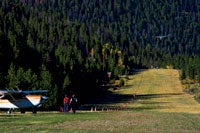 “It took an extra year, but something good came out of it,” says Hanselman. Since then, spurred by renewed interest in these airstrips, volunteers have helped improve some of them, putting in windsocks and making them a little more pilot friendly.
“It’s the only way we’re going to be able to keep them open,” Hanselman explains. “My role in general aviation is just to let people know what’s going on in backcountry aviation, and promote a little safety and education. And I think that will give us a shot at keeping the backcountry open for our children.”
 The 7 Essentials Of Backcountry Flying
The skills and techniques of backcountry flying can take years to master. Hanselman includes numerous tips in his books, but here are seven basic rules that can keep you safe in the backcountry.
1 Get Proper training. Seek out training from instructors who have backcountry flying experience. The challenges of obstructions, high elevations, rough fields and other hazards unique to the environment demand a precision of control that must be practiced in the backcountry. The backcountry is no place for do-it-yourself training.
2 Carry a personal locator beacon (PLB). “I can’t say enough about the importance of a personal locator beacon,” says Hanselman. PLBs take the “search” out of search and rescue. Within minutes of activation, a distress signal is sent via satellite to emergency centers, and rescue efforts commence. As the beacons are personally registered to their owners, rescuers know not only where to look, but also who they’re looking for.
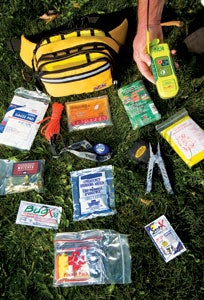
3 Carry a survival kit. Have a survival kit designed for the wilderness environment you’ll be operating in. It must carry all necessary survival items, yet still be compact and light. “Rob Hunter [of PreparedPilot.com] put one together for my purposes,” says Hanselman. “It has to be small. Sometimes you’re heavily loaded, and you don’t have room for a big survival kit.”
4 Have an emergency plan and brief all passengers before the flight. In addition to a regular preflight briefing, discuss survival plans and the location of emergency gear. Always show passengers how to operate the PLB; it could make the difference between being rescued and being stranded. Also, file a flight plan noting your route, or tell others where you’re going and when you’ll be back.
5 Pick the best emergency landing spot. If you’ve got a choice of rocks, water or some trees, go for the trees. In the event that an off-airport landing is required, if possible, land (uphill) on an open ridge where you have the best chance of being spotted. Don’t land in the water in creek bottoms. Even in the summer, the cold water can be a hypothermia risk. Trees are a better choice. Take them straight on, using the wings to absorb most of the energy. Consider landing early, rather than stretching a glide and risking a stall/spin.
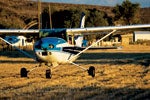 6 Be on the ground by 10 a.m. and stay there until 4 p.m. As the air heats up during the day, turbulence and shifting winds, updrafts and downdrafts create hazards amplified by the high elevations and uneven terrain. Plan on arriving at your destination by 10 a.m. The winds begin to die down around 4 p.m., or as the shadows cross the runway, and continue abating until darkness.
7 Only fly in good weather. “Weather is what gets us,” comments Hanselman. “I’ve lost many friends who were incredibly good pilots—the weather got them. I feel commercial pilots are under pressure to push that weather. As recreational pilots, we really have a big advantage. If it looks crappy, stay where you are. Spend another night, meet more people, have a good time.”
Ordering Info
To order books by Galen Hanselman, contact Q.E.I. Publishing at (800) 574-9702 or www.flyidaho.com.
| Backcountry Flying Resources | |
| Idaho Aviation Association www.flyidaho.org |
|
| Idaho Transportation Department, Division of Aeronautics itd.idaho.gov/aero |
|
| McCall Mountain/Canyon Flying Seminars www.mountaincanyonflying.com |
|
| Montana Pilots’ Association www.montanapilots.org |
|
| Recreational Aviation Foundation www.recreationalaviationfoundation.org |
|
| Utah Back Country Pilots Association www.utahbackcountrypilots.org |
|


