

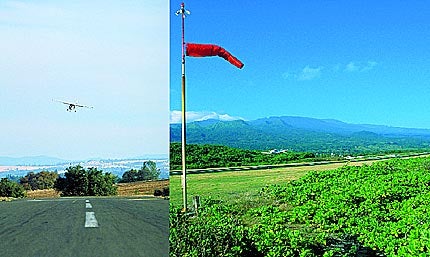
 The crosswind landing is a complex maneuver to understand and execute. There are many changing forces to evaluate and juggle simultaneously, and the high degree of control coordination and timing required is seldom matched by any other maneuver of a normal flight. This means that a pilot must use the technique frequently to remain proficient.
Many pilots, however, are simply unable to fly as often as they wish. And they elect not to fly in crosswinds, which could test their ability to handle them. It’s no wonder our crosswind ability is often one of our first pilot skills to get rusty, making it a major cause of flying accidents.
But the key to mastering this skill lies in the full comprehension of the elements involved. So, for those who would like to maintain and expand their crosswind skills, here are answers to some commonly asked questions about this complex maneuver.
Q: How can I estimate all the crosswind components?
A: Wind socks that are used at general-aviation airports are normally designed to stiffen at 15 knots. Thus, a sock drooping at a 45-degree angle indicates a wind velocity of about seven or eight knots. If the sock is angling 30 degrees off the nose, estimate the crosswind component at 1â2 the wind’s velocity. If it’s at a 45-degree angle, calculate the component at 2â3 the wind’s velocity. At 60 degrees, use 3â4 the wind’s velocity.
Q: How much crosswind is safe?
A: Each make and model has a designed maximum crosswind component that it can accept. This limit is often stated in the plane’s Pilot’s Operating Handbook (POH). If it isn’t, apply a rule of thumb: 25% of the plane’s flaps-up stall speed.
Additionally, pilot skill places a limitation on crosswind safety. Avoid crosswinds that exceed your demonstrated ability; divert to another runway or nearby airport. To best evaluate, maintain and expand your crosswind skill, schedule semi-annual dual instruction flights in crosswinds that exceed your comfort level.
Q: Why is it so important to land astride the center stripes with no drift, the nose pointed straight ahead and at the right touchdown speed?
A: A centerline touchdown conserves runway width that may be needed in the event of an unanticipated swerve. Also, runways are often laid with a high crest for quick drainage. Any off-center touchdown on the sloping side surface invites a swerve.
Unless the plane’s nose is pointed straight ahead with no side drift, an unwanted side load is imposed against the landing gear. Then, chirping bird-hops or a hairy skid toward mishap, a tattered wingtip or even a possible overturn, is a real prospect.
An incorrect touchdown speed leads to a bounced landing that adds complication. If you bounce, maintain the crosswind correction so you’ll glide straight ahead, rather than bounce sideways into a side-load condition.
Q: Which crosswind technique works best: the crab, the slip or a combination of both?
A: The crab method establishes a wind-correction angle (or crab) on final and maintains a drift-free descent in this maneuver, until the moment of touchdown. At the exact instant before the tires touch, the plane is whipped into runway alignment and lands without a side drift, with the nose pointed straight down the runway.
Wind, however, is fickle. A gust in that moment when the plane is straightened out for touchdown will drift the plane to impose a side load on the gear. If you can’t predict the instant of touchdown and straighten out too early or too late, the plane will drift into a side load on impact. In the event of a bounced landing, there’s little time to reestablish the crab, and the drifting plane will re-land with a side load. So, unless the pilot is very skilled, the crab method can be risky.
The pilot using the slip method establishes the slip well out on final and corrects for the wind with that slip right on through touchdown. It’s a relatively easy and effective technique, but it’s uncomfortable and a little scary for non-pilot passengers—particularly if the direction of the slip leans them against the door. Also, due to the static port’s position, many airspeed indicators are inaccurate during a slip. Additionally, the POHs of some aircraft advise against prolonged slipping.
The combination crab-and-slip method is safe, easy to perform and more effective. To use this technique, establish an initial crab angle of about one degree for each one knot of crosswind component. (Expect to modify your crab angle throughout the letdown. Wind velocity and direction will change as you descend closer and closer to the ground.) By using the runway’s center stripes as references, you can prevent wind drift with a crab until you begin to round out.
As you round out, shift from the crab to a slip by lowering a wing into the wind and using the opposite rudder to hold the plane’s nose pointed straight down the center stripes. This slip is continued right through touchdown. Small changes in the magnitude of the slip easily allow for any momentary wind shift. It’s unnecessary to know exactly when the tires are going to touch; simply hold the touchdown attitude until they do. And if a bounce occurs, the ailerons are already doing their job to ensure that the airplane floats straight ahead. Most pilots prefer to use the combination crab-and-slip method for crosswind correction because of these reasons.
Q: What are the functions of ailerons and rudders during the round-out?
A: Each control performs a separate and different function. Ailerons are used to stop any sidewise wind drift, while the rudder is used to keep the plane’s fuselage aligned with the runway center stripes. When you use ailerons to bank into the wind—let’s say, to the right—the wing’s lift is deflected toward the right, and the tilted force of lift tugs the airplane against the wind. If there isn’t enough bank for the wind, insufficient lift is deflected to the right for the required “tugging power,” and the plane still drifts sidewise with the wind. If there is too much bank for the crosswind, excess lift is deflected to the right, and the airplane actually moves sideways into the wind.
Keep in mind that the degree of crosswind correction that is required rarely remains constant during the round out. The slower the plane’s speed, the greater the crosswind’s effect. This must be met with steadily increasing correction as the plane decelerates from the approach speed to touchdown speed, and you’ll need to stay nimble with ailerons and rudder.
Q: Is there a simple way to improve the crosswind-control coordination that is needed during round-out?
A: Coordinating the controls during round-out does take practice. Unfortunately, the few seconds when it’s employed with each landing don’t provide much time for practice and improvement—particularly since the pilot’s main focus and concern is on the imminent touchdown.
There’s a better and more relaxed way to improve your skill: At 2,500 feet above a long, straight road, establish a wind-correction angle that prevents drift. Reduce the throttle and begin a shallow descent at approach speed, using the road below and ahead as a centerline. Practice the shift from the crab to the slip, a point of difficulty for many pilots. You’ll still have ample time to practice coordination with the crosswind, centerline and your slip. Level off at a safe altitude above the road, climb to your starting altitude, reverse direction and practice with the opposite crosswind. Several cycles of this exercise should have you landing with the best of them.
Q: Is there an easy way to determine the amount of ailerons and rudder to use in crosswind landings?
A: Many pilots who have difficulty with crosswind-control coordination can’t tell you the true reason why the center stripes are there. Center stripes are painted on the runway with the specific purpose to assist control coordination during crosswind landings. It gives a second-by-second evaluation of wind drift and runway alignment.
Picture landing in a right crosswind with the center stripes in full view ahead. If you start to drift left of the stripes, you know you must increase aileron. If, on the other hand, you move right (against the wind), you know to decrease aileron pressure. And if you see the nose cocked to the right of the stripes, you know to increase opposite rudder. If the nose points to the left, decrease opposite rudder pressure. Use the center stripes to evaluate the magnitude and timing of your aileron and rudder deflections during round-out—crosswind-control coordination is as simple as that.
Q: What is the purpose of a follow-through?
A: Once the plane makes contact with the runway, the need for crosswind correction is far from over. The moment that the upwind tire touches the ground, speed dissipates further. Continue to increase aileron deflection, in case of a bounce, and maintain center-stripe alignment with the rudder.
Continue to add aileron, even after the second tire sets itself down on the runway. The drag created by the “down” aileron opposite the crosswind helps keep the plane from weather-vaning into the wind. A perfect follow-through has the ailerons reaching full deflection, just as the plane rolls to a stop.
Q: Is there a fail-safe measure against a crosswind accident?
A: Most modern light airplanes are capable of delivering a go-around from the touchdown attitude. Pilots, however, may need review instruction in the critical dos and don’ts of the maneuver; and if so, they should get it. Unless your plane is landing astride the center stripes, aligned with the runway and free of drift, a go-around is in order. You may spare your airplane from damage. If all pilots would hold the mental commitment to a go-around, if needed, crosswind landing accidents would be virtually eliminated.

