
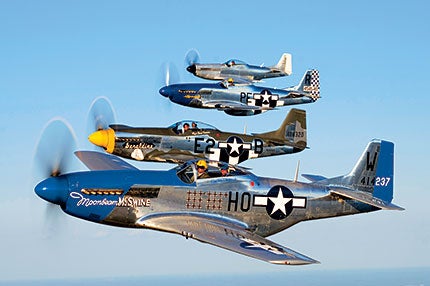
It’s perhaps the most iconic military airplane in the history of aviation. Regardless of its real talents (and they’re considerable), the North American P-51 Mustang has achieved a status among fighters unmatched by any other aircraft. It may not have been the fastest, best armored, most maneuverable or longest ranged when it was in service in both the Atlantic and Pacific theaters, but it’s still generally regarded as the world’s best, all-around piston fighter.
So imagine the joy of warbird lovers and Mustang fans at seeing 78 P-51s in the same place at the same time. That’s exactly what happened last September in Columbus, Ohio.
The Gathering of Mustangs and Legends was conceived by Lee Lauderback and Angela West of Stallion 51 (www.stallion51.com) in Kissimmee, Fla. Lauderback and West run what’s perhaps the premier Mustang transition school, teaching new P-51 owners and anyone with the inclination and the talent to fly the world’s best prop fighter. The Gathering was an opportunity for Mustang owners, pilots and fans to come together and compare notes on what’s certainly the world’s most famous piston fighter.
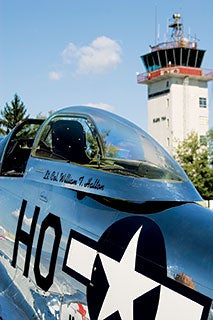
The 2007 Gathering was staged 10 miles south of Columbus, at the old Lockbourne Army Air Base, which is now known as Rickenbacker International Airport (named for famous WWI ace Eddie Rickenbacker). More than 200,000 people attended the four-day worshipfest, and the show exhibits far more than simply P-51s.
 For their part, the Air Force was celebrating its 60th anniversary and participated with everything from the USAF Thunderbirds, the F-15 Eagle, F-16 Falcon and, perhaps most impressive of all, the F-22 Raptor. The Raptor’s vectored-thrust technology allows it to do things most of us thought were impossible for a jet fighter. The announcer agreed, as he alluded to additional talents with the comment that “other maneuvers are classified.”
There was a variety of other warbirds on hand, some on static display and others participating in the flybys. Among the planes were two of the world’s three flying P-38s, two P-47s, a number of P-40s, a P-63, a pair of B-25s, a C-47, two B-17s and even an Avro Lancaster. Many of these aircraft participated in Heritage Flights with the current-generation military jets, and others performed acro routines.
But the Mustang and its pilots were the primary subject of attention, and Lauderback put together an impressive series of displays of the type.
Several dozen Mustang experts, such as Bud Anderson, Bob Hoover, Robert Gruenhagen, Lee Archer and Frank Borman, were on hand to describe the airplane’s flight characteristics and quirks. In addition to a number of flybys and aerobatic demonstrations, Lauderback and fellow Mustang expert Ed Shipley, a retired television executive, flew two-plane formation routines so tight, it looked as if the aircraft were chained together.
 Imagine the joy of warbird lovers and Mustang fans at seeing 78 P-51s in the same place at the same time.
(Back in June 2007, I spent two weeks with Shipley and Steve Hinton on the attempted flight of Rod Lewis’ P-38 Glacier Girl to Duxford, England, and the delivery of the freshly built TF-51 Miss Velma. Hinton’s Planes of Fame Museum team in Chino, Calif., built up the TF-51 with parts from several dozen other aircraft, and Shipley piloted the airplane to England. Though Hinton had a problem with the P-38’s right engine over the Labrador Sea and had to return to Goose Bay, Shipley completed delivery of Miss Velma, often flying no more than five feet away from Lewis’ Pilatus PC-12 on the trip across the North Atlantic.)
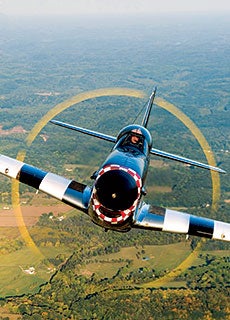
In Columbus, the fans celebrated all things Mustang, from the sporty Ford car to the legendary airplane. I even thought I saw a herd of wild mustangs grazing in the grass on the opposite side of the runway. One of the highlights of the show was the mass flyover of what were planned as 51 P-51s. Even if the actual number was slightly less than that, it undoubtedly represented the largest group of Mustangs in the air at the same time and place since WWII.
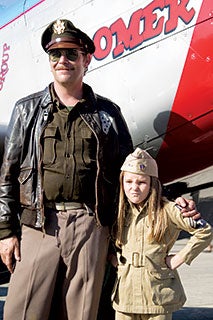 More than 200,000 people attended the four-day event at Rickenbacker International Airport, where 78 P-51 Mustangs were on display. |
Virtually every pilot knows at least some of the P-51’s story. In 1940, the British Isles were under siege in what was to become known as the Battle of Britain. Winston Churchill called on the United States for help. At the time, the only fighters even remotely capable of countering the German Me-109 were the Bell P-39, an underpowered ground-attack aircraft, and the Curtiss P-40, an antiquated 1933 design with limited speed and high-altitude performance. Churchill reluctantly requested a large order of P-40s to help defend against the expected German invasion.
Unfortunately, Curtiss Aircraft, designer of the P-40, was already at peak production and couldn’t turn out additional airplanes in time to help the British. In desperation, Churchill turned to North American Aviation, a company the British had dealt with before.
North American had never built a fighter, but NAA president Dutch Kindelberger was convinced his company could design and build a prototype super fighter in the same time it would take to retool and ramp up production on the P-40 under license. In a twist of irony, Kindelberger put expatriate German designer Ed Schmued in charge of the project, along with codesigner Ray Price, and promised the British the new fighter, initially dubbed the NA-73X, would be completed in only four months.
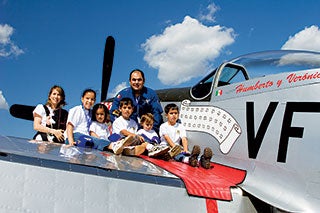 For Humberto Lobo (above), who owns the only Mexican-registered P-51, attending the event was a once-in-a-lifetime experience. He and his family made the journey from Monterrey, Mexico. |
Accordingly, the original P-51 was conceived, built and test-flown in a mere 120 days in the late ’40s. (The design wasn’t totally new—it was related to the earlier A-36.) The Mustang was the first fighter to incorporate an NACA-developed, low-drag, laminar-flow wing with a nearly symmetrical airfoil. It also flew with 180-gallon wing tanks and an additional 85-gallon aft fuselage tank. In combination with twin, 75-gallon drop tanks, the Mustang offered an impressive six hours of endurance, a feature that was to serve it well on bomber escort missions over Germany later in the war.
Early Mustangs were delivered with a 12-cylinder, 1,200 hp, Allison V-1710 engine, but later, more successful versions featured the Packard-Merlin V-1650 powerplant, delivering 1,650 hp. The P-51 entered service in late 1942, eventually achieving fame as perhaps the most talented and charismatic fighter of WWII.
Better still, it earned the respect of virtually everyone who flew it and many who didn’t (on both sides of the war). When the Allies launched bombing raids over Germany in 1942, there was no fighter capable of flying escort all the way to the target and back. The bombers suffered horrific losses until the P-51 entered service in significant numbers in 1943. Me-109 pilots who had once dominated the skies over Europe often found they’d met their match in the Mustang. The P-51’s maneuverability and speed, coupled with a typical armament of eight 0.50-caliber machine guns provided a lethal punch that gradually won air supremacy over Germany.
Though there were something like 15,000 Mustangs of all types produced (at one point, North American was building an astounding 550 Mustangs a month), postwar demilitarization, accidents, normal attrition and the vicissitudes of time have decimated the type. Today, there are only about 130 Mustangs still flying, and prime examples now demand as much as $2.5 million, not bad for an airplane that sold new for $16,000.
That made the Mustang turnout at Rickenbacker all the more surprising. It was the most visible proof yet of a love affair between pilot and the airplane that remains a legend long beyond its own time.
 |
|
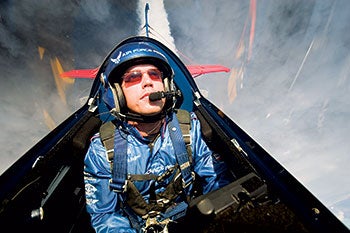
Happy 60th, U.S. Air Force As if the Gathering of Mustangs and Legends didn’t provide enough fanfare at Rickenbacker International Airport, the Air Force was also commemorating its 60th anniversary during Air Force Heritage Week. The Air Force had a strong presence in the daily air show, with everything from the F-22 Raptor to the Thunderbirds to Ed Hamill, a civilian air-show pilot sponsored by the Air Force Reserve Recruiting Service. Having launched his aerobatic career in 1998, Hamill performs today in an Air Force Reserve Biplane, a highly modified Pitts S2-C. His awe-inspiring routine includes challenging maneuvers, such as low knife-edge passes, and his newest figure, “David’s Tumble.” When Hamill’s not thrilling show crowds, he’s a Major in the Air Force Reserve and an F-16 instructor at Luke Air Force Base in Arizona. Advertisement
“It’s very special to fly my Air Force Reserve Biplane during the 60th anniversary of the Air Force and I’m honored to be a part of the Gathering of Mustangs and Legends for the final roundup of these incredible heroes and their magnificent flying machines,” says Hamill. “Flying a biplane to help recruit for the military is what the very first military demonstration teams did right after World War I, and I’m proud to continue that heritage.” The upcoming 2008 season marks the 60th anniversary of the Air Force Reserve, and Hamill will perform at more than 16 shows around the country. Learn more at www.edhamill.com and www.afreserve.com. |


