











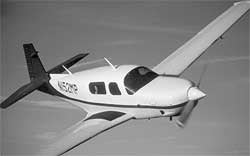
 Mooney PFM | 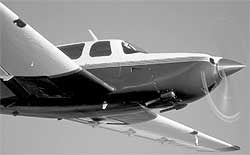 Mooney Ovation | |
STANDARD DATA: (Ovation) Seats 4. Gross wt. 3,368. Empty wt. 2,205. Fuel capacity 89. Engine 280-hp Continental IO-550-G. STANDARD DATA: (Bravo) Seats 4. Gross wt. 3,368. Empty wt. 2,268. Fuel capacity 75.6. Engine 270-bhp Continental TIO-540-AF1B. | 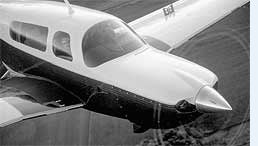 Mooney Bravo | |
Mooney Bravo |
In 1988-89 Mooney offered the PFM (M20L), a regular M20 airframe with a Porsche engine up front. It was a first in many ways, primarily because it offered a high performance automobile manufacturer’s variant for an aircraft, and second, the PFM was the first airplane to have a single-engine power control, the precursor to what is now called FADEC (Fully Automated Digital Electronic Control). Porsche placed limits on their liability exposure by setting a finite availability for the PFM Mooney engine, all of which were eventually removed from their M20 airframes and returned to Porsche.
Also in 1989, Mooney addressed a common complaint about comfort in the M20 airframe, and extended the fuselage by 18 inches. The first model to take advantage of the new dimensions was the M20M TLS. With a 350-hp Lycoming, derated 270 hp, the TLS turned in an effortless 223-knot high-speed high-altitude cruise speed. The aircraft would ultimately be renamed the Mooney Bravo.
After testing a model-name change to Mooney 205, the venerable Mooney 201 was christened the MSE (Mooney Special Edition M20J) in 1990. That name would continue until 1998 when the 200-hp M20 was laid to rest in favor of more powerful newcomers.
Beginning in the mid-1990s Mooney began to search for a replacement for the 201, arriving first at the Ovation (M20R), with a 280-hp Continental. In 1997, Mooney searched for a lower-costing, entry level design, offering the 220-hp Encore (M20K). In 1999 they tried again with the 244-hp Eagle (M20S). Neither the Encore nor the Eagle remain in production, however the M20 airframe will doubtlessly continue to evolve for years to come.