

 |
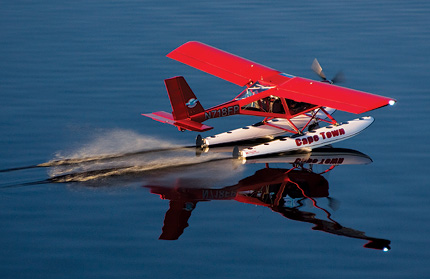
America has far more lakes than airports. By itself, my home state of Minnesota has more lakes than the entire nation has airports. Given this 50:1 advantage, floatplanes or seaplanes make a lot of sense; there are many places you can land, plus you can reach interesting locations you never considered in a land plane.
Lucky me. I’ve gotten to fly lots of light floatplanes and I get a huge smile on my face every time I launch from water or splash down in a lake. The sensation has no match in landplanes. Once you’ve flown a floatplane, you’ll forever look at flying through a new lens.
Imagine flying a mere wingspan above the water, safely!hopping over small islands and zooming down to the water’s surface on the far side, always landing directly into the wind, taxiing up to a dock or beaching on the sand or stopping to do a little fishing while standing on one float. Let me put a finer point on it: If you haven’t tried float flying before, you’re missing out on one of the truly fun things to do with an aircraft.
Two drawbacks to floatplanes are price—water-capable airplanes can easily cost more than your house—plus some loss of performance or carrying capacity. However, consider light-sport floatplanes and amphibians. They dramatically lower the price point, and some perform as well as their water-averse landplane counterparts in the LSA fleet.
Assuming you take the bait, where might you go to find the LSA float-plane experience?
 |
Who’s Got The Floatplane?
Based in Sebring, Fla., Float Planes and Amphibs (FPNA, www.fpna.com) is an amazingly versatile light-aviation organization. They cater to floatplane enthusiasts, but the company represents a wide range of light-sport aircraft, including powered parachutes and trikes. Plus, they do training in multiple locations.
FPNA’s Capetown floatplane can be purchased for less than a hundred grand. That’s the base price, and you’ll surely find some accessories irresistible. Yet floats alone for larger GA airplanes can exceed that cost.
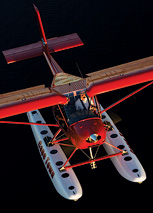
The Capetown is the FPNA variation of the Aeroprakt A-22, the original design from Ukraine. It’s distinctive on any ramp because of what appear to be acres of window, mostly clear, bubbled-out doors and a large skylight. Plus the fuselage aft of the cockpit is see-through. If you prefer to be surrounded by thin sheets of aluminum, the Capetown may not be your airplane. But if you like sightseeing from aloft, few airplanes hold a candle to the Capetown.
 |
The A-22 was originally created in Ukraine by engineers trained at onetime-Communist airplane behemoth, Antonov. Aeroprakt’s youthful chief designer, Yuri Yakovlev, went from working on the largest airplanes on the planet to some of the smallest.
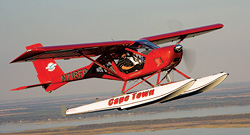
The Capetown’s composite Waterborne Floats were designed and built by FPNA in Sebring and married to an A-22 that had been strategically beefed up to take the punishment that water operations experience.
Using their own business model and introducing modifications for the American LSA market, FPNA receives some assemblies from Ukraine and builds other major components like the wings and float system. After this integration, FPNA is considered the manufacturer of the Capetown.
FPNA’s Capetown is an all-metal airframe with Ceconite-fabric-covered control surfaces. Its cowls and wingtips are composite. The Capetown’s floats are composite with machined aluminum amphibious gear.
As with the majority of light-sport aircraft, the Capetown is powered by the liquid-cooled, four-stroke, 100 hp Rotax 912. Now with a 2,000-hour TBO, Rotax engines have achieved an enviable reputation for reliability.
 The sensation has no match in landplanes. Once you’ve flown a floatplane, you’ll forever look at flying through a new lens.
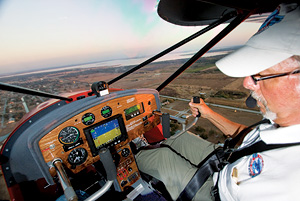
The Capetown—like its wheeled sibling, the Valor (FPNA’s rebranded version of the A-22)—offers more than massive visibility. Both versions boast one of the largest cockpits in all of light aviation at better than 50 inches wide, 10 inches wider than a Cessna 172. Behind adjustable side-by-side seats, you’ll find a fabric baggage pouch that will let you stow some fishing gear and an overnight bag or two.
As in other light-sport designs, the Capetown and Valor use full-span ailerons, often referred to as flaperons because they offer 10- or 20-degree “droop” positions while still serving their function as ailerons.
 |
My experience with the Capetown revealed responsive slow-speed handling and benign stall characteristics. Low takeoff speeds are great for water-based operations, and handling was fluid if not fast.
I prefer a joystick, but the Capetown’s standard yoke control will be quickly familiar to most GA pilots. An optional center stick can be ordered for those who share my preference. The Valor’s and Capetown’s flap levers are centrally placed overhead.
The Capetown is available as a ready-to-fly aircraft that can be used for commercial flight training or rental (S-LSA), or as a quick-build kit (E-LSA).
Photo Mission
I first flew the A-22 with designer Yuri Yakovlev in Ukraine in 2003 before light-sport was even a term. Back in the U.S., I got a chance in the land version in 2007, and since then, I added an hour or so in the amphibious Capetown. Just recalling the experience triggers another smile.
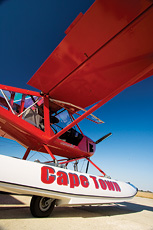 |
On James Lawrence’s air-to-air photo mission, I went aloft with FPNA proprietor Shawn Okun in the target Capetown amphib. Shawn did the initial flying while each of the formation pilots eased into his role. After the flock found the groove, I had a chance to take the controls.
Water launches can be hard on airplanes. That’s why you see extra bracing in GA planes modified for floats. The Capetown, however, starts flying at such a low speed (below 40 knots) that the abuse is much reduced—though the Capetown does sport a few added braces.
That slow-speed launch also speaks to the Capetown’s cooperative maneuverability at slow speeds aloft. It’s truly a joy at 45 knots where low-level flying is such a kick.
It managed 87 mph upwind and 118 mph downwind for an average groundspeed of 103 mph or 90 knots. Even when it had the amphib gear and floats, the Capetown could be seen climbing at a sustained 700 feet per minute.
The airplane’s full-span flaperons work well. In the wheel-equipped Valor, I timed a snappy two and a half seconds in a 45-to-45-degree roll-reversal exercise. The low-slung weight of Capetown’s amphib gear slows that a little, but it still qualifies as responsive. And, as a side benefit, the low-down weight helps Capetown feel even more stable in bumpy air.
Adverse yaw was almost nonexistent, giving only a slight hesitation before turning the direction as controlled. The Capetown or Valor will handle by control yoke only—that is, without rudder pedal input—readily, almost like a two-control design.
Power-off stall with the yoke full aft came at around 40 mph indicated, or barely 35 knots. In the stall, I experienced very little altitude loss and there was no tendency to break sharply toward the nose.
If you’re an open-cockpit enthusiast, you’ll love the A-22 because the Valor or Capetown can be flown with the doors completely removed. It might cost you 10 mph in cruise, but the feeling is one of air-in-your-hair freedom. Try that in your Bonanza! The doors quickly detach from hinges at the top of the door.
Setting You Back To Set You Up
If I’ve convinced you to give floatplanes a try, you’ll see the attraction. You can choose a new type-certified airplane on floats (if you’ve got bigger bucks), a used TC’d floatplane (still loads of cash) or a brand-new float-equipped LSA. FPNA quoted the Capetown at $99,500 in summer 2010. At that figure, this is a great value in a brand-new floatplane you could rent out or use for paid instruction.
Factoring in some gear you’ll probably want, I suggest an ELT ($375); a Mode C transponder ($2,575, not always needed for float flying); a Dynon D-180 EFIS with all engine monitors ($4,760); a Garmin SL30 radio ($4,375); and a Garmin GPSmap ($2,496 with panel-mount dock) for a grand sum of $114,480, plus plan on some shipping and registration costs. This represents good value for a brand-new amphibian, but if it still sounds beyond your budget, ask FPNA about their Experimental LSA kit; you do some work and save a few dollars.
With 10,000 airports and 50 times that many landable lakes, you’re bound to generate a smile of your own stretching as wide as the horizon.
