

 No one manufacturer takes the industry by storm these days. Beech did it with the Bonanza in the ’40s and ’50s, Cessna rocked general aviation with the Skyhawk and Skylane in the ’60s, and Mooney rescued itself from bankruptcy with the outstanding 201 in the ’70s, but today’s market is so much smaller that any runaway success is unlikely, if not impossible. But Diamond is set to change all that.
When Diamond Aircraft of Weiner Neustadt, Austria, introduced the 2000 model Diamond DA40 Star, it was an instant standout among 180-hp, fixed-gear four-seaters. Much more than simply a stretched version of the two-seat DA20 trainer, the Star was a truly new airplane, although it wisely retained a strong family resemblance to the company’s popular two-seater. The DA20’s waspish empennage and T-tail were still there, as was the short chord, long-span, high-aspect ratio wing with upturned winglets. The Star also sported a forward-opening canopy, ventral fin and composite MT prop.
The Star joined an already crowded market, not surprising in view of the overall popularity of the class. Fixed-gear, 180-hp singles often are regarded as minimum entry-level family airplanes, capable of lifting 2+2 or even a full four folks with reduced fuel. For that reason, a half-dozen major manufacturers offer their own version of the formula. The Star is the newest airplane of the lot, the only all-composite machine in the class, a 21st-century design with a truly modern look.
Newest doesn’t automatically translate to best-selling, however. The Star’s older competition is well-entrenched, in some cases, boasting a quarter-century or more of market acceptance and sometimes trading on sales histories of 2,000 units or more. Piper’s Archer/Challenger/Cherokee 180 is the oldest model in the class and one of the most established. Drawing on a tradition that stretches back to 1963, the Cherokee is a proven winner among buyers of mini-family-haulers.
Cessna’s fixed-gear Cutlass can trace its roots to 1983, but today’s Skyhawk SP is proving almost as popular as the straight 172R. The newest iteration of the Grumman-American Tiger, simply called the New Tiger, re-creates the happy, little airplane we all loved in the ’70s and early ’90s without reinventing the wing. SOCATA’s TB-10 Tobago offers the largest cabin in the class, supported by essentially the same wing and fuselage used on all the French Caribbean singles, including the popular Trinidad retractable. Finally, the Maule MX7180A is one of Maule’s myriad of handmade models, available in your choice of nosegear or tailwheel.
Yet, the new Diamond Star offers better performance numbers in virtually all areas. In addition to providing something none of the others have (a rear entry door), the new Diamond enjoys virtually all the performance advantages: climb, speed and service ceiling. Such numbers have helped the Star to a sterling sales record by the standards of the current market. As this is written, Diamond has delivered some 285 Stars in only four years of production. That’s nearly 75 airplanes a year, a sales record most companies would envy. The current production rate is eight per month.
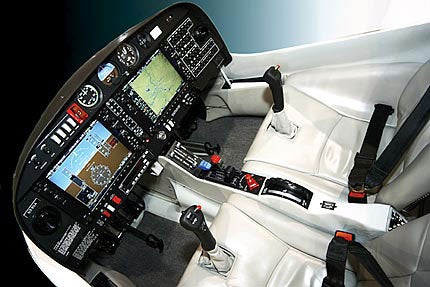
Now, Diamond Aircraft has opted for a further improvement. By the time you read this, Diamond will be delivering new Stars fitted with the Garmin G1000 Integrated Avionics System. For 2004, Diamond will offer a standard VFR airplane at $188,900 and a G1000-equipped, IFR airplane at $224,900. That’s a delta of $36,000, only about $25,000 of which is directly attributable to the G1000 do-everything navcom system.
Specifically, the G1000 system consists of a 10-inch primary flight display (PFD) dedicated to aircraft attitude and flight conditions and a 10-inch display committed to navigational awareness and all parameters of engine/systems condition. In computer terms, both are XGA-quality, high-resolution (1024 x 768) screens, capable of readouts in a bewildering variety of colors.
More than that, however, the G1000 incorporates all avionics and engine readouts into central locations and displays such exotica as NEXRAD weather radar, TAWS terrain awareness and TIS (Traffic Information System), and a mode-S data uplink of ATC traffic information.
The G1000 isn’t that tough to master, especially for those pilots already schooled in operating the popular Garmin GNS 430/530 systems. Controls are reasonably intuitive, with the switching panel and transponder incorporated into the flat-screen displays.
Cessna is installing the system in the 182/T182 and 206/T206 for 2004. Don’t be surprised if you see the G1000 in other manufacturers’ airplanes before the end of the year.
With or without the Garmin G1000 system, the DA40 Star represents a considerable step up from fixed-gear, four-seat singles of even a few years ago. The forward-hinged canopy opens up both front seats for easy entry, and the separate, gull-wing left-side door opens up and to the right, providing friendly access to the rear buckets.
The cabin measures a full 45 inches across, making the Star wider than everything in the class except the SOCATA Tobago. Joysticks replace yokes to free up more of the instrument panel, a special benefit with the flat-panel Garmin G1000 system.
Like the Columbia 300/350 and Cirrus SR-20/22, more than coincidentally also 21st-century designs, the DA40 utilizes extensive carbon-fiber construction, offering airframe and wing surfaces as smooth as a waxed watermelon. In combination with the efficient European Wortmann FX-63-137/20 laminar flow airfoil, one result is that the DA40 turns in the best climb and cruise speed in the class.
Climb is especially notable, partially a function of the high-aspect ratio and high wing-loading. Vy is a surprising 63 knots in a fairly flat attitude, but most pilots will be more comfortable with 80 knots or more for the ascent.
Either way, the Star’s upward mobility is impressive. At 1,070 fpm, it’s 150 fpm better than the next closest rival and a surprising 500 fpm quicker than the worst airplane in the class. Equally important for pilots based in the West, where rocks can reach three miles into the sky, the Diamond Star’s 15,000-foot service ceiling allows for reasonable climb numbers in high-density situations.
As with most normally-aspirated singles, the DA40 Star does its best work in the 7,000- to 9,000-foot altitude range, offering cruise performance in the 140- to 145-knot range. That’s equal to or slightly better than the Tiger’s best efforts, and the Tiger’s speed has always been regarded as revolutionary for a fixed-gear, 180-hp production airplane.
| Factory Comparison: | Diamond DA40 Star |
Piper Archer III |
Cessna Skyhawk SP |
| 2003 Base Price*: | $224,900 | $205,500 | $165,000 |
| Cruise Speed, 75% (kts.): | 145 | 128 | 124 |
| Vso (kts.): | 49 | 45 | 48 |
| Fuel Burn, 75% (gph): | 10.2 | 13.5 | 10 |
| Climb Rate (fpm): | 1070 | 680 | 730 |
| Service Ceiling (ft.): | 15,000 | 14,100 | 14,000 |
| Takeoff Distance (ft.): | 720 | 1135 | 960 |
| Landing Distance (ft.): | 480 | 920 | 575 |
| Gross Weight (lbs.): | 2535 | 2550 | 2550 |
| Useful Load (lbs.): | 894 | 876 | 924 |
| Power Loading (lbs./hp): | 14 | 14.2 | 14.2 |
| Wing Loading (lbs./sq. ft.): | 17.4 | 15 | 14.7 |
| Fuel Capacity (gals.): | 39 | 48 | 53 |
| Engine Horsepower: | 180 | 180 | 180 |
| Landing Gear Type: | Tri/Fixed | Tri/Fixed | Tri/Fixed |
| Seat Capacity: | 4 | 4 | 4 |
| * 2004 base prices hadn’t been announced at press time. Standard equipment may vary. Sources: Aircraft Bluebook Price Digest, Jane’s All The World’s Aircraft and manufacturer’s specs |
|||
| Factory Comparison: | New Tiger |
Socata Tobago | Maule MX7180A |
| 2003 Base Price*: | $235,800 | $283,202 | $110,850 |
| Cruise Speed, 75% (kts.): | 143 | 127 | 122 |
| Vso (kts.): | 53 | 52 | 35 |
| Fuel Burn, 75% (gph): | 10.7 | 10 | 10 |
| Climb Rate (fpm): | 850 | 790 | 920 |
| Service Ceiling (ft.): | 13,800 | 13,000 | 15,000 |
| Takeoff Distance (ft.): | 865 | 1070 | 550 |
| Landing Distance (ft.): | 410 | 625 | 350 |
| Gross Weight (lbs.): | 2400 | 2535 | 2400 |
| Useful Load (lbs.): | 900 | 992 | 1050 |
| Power Loading (lbs./hp): | 13.3 | 14.1 | 13.3 |
| Wing Loading (lbs./sq. ft.): | 17.1 | 19.8 | 14.5 |
| Fuel Capacity (gals.): | 51 | 54 | 40 |
| Engine Horsepower: | 180 | 180 | 180 |
| Landing Gear Type: | Tri/Fixed | Tri/Fixed | Conv/Fixed |
| Seat Capacity: | 4 | 4 | 4 |
| * 2004 base prices hadn’t been announced at press time. Standard equipment may vary. Sources: Aircraft Bluebook Price Digest, Jane’s All The World’s Aircraft and manufacturer’s specs |
|||
While it’s true the Cirrus SR-20 does better with 20 more horses under the cowl, the fixed-gear Star’s performance is nearly the equal of some early 200-hp retractables, specifically the Piper Arrow, Beech Sierra and Commander 112. The long span, short chord, NLF wing is in its element at tall altitudes and manages to deliver good cruise two miles above the sea.
With an optional 52 gallons in the tanks and a max cruise burn of just over 10 gph, the Star offers a 75% endurance of four hours, worth about 560 nm at a sitting. The four-cylinder Lycoming scores a specific fuel consumption (sfc) of .41 lbs./hp/hr., so full-throttle cruise at 10,000 feet exacts about 60% power and burns 7.6 gph in exchange for 134 knots. That’s better than 20 smpg, better than most SUVs and twice as fast. With such numbers, you can extend the airplane’s reach to nearly 700 nm after five hours in the air.
The DA40’s control response throughout the speed range probably isn’t that much more enthusiastic than in a standard yoke-controlled airplane, but it just feels better with a joystick for roll and pitch control. Roll rate is probably about 45 degrees per second, quick enough to satisfy most pilots who aren’t into unlimited aerobatics. The pitch response is predictably quicker, but not so fast as to compromise its structural integrity.
The Star is technically certified for in-flight loads in the normal category, although the composite structure can probably far exceed the standard 3.8/5.6 G limits. (Indeed, Diamond went the extra mile in crashworthiness. The airplane features crush zones beneath the cockpit, intended to compress at a rate that will protect the occupants. Specifically, the Star’s fuselage is constructed to withstand 26 G’s.) In more normal circumstances, landings are a total non event. The stall is easily predictable at a dirty 45 knots with gentle, but recognizable, pre-stall buffet, so approaches are possible as slow as 60 knots without violating the 1.3 Vso rule. A more reasonable number for final is 65 to 70 knots if there’s no need to plonk it on and stop it short.
Unlike other companies that are taking a wait-and-see attitude about the general-aviation market, Diamond Aircraft is pursuing an aggressive program of marketing new models. By the time you read this, the innovative, diesel-powered Twin Star will be certified, flying behind a pair of 135-horsepower Thielert diesel engines, directed by the aforementioned Garmin G1000 system and priced around $360,000. The Austrian company also is hard at work on the D-Jet, a five-place, personal, mini-jet designed on the premise that less is more. The Diamond jet is being configured to deliver just over 300 knots at 25,000 feet, employing a single, Williams, 1,400-pound thrust, FJ-33 turbine. The first flight is scheduled for October, certification for 2006 and the price will be about $1 million in 2004 dollars.
Such confidence in the future serves Diamond Aircraft Industries very well. For the nonce, the new Garmin G1000-equipped DA40 Star is hard evidence of what can be accomplished with composite structures, a slick airframe and wing combination, and some of the most innovative avionics available in the business.
For more information, contact: Diamond Aircraft Industries, (519) 457-4000 or log on to www.diamondair.com.
SPECS: 2004 Diamond DA40 Star N59GA


