

You need Adobe Flash Player 10 to view this widget.

 |
On January 18, 1911, Eugene Ely became the first person ever to land an aircraft on a ship. He did so in a 60 hp Curtiss Model D, which was constructed from spruce, bamboo and doped linen, and had a maximum speed of 43 knots. He touched down in the pusher biplane on a temporary wooden platform on the USS Pennsylvania, anchored in the San Francisco Bay.
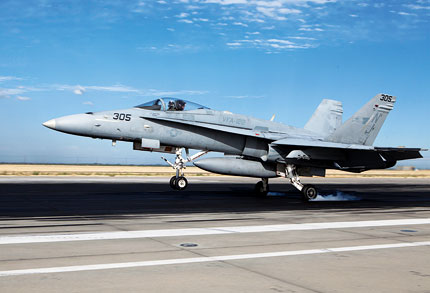
Today, June 28, 2011, I’ll also land for the first time ever on a ship. I’ll do so in a 36,000-pounds-thrust Boeing F/A-18 Hornet, constructed from exotic heavy-duty alloys, and has a maximum speed of Mach 1.8. I’ll touch down in the fighter jet on the flight deck of a moving aircraft carrier, at a location so classified that even I don’t know where it is.
Ely’s landing 100 years ago was under the pressure of thousands of spectators, including high-ranking naval officers and a horde of journalists asking questions. Should he have inadvertently lost control in the direction of the ship’s steel mast, a canvas awning had been rigged as a barrier.
My landing right now is under the pressure of, well, myself, and I’m the only journalist around. Should I not make the grade, an operator in the backroom is ready to simply press the simulator’s reset button.
 |
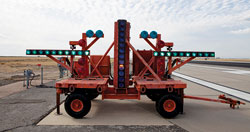 |
| Central California’s Naval Air Station Lemoore is home to the U.S. Navy’s entire West Coast stirke-fighter capability. The Strike Fighter Squadron 122 provides F/A-18 Hornet training for carrier fleet replacement. A landing signal officer (left) works with training pilots to fine-tune their approaches. The Optical Landing System (right) includes a row of green datum lights, from which a pilot can gauge their position relative to the glideslope; the ball, which indicates the aircraft’s position above or below the glideslope; and wave-off lights, red flashing lights that are operated manually by the LSO and command a pilot to execute a go-around. | |
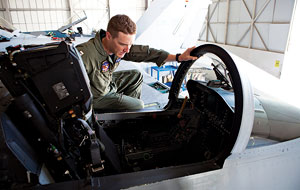 1 In The Hangar The supersonic all-weather Boeing F/A-18F Super Hornet strike-fighter jet excels at dog fighting, and is known for its tactical abilities. Lieutenant Kyle “Nac” Hartman, a NATOPS Officer for the VFA-122 Squadron, briefs the F/A-18 cockpit layout and safety procedures. |
“Keep the carrier in the lower-left quadrant of the crosshairs,” F/A-18 instructor Ben “Julie” Charles tells me at three miles out, as I intercept a 3.5-degree glideslope on the Hornet’s head-up display. “The ship is moving away, so it will eventually self-correct to center.” On an angled deck, the final bearing is approximately 10 degrees offset from the ship’s heading. “During the day, we reference the heading of the ship,” he explains. “At night, we reference the final bearing. The tricky thing is that the final bearing is continually moving to the right.” I’m glad it’s daytime in this machine.
At ¾ mile out, a carrier pilot will “call the ball” and fly the remainder of the approach visually. The corrections become smaller and smaller. I do my best to fly this formidable beast delicately and precisely, but the sight of my first-ever carrier is so awe-inspiring and nerve-wracking that I momentarily freeze on the controls. I also forget to breathe. Excitement and tension take over.
“A little high, bring it down!” Julie jolts me from my stupor, and I nudge the control stick forward ever so slightly. I’m still holding my breath. Perhaps it wasn’t ever so slightly enough, because the landing feels and sounds more like a smack than a squeak. But it’s a landing. In a fighter jet. On an aircraft carrier. Just like Maverick. (Sort of.) Before I can exhale, the F/A-18 comes to an abrupt stop. Its tailhook has successfully caught on one of the deck’s four arrestor wires. (Does it really matter which one?)
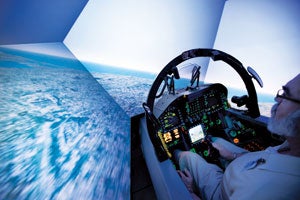 2 F/A-18 Simulator 2 F/A-18 SimulatorAfter launching from MCAS Miramar, Plane & Pilot Publisher Mike McMann flies a high-speed pass over the San Diego area. F/A-18 pilots in training at NAS Lemoore will spend 12 hours with an aircrew instructor in a simulator before their first flight in the real aircraft. |
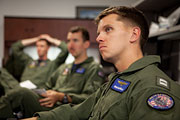
In real life, an F/A-18 pilot recovering onto a carrier relies upon a landing signal officer (LSO) to monitor glideslope, airspeed and lineup during the approach. The LSO will transmit corrections on the radio, and use light signals on the Optical Landing System. During our day at Naval Air Station Lemoore, Plane & Pilot Publisher Mike McMann and I spend an hour in the LSO shack at the approach end of runway 32L. The 10 Hornet pilots in the pattern have reached the end of their eight-month training course, and are in the Carrier Qualification Phase, working on field-carrier landing practice. If they perform up to par, they’ll receive carrier qualification and be assigned to fleet squadrons.
Lieutenant Brant “Winthorp” Gresham, who’s performing LSO duties, has something to say to everyone. “Too much power, come back on power.” “Too high.” “Too long.” “Not enough power, add more power.” He even waves a few passes off with red flashing lights. If that seems harsh for a group of naval aviators who are just two weeks away from the “runway at sea,” that’s because it has to be. On the open sea, landing on a carrier populated with thousands of people, there’s no room for error. “Ninety-nine percent of the time, the LSO is going to have a comment,” Winthorp explains. “We call a really good pass an ‘okay’ pass.”
 |
 |
Central California’s NAS Lemoore (cnic.navy.mil/lemoore) is home to the U.S. Navy’s entire West Coast fighter/attack capability, including Strike Fighter Wing Pacific and its squadrons. Our host is Strike Fighter Squadron “One Two Two,” also known as the Flying Eagles as well as VFA-122 (http://www.vfa122.navy.mil/). There are approximately 100 aircraft in VFA-122. The squadron consists of 1,200 personnel, of which 100 are staff officers (75 of those being aircrew instructors), 200 students, 600 maintainers and 300 civilians. Its mission is to provide maintenance and flight instruction for fleet-replacement squadron training. Additional responsibilities include transition training and refresher training.
Naval aviators are known for being highly skilled and accomplished. Astronauts John Glenn and Neil Armstrong were both naval aviators. The U.S. Navy Flight Demonstration Squadron, the Blue Angels, thrills millions of fans each year with its unfathomably tight formations and high-performance aerobatics. In the second part of Plane & Pilot‘s Naval Aviation series, we’ll go behind the scenes with the Blues during their winter training at Naval Air Facility El Centro.


