

 |
The benchmarks of speed in general aviation have traditionally been easy to define. Back in the days when velocity was measured in mph, the two most common goals were 150 and 200 mph. Many singles could top the 150 mph mark—not many could touch 200 mph.
A truly slick Bonanza could sometimes manage 200 mph, and there were a few Mooneys that could match the magic 200, but the majority of piston speedmeisters in those days were twins.
Today, speed is measured in knots, and the bar has been raised accordingly. Two-hundred knots (230 mph) is the new, not-so-impossible dream, but again, there are few single-engine, piston airplanes that will achieve that goal. Flying 250 knots (287 mph) is a VERY difficult task, and no current, certified piston single achieves that speed (though the Mooney Acclaim S comes close).
The New Goal
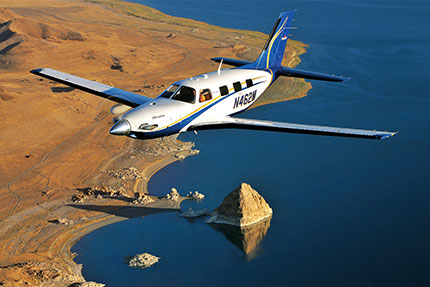
That may be a contributing factor in the emergence of single-engine turboprops. Piper’s Meridian is the most recent entry into the certified uniturbine market, a good idea that was finally born in 2001.
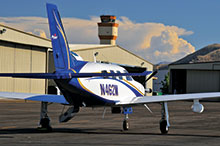 |
The PA46-500TP upped the ante to 260 knots, 50 knots quicker than the derivative Piper Mirage. Better still, it provided Piper with an entry-level airplane to a market the Vero Beach manufacturer hadn’t seen in nearly a generation. Piper’s twin-engine, world-beater, Cheyenne 400LS was the company’s last turbine product, discontinued in 1991, but capable of blazing along at 350 knots.
The Meridian reintroduced Piper to the high-altitude regime. While it’s true the turbocharged Mirage, Matrix and Seneca V are all capable of flight at 25,000 feet, few pilots choose to cruise that high with piston engines.
Turbines are made for the high road, and the Meridian will spend virtually all its time in the flight levels where traffic is usually light, weather and turbulence are most often well below and terrain isn’t a factor unless you’re flying in Alaska, the Andes or the Himalayas.
Simplicity Redefined
Turboprops in general employ massive simplicity masquerading as complexity, and that’s only appropriate, as the Meridian is among the simplest of turboprops. The myth among piston pilots is that turboprops and jet engines are almost too complex for mere humans, and that’s exactly backward.
Piston powerplants are, by far, the more complex, especially those on such heavy general aviation iron as the 421, Duke and Commander 680. True, things happen faster in a turboprop or jet, but the engines themselves are almost ridiculously simple, especially in contrast to piston mills that may have 250-300 moving parts.
Turbines dispense with turbocharging, operating as normally aspirated, flat-rated engines. Their potential power at sea level is far in excess of full-rated power. The pilot restricts power to a given torque limit at sea level, then adds power as he climbs higher. On the Meridian, max thermodynamic rating is 1,029 shp, but the flat rating is limited to 500 shp. This is somewhat analogous to the old manual turbochargers on Aerostar 601s that demanded adding power as you climbed higher.
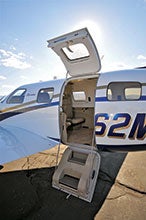 The double-clamshell airstair door provides entry to a luxurious and spacious cabin, furnished in leather. |
Turbines are relatively bulletproof, but just as with piston engines where the worst abuse is simply to start them, the starting process in a turboprop is one of the few areas where you CAN mismanage the engine. Even then, an overtemp or “hot start” is unlikely, as the little Pratt & Whitney PT6A-42A is so simple, you’d have a hard time hurting it unless you tried to start without sufficient electrical power.
Takeoff is enthusiastic, with 500 shp to propel only 5,100 pounds of airplane. The Meridian vaults uphill at an initial 1,500 fpm, and it will hold that rate for the first 10,000 feet, tapering off to 1,200 fpm at 17,000 feet. You can plan a climb from near sea level to FL200 in about 15 minutes.
Cruise In The Flight Levels
Strong climb is important in a turboprop, as high altitude is where the airplane is happiest. If the winds are willing, you’ll fly high in the Meridian to realize the airplane’s maximum speed and economy. Even the middle flight levels can offer occasional jet streams of 50 to 100 knots. For maximum efficiency and optimum comfort, most trips will be flown at 26,000 to 28,000 feet, weather permitting. (The Meridian’s certified ceiling is 30,000 feet, but operators are unlikely to spend the $100,000 or so necessary to certify the airplane for RVSM operation at 29,000 or 30,000 feet.)
For better or worse, most trips are two-way. Not all flights are eastbound, where the wind is most often a push, and you may wind up having to fight strong Westerlies at times. Even if the breezes aren’t going your way, the trade of speed for fuel may favor the high road. At 27,000 feet, the airplane burns about 240 pounds/hr (36 gals./hr) in exchange for 255 KTAS. Slog along at 20,000 feet, and speed drops 20 knots while the fuel burn actually increases. If the wind at 27,000 feet subtracts more than the benefit in true airspeed and the weather is willing, you may have to fly lower.
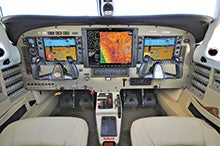 The Garmin G1000 includes a pair of 10-inch diagonal PFDs that feature synthetic vision and a single 15-inch MFD. |
Managing The Load
If the Meridian has an Achilles’ wing, it’s probably payload. Like the derivative Mirage, the Meridian is challenged to carry full fuel and six folks. That’s not a big surprise, as nothing else in the class will do that job either. The typical, well-equipped Meridian features a useful load of 1,700 pounds. Subtract 170 gallons (1,139 pounds) of fuel, and you’re left with about 561 paying pounds, three very small folks and toothbrushes, or two real people and some cargo (considering the rising weight of Americans).
The good news is that with 170-gallon tanks, you have the flexibility to carry a light load a long way (nearly 1,000 nm) or leave some kerosene behind and haul more paying pounds. Better still, you could leave from the airport nearest your home on your own schedule (without hassling with TSA), keep your shoes on and carry whatever you wished in your baggage, knowing that all your belongings would arrive at the same time and place you do at no extra charge, and you wouldn’t need to manhandle suitcases from a carousel.
If the stage length is shorter, you could fly with, say, 120 gallons instead of 170 gallons, and cabin payload would increase to almost 800 pounds. That would allow short business trips of two-and-a-half hours, 600 nm in zero wind. That’s as long as many people are willing to sit in an airplane anyway, even one as comfortable as a Meridian.
Destinations are no longer limited to those with paved runways. Recently, Piper received approval from the FAA for operation into dirt strips, effectively opening up access to several thousand additional runways in the U.S. and overseas. Takeoff and landing distances remain shorter than 2,000 feet.
 Turbines are made for the high road, and the Meridian will spend virtually all its time in the flight levels where traffic is usually light, weather and turbulence are most often well below and terrain isn’t a factor.
And the Meridian is, above all else, a supremely comfortable machine. Piper’s original 1984 Malibu introduced cabin-class comfort to the single-engine market, and the Meridian has only continued and improved upon that tradition.
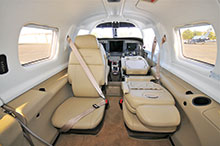 |
The Vero Beach company learned a long time ago that performance is important, but comfort can be an end in itself. The double-clamshell airstair door provides entry to a truly luxurious cabin, sumptuously furnished in leathers and wools and generously proportioned, roughly four feet wide and the same dimension tall. That’s bigger than any other Piper, and an excellent entry into the cabin-class single market.
For 2011, the Piper Meridian continues to offer the fully integrated Garmin G1000 glass panel. The G1000 has been around for several years on other Pipers, Cessnas, Beeches, Mooneys, Diamonds, TBMs, Pilatus and a plethora of other models, and we’ve probably written several dozen stories about it.
For that reason, we won’t wave that same flag again. On the Meridian, the system includes a pair of 10-inch-diagonal pilot and copilot’s PFDs and a single, central, 15-inch MFD. The two PFDs include synthetic vision (inevitably SVT), a far bigger benefit than you could possibly imagine.
Synthetic vision was introduced two years ago and presents a full-color, computer-generated image of the world, relying on a database that’s nothing short of amazing. Technically, the database takes a terrain data point every nine arc seconds. That’s 160,000 data points/square mile or about 570 billion (yes— with a “b”) data points in the contiguous U.S. alone. Billions and billions served.
No matter what the weather is, synthetic vision projects a detailed image that’s almost eerily accurate. The SVT database is worldwide, although it stops at 75 degrees north and south (in case you live in the town of Spitsbergen, Norway).
 |
(During a test flight in the new Meridian, I was flying over a large lake east of Lakeland, Fla., in CAVU conditions, and I looked down at the shoreline and compared the real world out the window to what I was seeing on the pilot’s PFD. The only difference between the two lakes was that the real one had boat wakes.)
The Meridian’s application of the G1000 has been beautifully adapted to the airplane, with special applications to assist the pilot in engine start, overspeed and every other critical engine parameter. The Garmin avionics also includes the G700 autopilot, another system that’s so smooth and seamless, it’s almost transparent. If you can read the names on the buttons, you can learn to use the G700 in short order.
The Price Of Admission
The new 2011 Meridian in Garmin trim sells for around $2.1 million. That’s $1.2 million less than the Daher-Socata TBM 850, and $2.3 million less than the Pilatus PC-12NG. In fairness, the latter boasts 1,200 hp, 11 seats and a 10,800-pound gross weight (more than double that of the Meridian), so it could be argued it’s in a totally different class. Alan Klapmeier’s Kestrel may be well on its way to certification, but it probably won’t be available on the market for at least two years.
Several VLJ projects also may provide competition for the Meridian in the next few years. The Diamond D-JET, Cirrus Vision SF50 and Piper’s own Altaire all hope to see daylight at prices only slightly above the Meridian while beating its performance significantly.
In contrast, the highly successful Cessna Mustang ($3.2 million) is hardly a VLJ, and the recently introduced Embraer Phenom 100 ($3.9 million) and upcoming Honda Jet ($4.4 million) are priced well out of the originally proposed VLJ market.
At a base price of $2,071,500, the Piper Meridian with Garmin avionics is here and now and offers a lot for the money. It’s, by far, the world’s least expensive turboprop.
With the possible revival of the Eclipse 500, Diamond’s D-JET and Cirrus’ Vision Jet in the offing, plus Piper’s own Altaire a few years down the road, the Meridian may continue to bottom the market. In price, that is.


