

 |
Ted Smith’s airplanes were nothing if not impressive. His final design, the innovative, midwing Aerostar 600, was conceived in the late ’60s. It’s now, as it was then, the fastest piston-powered, normally aspirated machine in the sky. Its eventual upgrade and final successor, the pressurized Piper Aerostar 700P, was (not surprisingly) the world’s fastest turbocharged airplane, scoring the magic 261 knots (300 mph) and running away from even many entry-level turboprops.
But it was Smith’s high-wing Commander line of multi-engine corporate transports that earned him perhaps the most recognition. Through the ’50s, ’60s and ’70s, his Commander 500 through 680 piston twins were regarded as the peak of the pyramid, among the top corporate transports available. Even President Eisenhower used a 680 Grand Commander as an occasional Air Force One because of its good short-field capability.
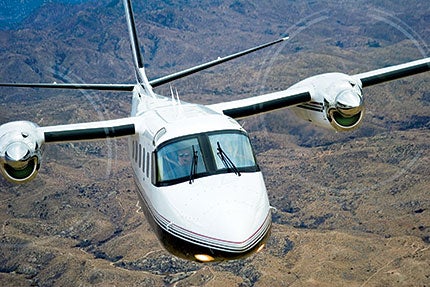
The most impressive of the Aero Commanders were the later models, however, developed after the line had been sold to Rockwell and then passed to Gulfstream Aerospace. Gulfstream introduced a series of improved turboprop models, culminating in the ultimate Twin Commander 1000.
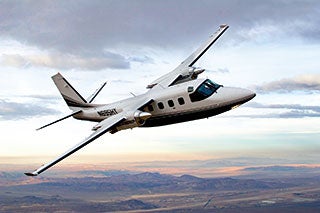
The top Twin Commander was produced for only three years, from 1982 to 1985, but Jay Obernolte, president of FarSight Studios in Big Bear, Calif., feels it was the best of the best. His company purchased the airplane in 2004, and it has averaged just under 200 hours flight time per year since the acquisition.
“For our missions, the Twin Commander is almost an ideal airplane,” says Obernolte. “Mine is one of only 42 built, a 1982 model that was originally owned by the DEA and operated for 20 years in a variety of government missions. When the DEA stepped up to jets in 2004, they traded in a number of 1000s, and Eagle Creek Aviation of Indianapolis completely renovated the airplane with what it calls a ‘radome to tailcone refurbishment,’ including Meggitt Magic avionics and RVSM certification. Eagle Creek is aggressive on maintenance of the Turbine Commanders, and I’ve been impressed with the company’s service. I took delivery of the 1000 in August ’04, and it went straight to work for my company.”
Obernolte’s FarSight Studios designs primarily sports and casual video games for platforms such as the Xbox 360, PlayStation 3, Nintendo Wii and a variety of PC applications. The company’s more popular 2007 games include Game Party, Backyard Football and Pinball Hall of Fame: The Williams Collection.
 |
“We’ve probably produced 30 different games over the last 20 years, and airplanes have been an important ingredient in our success in this business,” says Obernolte. “Our company airplanes have allowed us to be on site quickly to solve problems, often within a few hours of a call from a client about a problem with the software.”
The FarSight executive got his flying start at an almost ridiculously young age. Both his grandfather and father were enthusiastic pilots, and Obernolte can remember riding in the back of Skyhawks at age five while his father taught stalls to students up front. “I have vague memories of Dad telling a nervous student to look in the back seat during stall practice, and I’d usually be asleep,” laughs Obernolte.
“Dad took me up to near solo, and that’s when Mom put her foot down. I had to wait several more years until I went to Cal Tech in Pasadena to earn my pilot’s license with the college flying club.” Obernolte went on to earn an instrument rating and purchased his first airplane, a Glasair I, shortly after graduating from college with a master’s degree in artificial intelligence. He subsequently traded the Glasair I for a 300 hp Glasair III, buying the hotrod III from jazz saxophonist Kenny G.
“After college, I got married and we started having kids, so a two-seat airplane was no longer practical. Problem was, a Glasair III was a tough airplane to transition out of: It really was an exciting airplane to fly, with great handling and plenty of speed. I didn’t want to step down in performance—the Glasair cruised at nearly 220 knots,” Jay explains. “As a result, I bought a 1984 Aerostar 700P and absolutely loved it. It was something like a certified Glasair twin with more seats. The Aerostar was a great performer, probably the best handling asymmetrical-thrust twin in the sky, but of course, it was still a piston machine with all the inherent reliability considerations, and it had only six usable seats.”
Obernolte was looking to step up to a turbine, and he did extensive research before giving up his Aerostar. “I evaluated practically everything available, from Cheyennes, Merlins, Conquests to King Airs, but nothing quite fit what I had in mind,” he comments. “I even considered a Cessna Citation CJ1 jet, but it wouldn’t have been practical for summer operation out of Big Bear. Support was a major factor in our decision, and when the Twin Commander 1000 became available in ’04, I jumped at the chance to own the top of the Commander turboprop line.”
Obernolte focused his attention on a Twin Commander for several reasons, most having to do with practical considerations of loading, speed, range, short-field capability and payload. “I’ve always liked Ted Smith’s designs. He was something of a maverick, and all his airplanes place the cockpit out in front of the engines. I really enjoy the improved visibility provided by the more forward seating position. I also appreciate the idea of a forward-boarding door, so the pilot can be the last one in and the one to close the door, then not have to thread his way forward through five or six passengers to the front office.” Obernolte also favored the Twin Commander’s large external baggage compartment that allowed stowing most of the bags outside the passenger cabin, again similar to the Aerostar’s aft cargo compartment. “With those big 820 shp, Garrett TPE-331 engines, the huge, nine-seat cabin and all the other benefits, the 1000 was exactly the right airplane for us,” Obernolte explains.
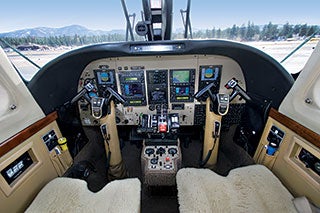 |
Perhaps the major benefit of FarSight’s Twin Commander is its flexibility, facilitated by an avionics suite that’s both sophisticated and easy to manage. With the Meggitt avionics system installed, Obernolte’s corporate transport is as talented as most airliners. The dual PFD/MFD Magic EFIS screens and the Meggitt 2100 Digital Autopilot provide confidence at all RVSM altitudes where the FAA requires the airplane to be flown on autopilot.
Obernolte and many of his 23 employees regularly utilize the big turboprop for trips as short as 70 nm to Orange County or Van Nuys Airports. FarSight’s missions often demand meetings with clients at various locations around the Los Angeles Basin, and meeting a schedule while contending with the L.A. freeway system using automobiles would be nearly impossible. The company has clients in the Bay Area, Seattle and at other places all over the States, and the Twin Commander also makes those trips far easier and sometimes quicker than on the airlines.
“One of the Twin Commander’s fringe benefits is that it’s actually a good short-field machine,” says Obernolte. “Using approach speeds of 100 or even 95 knots, I can handle strips as short as 3,000 feet. Even here at Big Bear on a summer day, I have an acceptable balanced field length. I can accelerate to rotation speed, lose an engine and elect to either stop or go, my choice. You can’t do that in many turboprops from this airport.”
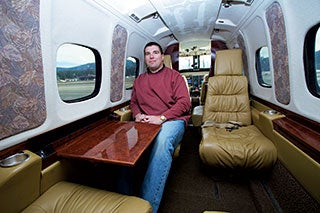 |
In fun mode, Obernolte says he can load up two couples and four kids and fly for as long as a parent can stand it. “We have a full video system installed in the airplane so passengers can watch DVDs or play games if they wish. The kids really like the isolation of the aft compartment with a door they can close and their own windows. They can sit back there, have fun or whatever while we watch the sights from up front.”
The exec says he sees performance at the very top of the turboprop class from his Twin Commander. “Climb is excellent, as much as 3,000 fpm, even from Big Bear’s 6,700-foot-high mountain runway. The airplane will climb straight to FL350 with a full load, but FL290 is the default altitude for us,” Obernolte comments. “Unless we’re going a long distance or there are strong tailwinds up high, we’ll use 290 most of the time. At that height, we see slightly better than 300 knots, depending on load, typically burning 500 pounds/hour. That’s only about 75 gallons/hour, so we still have good range. If we do elect to fly tall, we can go to FL350 and still score 285 knots on more like 400 pounds/hour. The high 6.7 psi pressurization system helps assure that the cabin stays down around 10,000 feet, even at nearly seven-mile altitudes.”
Using the lower power setting, the Twin Commander 1000’s 3,200-pound fuel capacity provides an easy six-hour endurance for as much as a 1,700 nm range, even more with the benefit of tailwinds.
Sometime down the road, FarSight has plans to acquire an Embraer Phenom 100 jet and then a Phenom 300, but the company president says the 100 definitely won’t replace the Twin Commander. “Yes, it will be a little faster, but it won’t have nearly as large a cabin or the same range as the Twin Commander 1000. In 2007, we were able to fly the 1000 from Big Bear all the way to the NBAA Convention in Atlanta nonstop without benefit of any tailwind. There’s no way we could have made that trip in a Phenom 100 with anything short of a hurricane on the tail.
“Generally speaking, we simply couldn’t do what we do at FarSight without the airplane,” says Obernolte. “It’s an invaluable resource for us, providing on-demand transportation to wherever we want to go on our own schedule rather than the airlines’. Perhaps best of all, it facilitates living and working up here in the clean air and sunshine of Big Bear rather than down in the sprawl of L.A., and that’s a benefit beyond price.”
SAGEM Avionics: A New/Old Player |
| Sagem Avionics of Grand Prairie, Texas, may not be all that familiar a name around the local FBO, but avionics shops recognize that, for nearly two decades, it has been an innovator in military, airline and helicopter electronics. An American subsidiary of the European SAFRAN Group, Sagem has been a worldwide player in satellite communications, gyro sensors, helicopter autopilots, navigators and biometrics for years. The company used to be known as SFIM, and in 2004, Sagem expanded its horizons, acquiring ARNAV Systems of Puyallup, Wash., the latter a designer of LORAN, GPS and FMS navigation systems and fuel computers for at least two decades. Sagem products are approved on a variety of corporate aircraft, and by the time you read this, the company’s line of electronics will be STC’d for Twin Commander turboprops. Sagem has equipped large fleets of helicopters, including Los Angeles Police Department, Riverside County Sheriff’s Department, Seminole County Sheriff’s Office and organizations that use everything from Aerospatiale to Bell to Robinson helicopters. Sagem has long been a proponent of sophisticated PFD/MFD cockpit-display systems, and the recent merger with ARNAV brings intelligent LORAN/GPS navigation and fuel computers to the product line. The Sagem Star 5000 offers pure GPS navigation, and the multisensor FMS-5000 provides full FMS functions. Advertisement
Additionally, Sagem’s fuel computers answer all your fuel questions, including current fuel state, burn rate, fuel burned, remaining and time to exhaustion (at current burn). Sagem products are approved on many GA fixed-wing and rotary-wing aircraft. For more, contact Sagem Avionics at www.sagemavionics.com or (972) 314-3600. |


