

 |
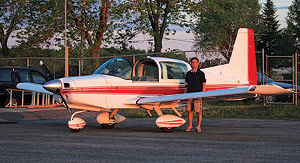
At exactly 5:45 a.m. on March 5, 2010, I took off in my 1972 Grumman Traveler from Canada’s St-Hyacinthe Airport (CSU3), on the south shore off Montreal. My brother-in-law Mark, who was scheduled to attend a meeting in downtown Toronto that morning, was my passenger. Mark is a person who likes to be in control of his life and who had never really been comfortable with the thought of flying. But, after having watched me do my thing for so long (and maybe with a little push from his wife), he finally said, “Hey what the heck…I’ll give it a try.”
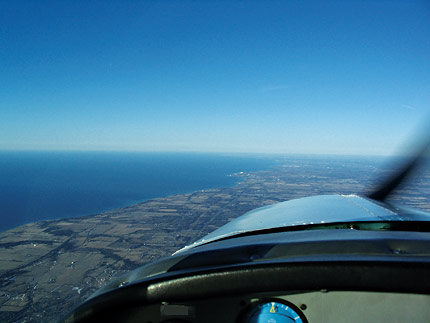
It was a cold morning, and we climbed up to 6,500 feet on a VFR flight plan to Toronto City Center airport. As the sun gradually rose, and after almost two hours into our flight, Lake Ontario was within reach, and with a 15- to 20-knot tailwind, our GPS predicted an ETE (total) of about two hours and 15 minutes to our final destination, which was excellent. With the beautiful blue sky, the unlimited view on the lake and calm air, it was one of the nicest rides I had experienced since I acquired the Grumman a year before. I bragged a little bit about the safety and comfort of this wonderful flying machine to Mark, who was still nervous but tried to hide it.
Not long after, Toronto Center advised us to descend to the altitude of 4,500 feet, and then to 3,500 feet. We were now flying over the water approaching City Center, but still at a great distance from it. Suddenly, the engine started stuttering. Thinking ice was the problem, I instantly pulled the carb-heat lever, and then the engine stopped. After many attempts to restart it, a loss of about 300 feet and now faced with the fact that it might never restart, I called Toronto Center to let them know about the engine failure and started proceeding toward the shore to our right side at best glide speed. Suddenly, everything became very quiet on the frequency. I could only hear one other pilot, a traffic reporter who was talking with the controllers, in an effort to locate us to direct the rescuers in case of a crash landing.
The controllers asked me if we could make it to Buttonville Municipal Airport (CYKZ), but it was obviously too far. We ended up on short final at an altitude of about 700 feet over the north shore of Lake Ontario with nothing interesting in sight that would give us any kind of hope for a smooth landing. There were trees, rocks, buildings and a tiny patch of grass! This is when I called the controllers (probably not without some emotion in my voice) to let them know that we were getting ready for an emergency landing. I then grabbed my passenger’s left knee (who by the way, is a father of four!) and said, “I’m sorry, beau frère, it wasn’t supposed to happen this way.” He then replied calmly by saying, “I trust you.” These are the only three words that came out of his mouth.
 |
A moment later, my many efforts in trying to restart the engine paid off. It started roaring again, not smoothly, but enough to climb back up to 3,500 feet. We then proceeded toward Buttonville Airport, and obviously, my goal was to climb as high as possible in case of another failure. Sure enough, as soon as we reached that altitude, the engine stopped again. To make matters worse, we were now flying over a very populated area during the morning rush hour. I then managed to glide the old Grumman to the airport and smoothly land it on runway 33, which had to be closed momentarily until we got towed away. What a feeling (and relief) it was for the both of us when those three wheels touched the beginning of the runway. Later that month, after a thorough inspection, it turned out that the engine failure was caused by a faulty carburetor that was later replaced by a new one.
When such an incident happens, there’s a lot that goes through your mind. In my 30 years of flying for pleasure, I always thought it could happen, because I had often read about other people’s stories. But I wondered if I would be able to deal with the situation correctly. Luckily, I obtained my commercial license a few years back for my personal satisfaction, and I had a chance to practice the emergency procedures again and again. Thanks to some very good advice from my instructor, things went pretty smoothly that day in March 2010.
In a matter of seconds, you find yourself face-to-face with danger and with the fact that this time it’s your turn, and now anything can happen…literally, anything. The level of concentration peaks to a high, and it’s a mixture of emotions and skills that are suddenly awakened. I’m glad to have managed to deal adequately with this situation, but the seven or eight minutes (or maybe more?) that the whole incident lasted drained all my energy. I remember thinking to myself, as I was gliding in short final to Buttonville, how exhausted and anxious I was for this to be over with. After having smoked my first cigarette ever and drinking a double Scotch at lunch hour, I slowly started to calm down.
I still really enjoy flying my Grumman today. I feel prepared to face the music if ”all hell breaks loose” again. My best advice: Think about it before, during and after your flight. There’s nothing like mental preparation to help you manage every important step of an emergency procedure…if your number comes up.
By the way, Mark made it in time for his meeting—mission accomplished!

