

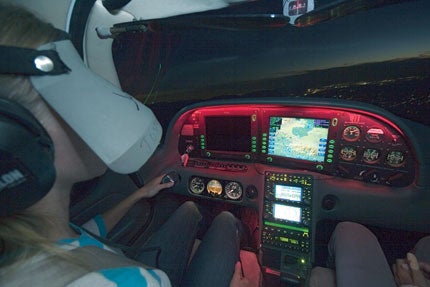
 NAVIGATING THE GLASS COCKPIT. Some aircraft accidents may be preventable if students are properly versed in what to do in the event of an equipment malfunction. |
While I was at an FBO at the Westchester County Airport north of New York City a couple of days ago, a guy I hadn’t seen in a long time walked in. We immediately started catching up on a host of things, not the least of which were the predictable topics of what we’re flying and how much (or little) we’re getting in the air these days. It turned out that this fellow has been flying a couple of times a week, mostly on business, in a new high-performance single he bought to replace a light twin. The airplane had been in the shop for a warranty repair to the autopilot, which no longer wanted to hold a heading. The technicians said they fixed the connector causing the problem, so a test flight was in order. Would I like to come along? Yes, of course.
On the walk out to the airplane, I started quizzing him about his transition to the new airplane’s glass cockpit. The transition, he reported, required a lot of work. He took the training offered to new owners by the manufacturer, used a flight school’s simulator for the airplane, studied almost everything he could get his hands on about the equipment and flew with instructors. After logging about 250 hours in the new airplane, he asserted that he felt very comfortable with the PFD, MFD, electronic checklists, weather graphics, terrain graphics, electronic flight charts, radios, GPS and every other useful item. I expressed concern that there are some pilots who may be relying too much on electronics at the expense of piloting and navigational skills. He agreed, swearing that he not only constantly monitors the systems when they’re doing the flying, but also makes a point to know at all times where the airplane is and where it’s supposed to be going, just like in the old days. He even uses paper charts for reference.
I made a note of his discipline in arranging for flight following during our brief test flight, programming what was to be a 30-minute trip with two other airports as waypoints and running every line of every checklist the electronics threw at him. He took the time to ensure that everything had initialized properly before calling for taxi clearance. When finally airborne and handed off from the tower to a departure controller, we were asked to remain at or below 3,000 feet because of traffic inbound to the major New York airports. The pilot told the controller that this was a test flight after an autopilot repair and agreed to the altitude request. Anyway, we were VFR, outside of Class B and D airspace.
A few minutes later, in stable level flight, it was time to turn on the autopilot for a test. The equipment was taking us to the first waypoint and the course was holding steady. Then, the aircraft’s nose started to rise. The nose-up attitude increased sharply, and we were climbing fast. The pilot attempted to troubleshoot, but the controller was on the radio within seconds, asking what we were doing at 3,900 feet. The pilot replied that there was an autopilot problem; the controller said it didn’t matter because there was no immediate inbound traffic. The pilot asked for vectors to return for landing. On the way back in, the autopilot didn’t do any better, so the pilot flew the approach by hand. Back to the shop.
This started me wondering whether the NTSB’s accident files might shed any light on the extent to which pilots of advanced aircraft have been getting into trouble because of inadequate training or equipment malfunction. A search revealed that there weren’t enough accidents in which glass-cockpit equipment was prominently mentioned to detect any patterns. But there was enough anecdotal evidence to suggest that all pilots who operate in glass cockpits need to be as studious and cautious as my friend.
A student pilot was seriously injured and his instructor received minor injuries when the Cessna 172S they were flying struck trees on a mountain near Asheville, N.C. The night/VFR flight originated from Big Sandy Regional Airport in Prestonburg, Ky. The instructor reported that the student was flying the airplane. They had received the weather on a computer before departure and planned a direct flight to Thomson-McDuffie Regional Airport in Thomson, Ga.
After departure, they climbed to 7,500 feet MSL and stayed there for about an hour, using the airplane’s GPS and MFD for navigation. The instructor said the ceiling began to drop and they had to descend to remain clear of clouds. They went down to 4,000 feet, checking the moving-map display at least three times to determine the lowest altitude they could be at while maintaining adequate terrain clearance. Both the instructor and the student reported that the highest terrain shown was between 2,000 and 3,000 feet MSL. The moving-map display was set at a range of 40 nm. According to the instructor, as they descended to 3,500 feet, the airplane began hitting the tops of trees. The instructor said the airplane was in no more than a five-degree nose-down attitude. It was on the ground quickly and came to a sudden stop. The two waited until daylight before seeking help.
Representatives of the NTSB, FAA and aircraft, engine and avionics manufacturers examined the GPS and MFD at a facility in Griffin, Ga. The data cards in the units were found to be current. The NTSB report contained nothing to back up the claims of the student and instructor that the GPS and MFD didn’t give them accurate readings of the terrain elevation. The NTSB noted that a bold-type warning in the MFD’s guide states, “Never use the terrain displayed on this equipment as your sole reference for terrain avoidance.”
The NTSB determined that the probable cause of this accident was the instructor’s inadequate visual lookout and failure to remain clear of objects during flight.
A Cessna 182T owned and operated by the Civil Air Patrol (CAP) crashed during climb to cruise altitude about 13 nm southwest of Las Vegas, Nev. Night/VFR conditions prevailed. Both persons onboard were killed. The airplane, which was equipped with an integrated cockpit system incorporating a PFD and an MFD, had taken off from North Las Vegas Airport and was headed for Rosamond, Calif.
After takeoff, the airplane was handed off to departure control and received traffic advisories. The pilot asked to leave the frequency in order to open a VFR flight plan. After returning to the departure frequency, the pilot asked for an altitude higher than the current 4,100 feet MSL. The flight was handed off to another controller, who approved a climb to 10,500 feet a minute and a half later. Five minutes later, radar contact with the airplane was lost. The last recorded altitude was 7,000 feet. The airplane had impacted an almost-vertical rock face about 1,000 feet below the summit of a mountain.
The CAP had established formal procedures for training its check and line pilots in flying glass-cockpit aircraft. To be qualified for VFR flight, a pilot must have demonstrated competence with the PFD, engine performance display (i.e., MFD), basic VOR and GPS navigation, and terrain avoidance and traffic information systems. For IFR flight, the pilot must have demonstrated competence with PFDs, MFDs, GPS navigation and ILS, VOR and GPS approaches, and use of the autopilot. A memo issued in November 2005 from the CAP’s headquarters informed all wing and region commanders that it would pay to send qualified check pilots to an FAA instructor training course covering glass cockpits. The memo described the CAP’s plans to work with Cessna to factory-train its instructors; it also listed some requirements for pilots to maintain currency in both glass-cockpit and CAP “round-dial” aircraft.
The Cessna 182T’s left-seat pilot was a CAP wing commander with an ATP certificate, several type ratings, a turbojet engineer rating and a flight navigator rating. He had logged more than 25,000 hours and was one of the check pilots who had received glass-cockpit and Cessna factory training. He had accumulated almost 75 hours in glass-cockpit Cessna 182Ts.
The right-seat occupant also held an ATP certificate with numerous type ratings. He had accumulated more than 28,000 hours and was a high-ranking official with the CAP, though he hadn’t been trained in its glass-cockpit Cessnas (and, therefore, wasn’t authorized to fly them).
The airplane’s MFD allowed the user to access a Terrain Proximity page, which provides terrain elevation relative to the airplane’s altitude, current aircraft location, range marking rings, heading box and depiction of obstacles. The guide issued by the avionics manufacturer states, “CAUTION: Use of Terrain Proximity information for primary terrain avoidance is prohibited. The Terrain Proximity Map is intended only to enhance situational awareness. It is the pilot’s responsibility to provide terrain avoidance at all times.”
The NTSB determined that the probable cause of this accident was the pilot’s failure to maintain an adequate terrain clearance/altitude during climb to cruise. Contributing to the accident were rising mountainous terrain, the dark nighttime lighting condition and the pilot’s loss of situational awareness.
Peter Katz is editor and publisher of NTSB Reporter, an independent monthly update on aircraft accident investigations and other NTSB news. To subscribe, write to: NTSB Reporter, Subscription Dept., P.O. Box 831, White Plains, NY 10602-0831.


