

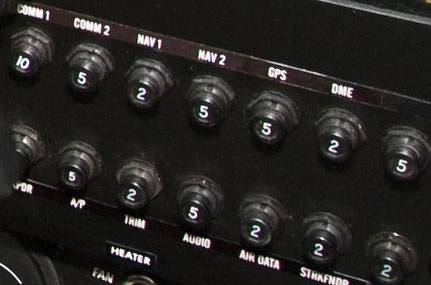
 WHEN TO RESET? The information in operating handbooks may conflict with FAA advice, leaving pilots in a confusing situation. |
The NTSB says it’s time to rethink something most GA pilots learned early in their training: If a circuit breaker trips while you’re flying, it’s okay to reset it after allowing a minute or two for it to cool, even if you have no idea what caused it to trip and cut off electrical power to a particular circuit. Only if the breaker trips a second time should you not try to restore power by resetting it—so the thinking has been. This still appears in operating handbooks put out by aircraft manufacturers, as well as in literature on aircraft operations.
Largely as an outgrowth of the in-flight fire and crash of a Swissair MD-11 in 1998, and an FAA Advisory Circular (AC) issued in 2004, air carriers reviewed the procedures followed by their flight crews in the event of a tripped circuit breaker. Guidance was updated to inform flight crews that if the cause of the breaker trip is unknown, or if the breaker controls a nonessential circuit, it should not be reset. Aircraft operated under Part 121 commonly have indicators, such as circuit breaker markings or coloring or segregated placement of specific circuit breakers in the cockpit, showing which circuit breakers are critical.
The NTSB suggests that many Part 91 pilots and operators may not know about AC 120-80, which dealt with in-flight fires and largely was aimed at air carrier crews, or may be unsure of whether to follow the advice in the AC or conflicting guidance provided by an aircraft manufacturer. It’s time for the FAA to issue new guidance aimed at Part 91 pilots.
In AC 120-80, the FAA expresses concern about resetting a circuit breaker (unless a reset is called for in specific procedures or the captain decides it’s necessary for the flight’s safe completion). It also says that crewmembers should remember not to use a circuit breaker as a switch to perform procedural functions unless doing so is specified in approved company procedures or the manufacturer’s operating procedures.
The FAA notes that circuit breakers are slow-acting devices and may not offer sufficient disconnect protection during events such as arc tracking or insulation flashover. Arc tracking is a phenomenon in which a conductive carbon path is formed across an insulating surface. The carbon path provides a short circuit path through which current can flow (electrical arcing). Insulation flashover, a result of arc tracking, is an instantaneous burn-through of an insulated wire with the possibility of continuing the burn into surrounding wires. The high temperature of an electrical spark causes a wire’s insulation to fail, thus allowing more arcing to occur, which can destroy even more insulation and, ultimately, an entire bundle of wires. The effects of electrical faults can include, in addition to wiring damage, component overheating, toxic fumes, smoke, fire and holes melted into the metal.
The subject of leaving a tripped circuit breaker alone came up in the NTSB’s investigation of the July 10, 2007, in-flight fire and crash of a Cessna 310R operated by NASCAR (the National Association for Stock Car Auto Racing). The plane crashed en route to Orlando Sanford International Airport (SFB) in Orlando, Fla. The commercial pilot, an ATP-rated pilot and three people on the ground were killed. The Part 91 flight was on an IFR flight plan in visual meteorological conditions.
The commercial pilot was acting as pilot in command (PIC) for the personal flight, with the ATP-rated pilot acting as a “safety pilot.” NASCAR normally required an ATP-rated PIC, and an ATP-rated “safety pilot” allowed the commercial pilot to act as PIC. The plane departed Florida’s Daytona Beach International Airport (DAB) at 8:22 a.m., destined for Lakeland Linder Regional Airport in Lakeland, Fla.
At 8:32:49, shortly after reaching a cruise altitude of 6,000 feet MSL, the ATP-rated pilot contacted air traffic control to declare an emergency: “Smoke in the cockpit we need!to land at Sanford.” The flight was cleared to proceed directly to SFB and descend to 2,000 feet. The last radio transmission from the plane was received at 8:33:15. It ended abruptly and seemed to include the phrase, “Shut off all radios, elec[trical].” Investigators said this phrase was consistent with the checklist guidance for an in-flight fire or smoke emergency in the Cessna 310R’s POH, which stated, “Electrical load—REDUCE to minimum required.” The last transponder reply was received at the time of the last radio transmission.
Primary radar returns that were recorded for another 90 seconds showed the plane maintaining a heading of about 150 degrees toward SFB. The last of these returns was recorded at 8:34:45. At that time, the Cessna was three miles northwest of SFB and descending through 1,200 feet AGL. The residential area in which the airplane crashed was about 0.7 nm west of the last primary radar return.
According to several witnesses, the plane was traveling “extremely fast,” was “very low,” and its wings were “rocking” as it descended. Just before impact, the 310R entered a “steep bank” and made a sharp turn to the west. Witnesses reported seeing smoke trailing from the airplane, and one person stated, “Smoke was trailing from the port side.”
Although much of the airplane was destroyed in the postimpact fire, investigators saw discolorations and soot deposits on parts that weren’t directly exposed to the postcrash fire. For example, the instrument panel’s deck skin showed signs of thermal damage. Localized areas of the underside of this component had discolored primer paint, patches of charred/bubbling paint and soot deposits. Also, the instrument panel’s glare shield, which is normally attached to the upper surface of the instrument panel’s deck skin, had thermal damage at the attachment point.
The cabin door was found 60 feet away from the main wreckage. It wasn’t burned, and its latching pins weren’t damaged. Numerous soot deposits, however, were noted on the door’s interior side. These deposits trailed across the door’s lower portion from an area that would have been near the instrument panel’s lower edge. The undamaged latching pins and the location and existence of a trailing soot deposit are consistent with the pilots having opened the cabin door to vent smoke during an in-flight fire.
A day before the accident, there was a burning smell after the weather radar malfunctioned while the airplane was in flight. The pilot on that flight turned off the weather radar and manually pulled the related circuit breaker, cutting power to the system. The burning smell subsequently “went away,” according to the pilot’s entry in the plane’s maintenance discrepancy binder, and the pilot flew the plane for more than an hour without further incident. The NTSB said that the radar problem could have developed into a significant in-flight smoke and fire event had the pilot not shut down the radar and pulled the circuit breaker.
According to regulations, GA operations may operate piston-powered airplanes such as the Cessna 310 with noncritical inoperative equipment if the inoperative item isn’t required for flight and is either: 1) removed from the airplane (with the cockpit control placarded and the maintenance recorded), or 2) deactivated and placarded as inoperative. Further, federal regulations state that an appropriately rated pilot or mechanic must determine that the inoperative equipment doesn’t constitute a hazard to flight.
Interviews indicated that NASCAR’s aviation director, maintenance director and chief pilot discussed the weather radar discrepancy the day before the accident, but no one examined the plane. The NTSB concluded that without examining the weather radar system and then either removing the plane from service or placarding it and collaring the circuit breaker so it couldn’t be pushed in (as well as making a maintenance records entry), it wasn’t permissible to fly the airplane under federal regulations.
The NTSB noted that both pilots on the accident flight had access to information that could have alerted them to the unresolved maintenance discrepancy and led them to take appropriate action. The NTSB theorized that one of the pilots may have reset the circuit breaker before or after takeoff. The impact and fire damage to the airplane, however, prevented physical confirmation that the circuit breaker was reset. The plane was airborne for 10 minutes before the pilots reported a problem; it crashed two minutes later.
Although the weather radar system and its wiring were the most likely source of the in-flight fire, there was insufficient evidence to conclusively determine the fire’s origin. The NTSB noted that GA pilots often reset circuit breakers during preflight preparations unless the circuit breakers are placarded or collared to show that the associated system is to remain unpowered. Further, the accident plane’s “Before Starting Engines” checklist included an item stating, “Circuit Breakers—IN.” The NTSB concluded that it’s likely one of the pilots, consistent with routine and/or the aforementioned checklist, reset the weather radar circuit breaker, which restored electrical power to the weather radar system’s wiring and resulted in the in-flight fire.
After the accident, NASCAR’s corporate aviation division made several revisions to its standard operating procedures, including the requirement that an “In Maintenance” placard be placed near an airplane’s entrance during maintenance. The revised procedures also require maintenance and flight crew personnel to meet face-to-face before each flight to discuss the airplane’s airworthiness.
The NTSB determined that the probable causes of this accident were the actions and decisions by NASCAR’s corporate aviation division’s management and maintenance personnel to allow the accident airplane to be released for flight with a known and unresolved discrepancy, and the accident pilots’ decision to operate the airplane with that known discrepancy, a discrepancy that likely resulted in an in-flight fire.


