

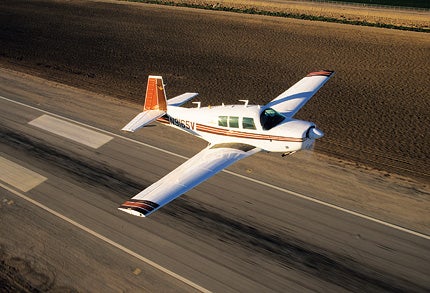
 GO FASTER Bill Cox has added many speed modifications to his Mooney. |
It’s probably the most common question I hear at air shows and conventions such as Sun ‘n Fun, AirVenture, AOPA, NBAA and Reno. “How can I make my airplane fly faster?” While it’s true that more speed isn’t the only goal of pilots, it’s certainly the most popular one. Like many new pilots born without a silver spoon, I rented for a year or two, then started my chain of aircraft ownership with a comparatively inexpensive and slow machine—an entry-level, two-seat, Globe Swift GC-1B. It looked fast and sexy, but it wasn’t—maybe 110 knots on a good day. Fun—yes; fast—no. Then, there were two Bellanca Cruisemasters, followed by a new Mooney 231. A partnership on a Seneca II was next, succeeded by my current airplane, a used Mooney Turbo Executive. The fastest of the group was probably the 231, capable of 180 knots TAS at 18,000 feet on a good day.
My current Mooney is a great little airplane, and I’ve spent the equivalent of its book value all over again on speed mods. So far, I’ve picked up a total of 14 knots in cruise speed by installing a LoPresti cowling, 201 windshield, Power Flow exhaust, gap seals, flap and aileron hinges, and plenty of other stuff I’ve forgotten. That extra speed has demanded 20 years of work, and yes, I’m aware I’ll never get that investment back when (if) I decide to sell.
Fortunately, whether you fly a Mooney or a Cherokee, you need not spend a huge amount to realize maximum cruise speed from your airplane. There are at least a half-dozen things you can do to optimize your airplane’s performance that are basically free. One or two other items will cost you a few bucks, but the results will be well worth it.
One thing I’ve been taught in campaigning the Mooney for more speed over two decades is that speed improvement is a game of inches. Each minor change may be worth only ½ to one mph, but put them all together, and the result may be a significant drag reduction. Also, keep in mind that speed improvements will most often result in a percentage increase. What may generate a full knot on a Bonanza might be worth only half to three quarters of a knot in a Skyhawk.
The first and perhaps simplest improvement to increase cruise performance is to minimize empty weight. You obviously can’t manage payload for the purpose of increasing speed, but there may be some things you can do to reduce the airplane’s weight before adding fuel, passengers and baggage.
A few years ago, I discovered I was carrying around many pounds of miscellaneous junk in my Mooney. There were as many as six cans of oil in the baggage compartment, two or three extra headsets, three Oshkosh tiedown kits, an extra tool kit, two or three kneeboards I never used, several old copies of the AOPA Airport/Facility Directory, approach plates and Low Altitude Enroute Charts for the entire USA, four life vests for trips around the arid Southwest, an old life raft that hadn’t been repacked in 10 years, and things like that. Traditional wisdom has it that every 100 pounds you lighten the airplane (in the standard range of general aviation singles between 2,400 and 4,000 pounds) result in about a one-knot speed improvement. In my case, I dropped perhaps 40 pounds of junk, so I realized about half a knot.
Another good idea is to store what weight you must carry as far aft as possible, consistent with CG limitations, of course. Any airplane will always fly faster with an aft CG because of the decrease in the download on the tail. The late Lyle Shelton, former owner of the Grumman F8F Bearcat Rare Bear, used to tell me that his airplane carried a lead weight in the tail cone to realize that last little bit of speed advantage around the pylons.
Rig is something most pilots who aren’t A&Ps can’t easily change, but it’s something you should have checked at every annual inspection. If an aileron, flap, elevator or a wing is out of rig, you can be losing several knots at cruise.
Similarly, prop balance is critical to optimum performance, and it’s not that expensive to correct. A prop that’s out of balance not only causes what seems like rough running, but inevitably hurts cruise performance. A balance job takes only a few minutes and rarely costs more than a few hundred dollars.
Still another factor that can cost you speed is open air vents. If you fly a four- to six-seat airplane with air vents in back but rarely carry more than two people, you may not know that the aft vents are open and causing minor drag. Closing the vents may not be an option on a hot day in summer, but some pilots fly oblivious to the added drag from air vents ejecting plumes of turbulent air into the relative airstream.
Metal airplanes, unlike most fabric-covered and fiberglass models, often are partially held together with screws, nuts and bolts. Many metal designs utilize wing, fuselage, landing gear and tail fairings that are held in place with standard, metal screws and/or nuts.
Again, anything that interferes with the smooth flow of air across the aircraft surface causes drag, especially at critical intersections where fairings are intended to smooth the flow. A fairing that’s loose may tend to suck outboard at speed, causing more drag than you might imagine. Accordingly, grab a creeper and roll under and around the airplane with a pair of screwdrivers and a set of open-end wrenches, tightening anything that appears loose. Landing-gear doors and the underside of the wing or belly are especially susceptible, because they’re probably inspected no more than once a year.
Finally, there’s wax. Some pilots are convinced that a good wax job can have a dramatic effect on an airplane’s cruise speed, often bragging of as much as a five-knot increase with a good wax and polish. The perception is that keeping the wetted area as slick as possible decreases drag and improves lift.
Sadly, that’s most often not the case. The reality is that a high-gloss wax job makes the airplane look so much better, you THINK it’s flying several knots faster. Usually, that’s wishful thinking.
I say “usually” because there’s at least one product I know of on the market that can have an effect. LoPresti Engineering in Sebastian, Fla., sells two surface preparations specifically intended to clean up an airplane both esthetically and aerodynamically.
The first, Speed Coat, goes on like standard paste wax, but the second, Knot Wax, is a more complex product that demands stripping all existing wax from the surface before application. When Dave LoPresti sent me a test kit of Speed Coat, I was a little dubious.
Wrong! I flew the airplane for the before, noted the speed, landed and applied LoPresti Speed Coat, refueled and went back up the following morning to check the speed. There was no question. At full throttle, 2,700 rpm and 8,500 feet, my Mooney scored something between one and two knots better groundspeed on three average, two-way GPS runs with Speed Coat in place. (Winds were calm, and temperatures were nearly identical for the before and after tests.)
Several years ago, Gretchen Jahn, then president of Mooney and now president of Remos, tested Knot Wax on a new Ovation, and said she saw roughly the same two-knot improvement.
Of course, one of the more frustrating aspects of applying these tricks is that the results may be hard to measure, especially incrementally. It may be next to impossible to see any airspeed change by employing only one of the techniques above. Collectively, you should be able to see a small but definite airspeed change by employing the ideas above. If you don’t have GPS and trust your airspeed indicator, you may be able to see a higher indicated airspeed, perhaps as much as three to five knots.
For many pilots, speed is the ultimate goal—the more the better. If you’re buying new, it can cost major bucks to step up progressively from 160 to 180 to 200 knots, but there are a few tricks that can let your existing airplane fly faster without a major investment.


