

 There’s no precise way to define taste, but it is possible to define class. Okay, perhaps class can also be difficult to define, but most of us feel it’s easy to recognize. To paraphrase a totally unknown art critic/congressman/pundit, “I can’t define class, but I know it when I see it.”
Most of us agree. When you see a new Mercedes S550 or a Bentley, you recognize class even before you see the nameplate. It’s the same with the Cessna 195.
Born in the post-WWII rush to accommodate a market that never materialized, the Cessna 190 and 195 (same airplane, different engines) were designed to one-up the Beech Bonanza. The goal wasn’t to outrun the jaunty V-tail, but to provide ultimate, Packard-style interior comfort to a class of pilots who believed the race wasn’t always won by the swift.
While there’s no evidence that Cessna designer Dwayne Wallace configured the 195 Businessliner around a Packard interior (as the Klapmeier brothers built their Cirrus around the BMW 5-series sedans), the new airplane’s mission was considerably more refined than the Bonanza’s, more concerned with how you arrived than how quickly you got there.
The 195 was essentially an Airmaster with a hormone injection. The notably smaller ’30s-era C-37 Airmaster flew with only 165 hp to protect it and carried four people (it says here) in modestly cramped comfort at speeds of 105 knots.
The Cessna 190/195 was the same airplane except scaled up in every department, a good thing because Cessna introduced the airplane in 1947 at a base price of $12,750, about $3,000 more than a Bonanza. The Cessna 195’s 300 hp Jacobs engine boosted its price an additional $1,000. That was a pile of money in those days, but it bought a semi-cabin-class airplane that was closer to a Spartan Executive than anything else.
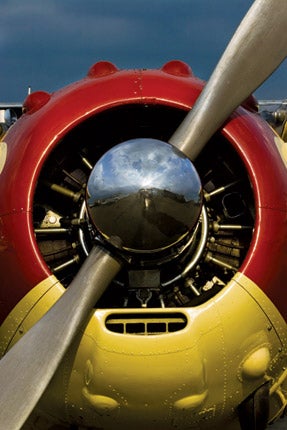
In exchange for such a stipend, Cessna delivered a product that was definitely a cut above the late-1940s competition. With a huge, 755-cubic-inch, seven-cylinder Jacobs radial out on the nose, the 195 transferred most of the engine’s 48-inch width to the cabin. The 195 was the last American airplane ever certified with a radial engine, and it carried off the job with style.
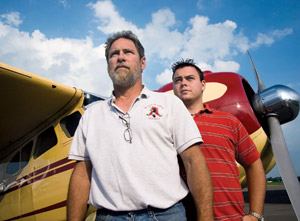 |
| Rick Farrow (above, left), a sales manager, uses his 195 both for business and pleasure, flying weekend hamburgers and regular vacations to the Bahamas. |
Even today, 195s always attract a crowd on any ramp. Pilot and passengers enter through a left-side aft door, then walk forward to the front office. Seating is for five in a two/three configuration. Pilot and copilot climb forward to front seats perched behind a gigantic panel and a windshield that drapes well back over the cockpit.
The airplane sports a multitude of features not found on most other airplanes of the time. Outside the 195, the big, 218-square-foot wing is full cantilever with no struts or braces to add drag. The Jacobs engine is hinged at the side, providing convenient service access to mag, distributor, starter and generator, as well as the rear of the engine itself. The engine is so tightly cowled that the rocker arms hide under small bumps around the cowling.
The gear is Steve Wittman’s patented design, constructed of chrome-vanadium steel for strength. The baggage compartment is accessed through a flush push button rather than a conventional handle. Landing lights are electrically activated and arc down out of the wings, a system later adapted to the Cessna 421.
Inside the 195, there’s a roll-down storm window fitted with plate glass, rather than Plexiglas, on the pilot’s side. Front seats adjust fore and aft, and through a surprising 14 inches to accommodate even the longest legs. A quartet of windows stretches along each side of the airplane to provide plenty of light despite the high wing. The parking brake has the added benefit of locking the controls as well as the main wheels. The main cabin door also does double duty: It’s directly connected to the boarding step and automatically retracts it when the door is closed.
 The 195 is more of a Bentley than a Jaguar XKE, and that was exactly what Rick Farrow of Godfrey, Ill., was looking for. Farrow, a Snap-on Tools sales manager, had worked his way through a half-dozen airplanes, culminating in a Beech Baron E55. About a dozen years ago, however, he amazed his friends by trading the Baron for the Cessna 195 you see on these pages.
“I think everyone was stunned,” says Farrow. “The E55 is almost universally regarded as a 200-knot hot rod, and no one ever expected me to trade for a classic Cessna 195.” In fact, Farrow’s airplane started life as a 190 with a Continental radial, but was later upgraded to a 300 hp Jacobs to make it a 195.
Farrow, however, hasn’t regretted the transition from hot twin to classic single. “The 195 certainly isn’t one of a kind, but it’s one of a few,” Farrow explains. “There were just over 1,000 of the type built, and probably half of those are still flying, some of them overseas, but no matter where I go (except to air shows like Sun ‘n Fun or Oshkosh), I almost never see any other 195s on the ramp. It’s a very unusual airplane.”
| Factory Comparison | Cessna 195 Businessliner | Cessna 195 Skywagon |
| Horsepower: | 300 | 300 |
| Max Cruise Speed (kts.): | 143 | 147 |
| Climb Rate, SL (fpm): | 1210 | 1010 |
| Service Ceiling (ft.): | 18,300 | 17,150 |
| Takeoff Distance, 50 ft. (ft.): | 1500 | 1365 |
| Landing Distance, 50 ft. (ft.): | 1495 | 1400 |
| Gross Weight (lbs.): | 3350 | 3350 |
| Useful Load (lbs.): | 1320 | 1663 |
| Wing Loading (lbs./sq. ft.): | 15.4 | 19.3 |
| Power Loading (lbs./hp): | 11.2 | 11.2 |
| Fuel Capacity (gals.): | 82 | 61 std., 80 l/r |
| Landing Gear Type: | Conv./Fixed | Conv./Fixed |
| Seating Capacity: | 5 | 4 |
| Source: Jane’s All-The-World’s Aircraft and Intertec’s Aircraft Bluebook Price Digest. | ||
Farrow flies his big Cessna regularly all over the Midwest. Just as with his Baron, he uses the airplane for corporate travel in pursuit of business for Snap-on Tools. “The company has a toolbox plant in Algona, Iowa, 50 miles from Mason City, and there’s no convenient airline service. With the 195, I fly out of my local airport near St. Louis and into the small, general-aviation Algona airport, do business, and I’m home for dinner.”
Farrow also makes the occasional weekend hamburger flight and regular vacation trips to the Bahamas. He’s an enthusiastic air-show fan, and that’s where we caught up with him, at the 2007 EAA AirVenture in Oshkosh, Wis.
We jumped at the chance to fly Farrow’s near-perfect 195. Engine start is a little different from firing up a standard Continental or Lycoming. After all the usual preliminaries, you engage the starter, then flip the mag switch to “Batt” after six blades have rotated past. In typical radial style, the cylinders cough and sputter, voting on whether conditions are right to run, then gradually come on line until the “Shaky Jake” has all seven cylinders firing.
Actually, the Jacobs’ nickname seems inappropriate for the 195’s R755. This engine is generally remarkably smooth, turning only 2,200 rpm at redline. “Leaky Jake” might be a more appropriate moniker. It seems all radials leak oil, so much so that the R755 features a huge, five-gallon, dry-sump oil tank mounted just behind the instrument panel. (One peripheral benefit of this arrangement is that in frigid weather, you have five gallons of warm oil circulating through the forward cabin to help reduce the chill.)
Just as with turbines, insufficient battery power can result in a piston version of a “hot” start. If the engine backfires during start, not uncommon with Jacobs radials, you can wind up with an induction fire. Standard procedure is to continue cranking to suck the flames back into the engine. If your battery is low on volts and can’t continue to turn the starter, you could be in a bad situation.
 Taxiing to the runway is a little different in a 195 because the airplane is effectively blind on the right. Scrunch your head against the left sidewall and you have a semblance of visibility straight ahead, but S-turns are still mandatory because of the deck angle. The panel is so wide, you’d have to make radical left S-turns to see anything forward on the right. Some pilots prefer to make severe left turns to open up the view straight ahead.
You have the same problem on takeoff, but the tail comes up fairly quickly so you can see what you’re about to hit. The big wing levitates like an elevator rather than pitching up precipitously, and the airplane clears the ground at 1,000 fpm at Vy. Again, though, forward visibility is severely limited at such a pitch attitude, and most pilots, Farrow included, prefer to ascend at a cruise climb of 110 to 115 mph, usually worth 750 fpm.
You sit high in the 195, about even with the wing, so maintaining visibility is easier by simply leaning forward ahead of the wing and looking out the side of the windshield. I discovered this problem during the formation session. It’s a relatively easy bird to hold in position, but you do need to avoid losing the photo ship above or below the wing.
Farrow suggests that block cruise is about 135 knots, and if that’s at least 60 knots slower than his old Baron, he doesn’t mind a bit. “I can fly for as long as four hours if I need to,” says the owner. “That’s nearly 550 nm in the 195, and I enjoy flying the airplane so much, I hardly notice.”
Perhaps the Cessna 195’s strongest suit is comfort and stability. It plows through turbulence with minimum fuss. “My wife, Jeanie, is a pretty informed passenger, having ridden in several of my other airplanes,” says Farrow. “She offers a passenger perspective I might not enjoy, because I’m so wrapped up in considerations of performance, handling and other flying characteristics. She often flew with me in the E55 and other airplanes, and she says there’s no question this airplane offers the best ride of any airplane she’s been in.”
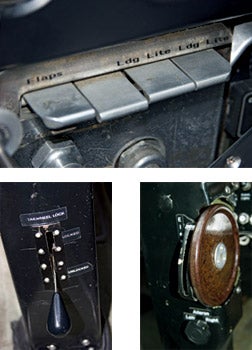 |
| The Cessna 195’s art-deco panel, which includes a wooden trim wheel, tailwheel lock lever and piano key–like switches for flaps, evokes a classy era. |
Descents in any radial present a challenge in that it’s important to maintain reasonable oil temperatures. The 195 is especially susceptible in that the big wing resists descents, seducing you into major power reductions. Chop and drop descents, however, are out of the question in a 195. You need to plan well ahead to make certain you don’t induce shock cooling and reduce oil temps to dangerous levels. Precise Flight SpeedBrakes would be a welcome addition coming downhill, but unfortunately, they’re not approved on the 195. The only alternative is careful planning and some flaps.
With a dirty stall speed down around 55 knots, approaches work out best at 70 knots or more. The small, short-chord flaps are relatively ineffective except at lowering the nose during approach. Landings aren’t nearly the challenge you may expect, but you do need to stay off your toes during landings. The trick is to stay away from the toe brakes unless you’re about to lose it completely. Cessna 195s aren’t that tough to land unless there’s a bad crosswind or you’re doing something dumb. I’ve done my share of dumb things in 195s, but (knock on aluminum) I haven’t lost one (yet).
Cessna’s last round-engine airplane serves all over the world, and you’ll often see the type in Alaska and Canada, operating on wheels and skis as well as oversized tires. No one will mistake it for a STOL machine, but it hauls a good load and can land in places that many other airplanes can’t.
If you ask Rick Farrow, he believes he’s found the perfect airplane. “I love the 195. About the only thing I’d rather have would be a later model, perhaps one of the last 1954 models.
“There’s probably no such thing as an end-all, do-all airplane,” Farrow suggests, “and despite all its talents, the 195 certainly wouldn’t qualify in every application. For me, though, it offers a little nostalgia, reasonable performance, great comfort and that indefinable quality known as class.”


