

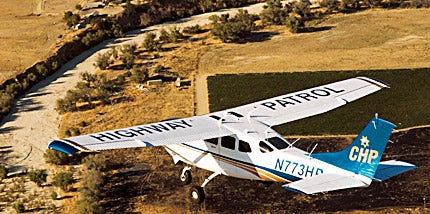
 California’s state police have used fixed-wing aircraft to patrol the Golden State’s roads for more than 30 years. The California Highway Patrol (CHP) first used Maule M4s, then transitioned to a dozen Cessna 185s. The universally beloved and talented utility taildraggers offered a forgiving personality, reasonable speed and good off-airport capability. Like 185s everywhere, the CHP Skywagons were revered by their pilots and generally regarded as flying jacks of all trades.
The trouble was, Cessna built the last Cessna 185 Skywagon in 1985. Despite the CHP’s best efforts to upgrade its 185s with new engines, radios, gear and other updates, the police airplanes were becoming long toothed. As they aged, it became progressively more difficult to keep them up and running, and dispatch reliability is an especially critical concern for a state police department.
In 1999, the CHP began replacing its aging Skywagons with Cessna Turbo-Stationairs. Working with two Californian Cessna dealers—Tom’s Aircraft in Long Beach and Channel Islands Aviation in Camarillo—the highway patrol placed an order for 14 very special T206H Stationairs.
The airplanes were delivered in stock configuration, then fitted with 200 pounds of radios, air conditioning, skylights and a right front door (in addition to the standard left front pilot and right rear cargo doors). Deliveries began in 1999, and the last airplane was complete and in service by 2001.
With the benefit of AiResearch turbocharging, the new Cessnas can maintain sea level power to 17,000 feet, though tall cruise altitudes rarely enter into CHP missions. The Cessnas are more commonly operated in California’s high country, places like Big Bear, Lake Tahoe, Lee Vining, Mammoth Lakes and Truckee—all airports perched in the Sierra Nevada mountains at elevations around and above 6,000 feet.
Having multiple doors makes the airplanes easy to load and unload, and the air-conditioning systems allow for more comfortable ground and flight ops in California’s low and high deserts, from Death Valley and Palm Springs to Mojave and Lancaster.
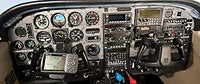 |
| The CHP’s Cessna 206s sport about 200 pounds of radios to support their law enforcement role. |
The mission of the CHP’s Stationairs is certainly as diverse as the department they serve, and the Cessnas are based at seven locations around California: Redding, Napa, Victorville, Fresno, Auburn, Fullerton and Paso Robles. Sergeant Michael Texiera supervises flight operations at the air unit in Paso Robles, and he acknowledges that they do quite a bit of traffic tracking from up high.
“Our job is pretty much a 50/50 split between homeland security and ground enforcement/surveillance,” says Sergeant Texiera. “It’s not all just looking for speeders, though that is one of our big jobs. In addition to traffic work and law enforcement, we’re charged with monitoring the state’s major utility and transportation assets such as dams and reservoirs, power plants, bridges and railroads. Our job is to check those facilities to make certain there’s no suspicious activity, no one on scene who shouldn’t be there. In the process of patrolling those sites, we sometimes see other things, and with our sophisticated UHF and VHF radio equipment, we can talk to virtually any police or fire department in the state. We can even serve as a line-of-sight relay station to forward transmissions from one ground station to another over the horizon. CHP was not involved in the Katrina disaster, but radio relay would have been a valuable feature with all the microwave stations destroyed in the southern Louisiana and Mississippi area.
“In traffic- or law-enforcement mode, the Stationair’s 140- to 150-knot speed means we can be on site in a short time and help determine what resources need to be called in. We often photograph accident sites from the air and try to identify those places that are especially accident prone so we can consider solutions to the problems. We can also fly special search-and-rescue missions if necessary, though that’s more a Civil Air Patrol (CAP) province than ours.”
The Stationairs aren’t that much faster than the old 185s down low, but the new planes are far more talented in other respects. Sergeant Texiera says the 206’s larger cabin, bigger payload and nosewheel simplicity make it nearly ideal for the CHP’s purposes. “The only thing we really traded away with the move to Stationairs was the ability to land off-airport, and we didn’t do that very often anyway with the 185s,” Texiera comments. “If you land an air unit, you obviously give up the speed and mobility of having an aerial vehicle in the first place, so we try to stay airborne as much as possible.”
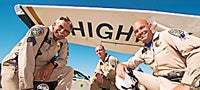 |
| Each CHP pilot typically flies about four hours per day, or 80 hours per month. |
Texiera says there are some instances when a landing becomes necessary. In one case, the CHP had been advised of a suicide threat and was directed to a car out in the Central Valley. An air unit was dispatched, spotted the car and, because of the immediacy of the situation, landed on the highway to make certain there was no one in it.
The CHP’s aircraft typically work hard to earn their keep. “We generally fly each airplane about four hours a day, so each pilot and flight officer can generally log 80 hours monthly. Our pilots must have at least two years of patrol experience before they can apply, and the flight requirements are a commercial license with instrument rating and a minimum of 300 hours. Patrol missions usually demand two officers on board, a pilot and flight officer, and we’ll occasionally use the airplanes on time-critical, pure transport trips as well, running personnel around the state as necessary. It’s a big, comfortable airplane for that job, reasonably fast and a good IFR platform. We rarely carry more than three people, and to that end, we’ve removed the aft two seats.
“With the 206, the cargo doors make it easy to load whatever we need to carry, and we usually need to carry a lot,” Texiera admits. “A fully equipped CHP 206 has about 700 pounds of payload. There’s plenty of room and weight allowance for such things as an emergency medical kit and a large survival pack in case we go down in a remote area.”
Sergeant Texiera says highway surveillance does comprise a major portion of the unit’s flights. The Stationairs often operate at 1,000 feet AGL in traffic mode, lower over uncongested areas, usually motoring along at 100 knots or less to keep a close watch on the traffic below. By definition, the CHP pilots become experts at slow flight, often droning along at speeds as low as 80 knots with partial flaps deployed for hours. The aerial units coordinate with ground assets to determine the predesignated areas of interest where patrol cars will be readily available.
“We don’t normally patrol for more than a few hours, but if we had to, using such dramatically reduced power settings, we could loiter for eight or nine hours, and that gives us a great edge over helicopters which typically have only two or three hours of fuel available at most.
“Contrary to popular belief, we don’t time speeders between known points on the ground,” Texiera explains. “The courts have ruled that that’s illegal because it represents a speed trap. Instead, we must match speed exactly with a speeder and time ourselves between those two points.
“With the aerial units, we don’t normally bother with anyone driving slower than about 80 mph, but we’ll often see drivers doing 100 mph or more,” says Texiera. “The T206 has a max speed of 140 knots available down low—that’s 160 mph in an automobile—so we can be fairly certain we’ll catch virtually everyone we go after. Perhaps the single most valuable benefit of the airplane for traffic watch is the ability to coordinate and direct ground units. If we’re chasing a bad guy, he has very little chance of escaping with the Stationair overhead. Even a Ferrari can’t outrun a radio.”
Texiera feels the T206 is practically ideal for the CHP’s specialized missions. “It’s generally a very reliable airplane, and our mechanics don’t normally run into anything they haven’t seen before. Systems are simple, the gear is tough and the Lycoming engine and AiResearch turbo are reasonably trouble free. Flying the airplanes as much as 1,000 hours yearly, we obviously have to keep them in excellent condition all the time, and it’s a tribute to the new generation at Cessna that we can do that.”
Texiera suggests that there’s a PR aspect to his job, as well—the CHP puts in regular appearances at air shows and county fairs around California, explaining the mission of the air units and recruiting for the CHP at the same time. “A flying position with the CHP is considered something of a plum, and there are often many applicants for open positions.”
So if you happen to be tooling down the interstate at 90 or so, or even zipping along a quiet, country road where you’re sure there’s no patrol car for miles, think again. The police may be flying above you, arranging for your next ticket a few miles down the road.


