
 |
It’s ironic that most general aviation pilots consider a possible engine failure as their greatest fear. Students constantly practice for it, there are countless debates about whether turning back to the airport or going straight ahead is right, and most of us start looking for places to land the minute our wheels leave the ground. But hard statistics show us that a mechanical failure is exceedingly rare. Most pilots will never see an engine failure in their flying lifetime. Much more sinister—and more likely—is a midair collision.
The 2010 Nall Report on aviation safety sheds light on GA midair collisions, which occur most often in good weather. In fact, 87% of them happen in day VFR conditions. They account for nearly 42% of descent/approach accidents, and most often occur near the airport. Most aircraft involved in midair collisions are engaged in recreational flying, and not on any kind of flight plan. Collisions happen mostly on weekends, with the vast majority occurring near nontowered airports and below 1,000 feet. They occur mostly from behind, or at a slight angle, not head-on.
Since 2000, the number of midair collisions annually has remained in the teens and 20s, though 2009 was an unusually quiet year with 10 of them. Compared to other accident causes, midair collisions are relatively rare, but when they do occur, they’re almost always fatal (seven out of the 10 in 2009). Given the lethality of these types of accidents, all pilots should have traffic avoidance on their minds. Today, we have two methods of avoiding midair collisions; one is the “see and avoid” concept, and the second is the Traffic Collision Avoidance System (“TCAS” for short).
“See and avoid” refers to 14 CFR Part 91.113 (b) that commands, in part, “! vigilance shall be maintained by each person operating an aircraft so as to see and avoid other aircraft.” The responsibility is on each pilot to see and steer clear of the other to avoid a midair collision. The problem is that this regulation gives no instructions or guidelines on how to specifically accomplish this “vigilance.”
Many of the procedures we follow today regarding traffic avoidance were enacted by the FAA in the 1950s after several high-profile midair collisions involving great fatalities. The most famous occurred in 1956 when 128 people died after a Douglas DC-7 operating as United Airlines flight 718 struck a gleaming TWA Lockheed Constellation named Star of the Seine over the Grand Canyon, shearing off the Connie’s tail and the DC-7’s wing, sending them both spiraling into the desert below. The public demanded modernization of the ATC system and greater safety oversight, resulting in sweeping changes.
The 1978 collision of a Boeing 727 and a Cessna 172 over San Diego, and the 1986 crash of a DC-9 after it hit a single-engine piper over Cerritos, Calif., galvanized the public further, and pressured the industry to enhance safety and modernize the air-traffic-control system, resulting in the 1986 Airport and Airway Safety Expansion Act. These changes paved the way for the ATC system and procedures we fly with today. For 25 years, we’ve been using mostly visual techniques, which rely heavily on our own physiology.
The Visual Scan
The most important tool we have in avoiding a midair collision is our eyes. The problem is that most of us haven’t been taught a technique for using them effectively in the cockpit. Most of us are pretty confident that our standard visual scan is sufficient to make sure we don’t run into somebody else.
The problem is that the part of our eye that’s most acute comprises only 1% of our vision. It’s the central part of the retina (the lining on the back of the eye) called the “fovea.” Any detail outside that 1% is simply missed. We lose 90% of our visual acuity once we look anywhere outside of a 10-degree cone originating from the fovea. The bottom line is that if we look only straight ahead, we miss 99% of the sky.
Pilots need to employ a scan technique that optimizes their vision. The Air Safety Foundation suggests, “Scan implies a sweep of the eyes, while a proper scan for conflicting traffic is actually a sequence of intense, fixated observations. The eyes need one to two seconds to adjust before they can focus; a continuous sweep blurs the vision.” Separating the sky into “blocks” of 10 to 15 degrees and stopping in each “block” from left to right is an effective scan technique.
Most pilots also settle into a focus area that’s just beyond the propeller. This happens naturally after a minute or so of focusing on open sky. Pilots need to make a conscious effort to refocus on the farthest object in the distance—a cloud or mountain—to give their eyes a chance to break focus and spot possible conflicting traffic.
L-3 Traffic Avoidance System
|
|
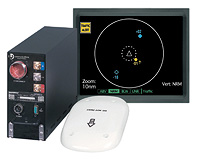
L-3 Avionics must be doing something right, because they just sold their 15,000th collision-avoidance unit. Their SkyWatch system is well known in the industry and was the first certified collision-avoidance unit for general aviation. Today, Hawker-Beechcraft, Piaggio and Quest Aircraft install the unit in their aircraft. One of the most full-featured TCAS systems around, the SkyWatch comes in both the standard “497” model and the “HP” version. SkyWatch works similar to other TCAS systems by continuously monitoring the location of nearby transponder-equipped aircraft, noting range, relative bearing, relative altitude and closure rate. Tracking up to 30 targets simultaneously, it uses this information to predict collision threats, and then presents potential hazards on a cockpit display (10 on the standard model, 35 on the HP). Advertisement
For pilots who have never flown with a full-featured TCAS, it’s enlightening to suddenly see all the traffic around you that you never noticed with a visual scan. “The main benefits of installing a SkyWatch system are enhanced safety and the peace of mind that brings,” explains Larry Riddle, vice president of business development for L-3 Avionics Systems. “Customers often say they didn’t realize how many aircraft were in the air until they installed a SkyWatch system, and now they wouldn’t fly without one.” In addition to standard TCAS functions, L-3’s SkyWatch system adds a lot of noteworthy features. The Look Up/Look Down display mode highlights specific layers of relative altitude range, which is useful during climb and descent where statistics show most midair collisions occur. SkyWatch also integrates with Stormscope lightning-detection systems. The unit’s “Verbal Intruder Positioning” (VIP) function verbally announces the range, bearing and relative altitude of threat aircraft through the cockpit’s audio system. This feature reduces heads-down time in the cockpit—critical in the airport area. Finally, L-3 Avionics adds a five-year warranty, giving owners peace of mind. As far as the future, L-3 is adding ADS-B-capable versions of the SkyWatch HP and TCAS I models, which are expected to be available in 2012. L-3 Avionics says installation is easy. “Actually, it is the most retrofit friendly, given the single antenna that transmits and receives through all 360 degrees,” says Kim Stephenson, Aftermarket Business Development Manager. “It can be displayed on over 30 different displays from other avionics manufacturers, so most aircraft owners already have a compatible display in their cockpit.” SkyWatch is priced at $15,990 for the 497 system, $20,990 for the HP and $24,340 for the HP with the TCAS I configuration (all prices MSRP). Contact www.L-3avionics.com for more information. |
|
10 Avoidance Techniques
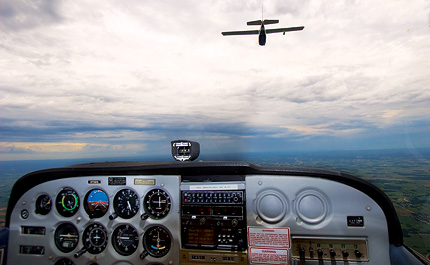
Once pilots understand the limitations of their eyes, they can employ other methods to reduce the likelihood of a midair collision. In today’s world of visually compelling electronic displays, it takes a concerted effort to divert our eyes from the cockpit to the outside world, though that’s one of the keys to “see and avoid.” There are a number of other traffic-avoidance techniques pilots should work into their normal procedures:
1 If under IFR control or on flight following with ATC, don’t rely on ATC to keep you away from other aircraft. Traffic avoidance is the most basic and irrevocable responsibility of a PIC.
2 Fly at proper VFR cruising altitudes (when above 3,000 feet AGL, fly at odd thousands + 500 feet on headings of 0 to 179, and even thousands + 500 feet on headings of 180 to 359).
3 Use any and all exterior lights to make yourself more visible. Turn on strobes and nav lights, and turn on landing lights within 10 miles of an airport.
4 Navaids, approach fixes and checkpoints still attract crowds. Fly to the right of course at these points along your route, and stay extra vigilant.
5 Maintain a “sterile cockpit” within five to 10 minutes of approach and departure. This allows you to concentrate on traffic avoidance without distraction.
6 Always use flight following (radar traffic advisories). Though separation remains the PIC’s responsibility, a second set of eyes looking out for traffic is useful.
7 Follow correct communication procedures. Use standard phraseology and ask for clarification if you don’t understand the controller or lose sight of traffic that has been called out to you.
8 Fly with sunglasses. Professional-grade sunglasses (as opposed to cheapie plastic sunglasses) reduce glare and eye fatigue. Know that polarized lenses can block the glint off a conflicting airplane’s wing, making it difficult to see.
9 At nontowered airports, report your position 10 miles out and again on each leg of the pattern. Have radio frequencies predialed to keep your eyes outside the aircraft. Follow AIM-suggested entry/exit procedures to the field, and give position reports outbound (most pilots don’t).
10 Check for traffic behind and below you at least once when on final. Have passengers look for traffic near the airport and in the pattern.
TCAS
Research began in the early 1950s on an airborne-collision-avoidance system. After decades of development and evaluation, the FAA introduced an early form of a traffic-collision-avoidance system (TCAS) in November of 1993, which was officially recognized by the International Civil Aviation Organization (ICAO).
Further technical development brought TCAS where it is today. The Airport and Airway Safety Expansion Act and ICAO now require all civil air carrier aircraft to be equipped with TCAS.
TCAS works independent of air traffic control, and monitors the airspace around an aircraft by looking for signal returns from other aircraft equipped with a transponder. TCAS-equipped aircraft scan in a predetermined range using the 1030 MHz radio frequency, and look for returns on the 1090 MHz frequency. The interrogation response occurs many times per second and creates a three-dimensional map of the airspace. The system warns pilots when it senses another transponder-equipped aircraft in close-enough proximity to induce a possible midair collision. Three components make up TCAS: a set of two or four antennas, the TCAS processing unit (computer) and a cockpit display.
There are two levels of TCAS systems. TCAS I was created for general aviation and regional carrier aircraft, and issues traffic advisories (TAs) to help pilots see conflicting traffic. TCAS II is the current generation, and is more sophisticated in that it analyzes the projected flight path of conflicting aircraft and issues resolution advisories (RAs) to pilots to resolve midair conflicts. Today, TCAS II is required internationally in aircraft with more than 30 seats or weighing more than 15,000 kg. The latest revision of TCAS II standards are referred to as “Version 7” in the United States.
The newest development in TCAS is Automatic Dependent Surveillance-Broadcast (ADS-B). With ADS-B, aircraft (or obstacles) will broadcast a message on a regular basis, which includes their position (latitude, longitude and altitude), speed and other information. Receiving equipment in aircraft will acquire this information for use in a several applications, including TCAS.
Instead of today’s systems that must constantly scan for a conflicting aircraft’s position, ADS-B systems will simply receive the accurate position report from the broadcasting aircraft.
The problem with TCAS is that for it to be completely effective, all of the aircraft in the airspace must be equipped with altitude-encoding transponders, which must also be accurate.
Max Trescott, who’s a recognized industry expert on glass cockpits and is the 2008 National CFI of the Year, says this about TCAS: “The big gotcha in these systems is that the altitudes are based on transponder output from both aircraft. But since either aircraft’s transponder could be off as much as 200 feet and still be legal, there could be as much as a 400-foot discrepancy in the relative altitudes displayed. Whenever a conflicting target is within 500 feet of their aircraft, pilots should locate the traffic or change altitude to increase the separation. Don’t be complacent just because the TCAS shows they’re 500 feet above or below you.”
Use Every Tool
It’s clear that though technology continues to evolve in the cockpit, a combination of visual methods along with TCAS should be used in avoiding midair collisions. Since traffic avoidance is our prime responsibility, we need to take it seriously and practice using every tool at our disposal.
It’s noteworthy that there has been no midair collision involving an air-carrier aircraft in the past decade, and that may be an indicator that TCAS is doing its job in increasing traffic awareness. Still, we have to be careful not to rely only on technology to keep us safe. After all, the only place we should be meeting other pilots face-to-face is on the ground, after the flight.
New “See And Avoid” Safety Portal
|
|
The FAA feels that midair collisions are enough of a problem that it’s now hosting the See and Avoid website on FAASafety.gov. The portal (www.seeandavoid.org) was originally developed by the Air National Guard Safety Division, though it now includes data from all branches of the military. The purpose of the safety portal is to eliminate midair collisions and reduce close calls through continuous flight safety and proper flight planning. The portal provides civilian and military pilots with reciprocal information and education on airspace, visual identification, aircraft performance and mutual hazards to safe flight. Advertisement
See and Avoid is targeted at two groups—the first is general aviation pilots, who are encouraged to include SeeAndAvoid.org as part of their flight planning. Since most GA pilots use the Internet to get weather, NOTAMs and flight-planning information already, the FAA feels that knowing where military operations are being done and where military aircraft will be is additional, helpful information so pilots can avoid that airspace. The second targeted groups are military safety officers at the nation’s flying military bases. It allows them to create content to allow civilian pilots to avoid conflicting military operations. The SeeandAvoid.org interface is easy to use, and includes Google maps with point-and-click interaction. Because the system interfaces with military systems in the continental United States (CONUS), Alaska, Hawaii, Virgin Islands, Guam and Puerto Rico, it gives an instant picture of military operations that civilian pilots want to know about for midair collision avoidance. Note that not all military activity may be displayed, so the FAA still urges caution when flying in areas where military aircraft could be. Pilots can access the wealth of information available on the portal by visiting www.faasafety.gov or by going directly to the portal at www.seeandavoid.org. |
|